Heljan 1500
Class 15 D8200 in BR plain green livery, as delivered into service.

Manufacturer catalogue image - please note that pre-release images may be CAD renders or CGI/AI images rather than photographs
Prototype Eras
Era 4 (1948 to 1956) British Railways Early Crest
Era 5 (1956 to 1966) British Railways Late Crest
Manufacturer description
Catalogue listing
Model details
Prototype information
at Yorkshire Engine Company (Batch 1)
British Thomson Houston
at Clayton Equipment Co (Batch 2)
* Class names often change over the lifespan of a locomotive, so this is not necessarily the class name used by the operator in the period modelled.
Supplier Links


Supplier links are provided for your convenience and do not guarantee that the product is currently available. RailwayModels.uk is not a representative of these suppliers, but may receive a commission when purchases are made through links on this page.
Related products
-
Heljan
1509
Class 15 D8204 BR Green Diesel Locomotive
-
Heljan
1510
Class 15 D8208 in Green with SYP with additional yellow pannel on 'B' end
-
Heljan
1511
Class 15 D8234 in green with small yellow panels - gloss finish
-
Heljan
1512
Class 15 D8242 Green Small Yellow Panels Double Arrows
-
Heljan
1513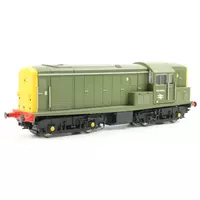
Class 15 ADB968000 in Sherwood Green with Full Yellow Ends (Carriage Pre-Heat unit)
-
Heljan
1501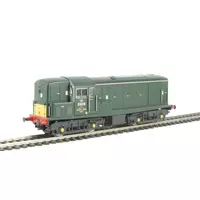
Class 15 D8219 in BR green with small yellow ends.
-
Heljan
1502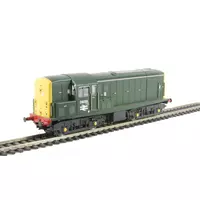
Class 15 D8229 in BR plain green livery with full yellow ends.
-
Heljan
1503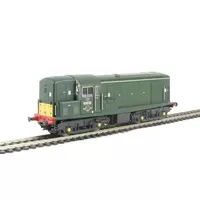
Class 15 D8233 in BR green with small yellow panels - as preserved - Limited edition of 1000
-
Heljan
1504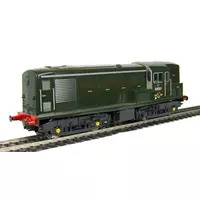
Class 15 D8201 in BR plain green livery (glossy finish)
-
Heljan
1505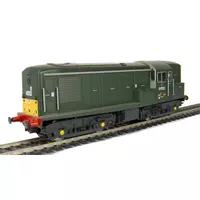
Class 15 D8202 in BR green livery with small yellow panels.
-
Heljan
1506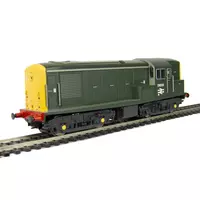
Class 15 diesel electric BTH/Clayton D8235 in BR green livery with full yellow ends.
-
Heljan
1507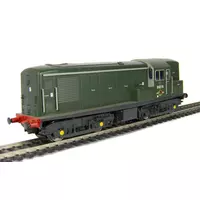
Class 15 D8215 in BR green livery.
-
Heljan
1508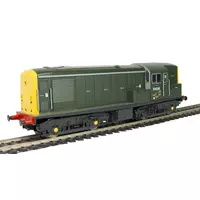
Class 15 diesel electric BTH/Clayton D8239 in BR green livery with full yellow ends and TOPS panels.
The Heljan model depicts British Rail Class 15 locomotive D8200 in the original British Rail green livery with the early crest. It represents a diesel‑powered, Bo‑Bo wheel arrangement built between 1957 and 1961, of which 44 were produced for British Railways. The model is supplied in OO gauge, with a pristine finish and the running number D8200 clearly marked.
The locomotive is DCC ready, featuring an 8‑pin socket, and all wheels are powered for pickup. It can negotiate a minimum radius curve of 1st radius (371 mm) and is coupled using NEM and tension‑lock couplers. The model carries the manufacturer part number 1500 and reflects the early crest period of British Railways. It was constructed in two batches: the first at Yorkshire Engine Company and the second at Clayton Equipment Co, both for British Thomson Houston. The maximum speed represented is 60 mph.