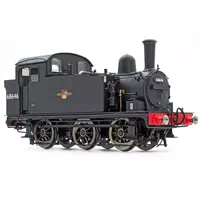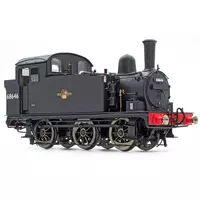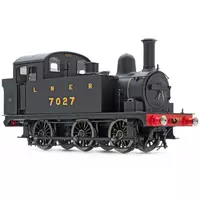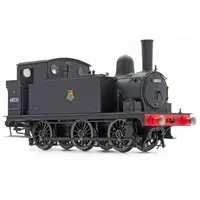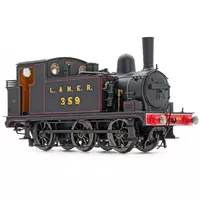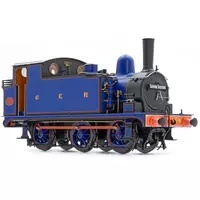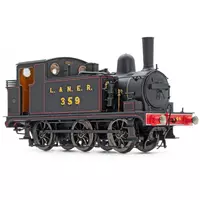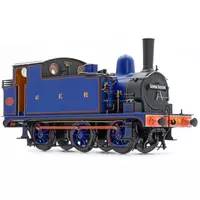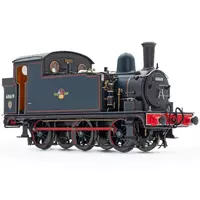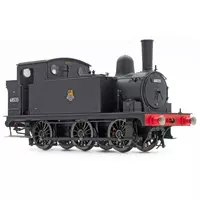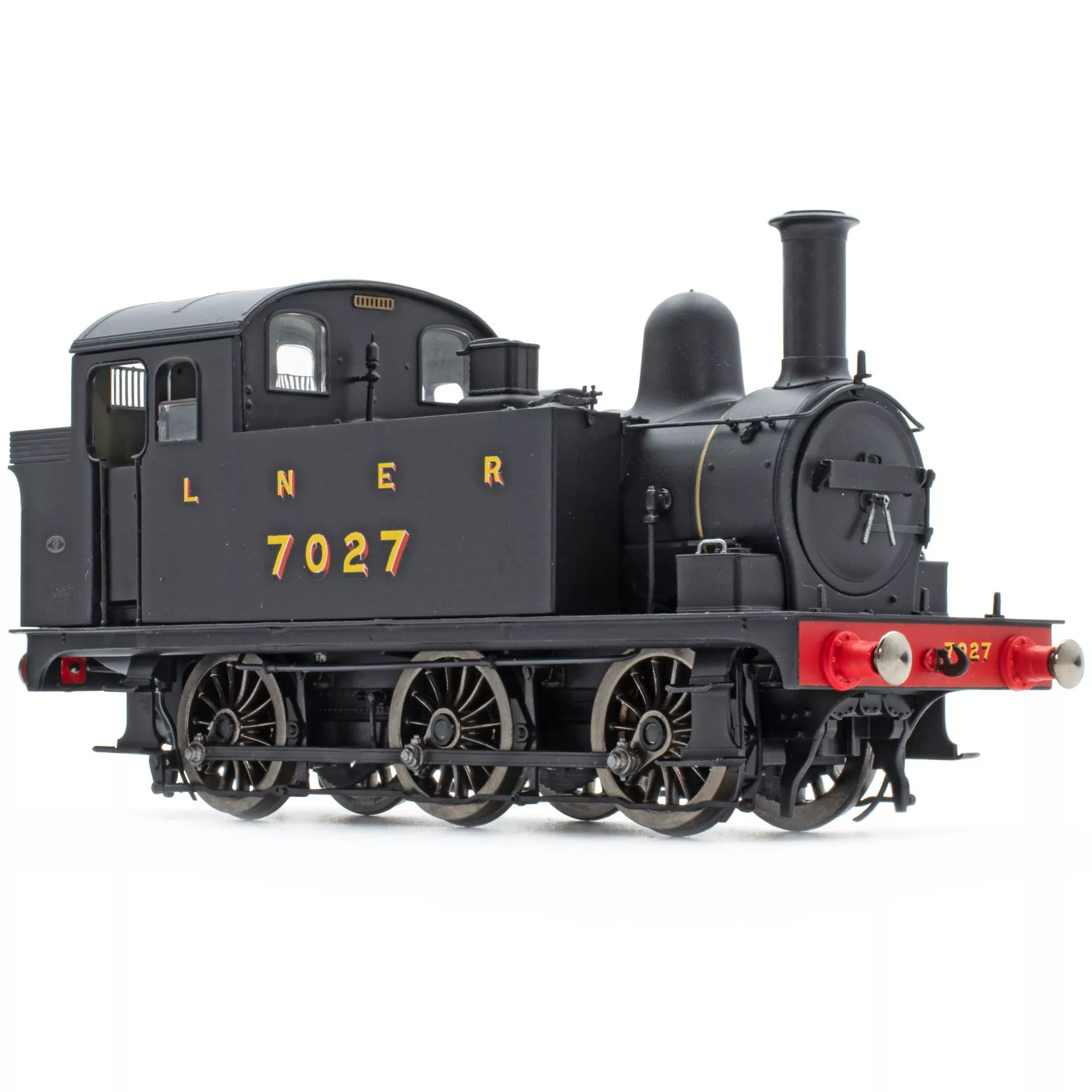
Manufacturer catalogue image - please note that pre-release images may be CAD renders or CGI/AI images rather than photographs
Prototype Era
Era 3 (1923 to 1947) The Big Four (LNER, LMS, GWR and SR)
Manufacturer description
The second batch of Hill’s ‘improved’ 0-6-0T locomotives, GER Nos.21-30 to Order G75, differed from the initial C72 order by being designated for shunting duties and differed in build accordingly. Sixteen spoke, unbalanced cast iron wheels were fitted, along with lever reverse and the side tanks were straight topped, lacking the raised chambers of the passenger tanks. Steam brakes were fitted from new, along with a wide-rimmed, parallel sided chimney, but the high arched, wooden cab roof was retained; a feature removed from the final I89 order which were fitted with elliptical wooden cab roofs.
Built at Stratford,as GER No.27, in December 1913, the locomotive was allocated to Cambridge Shed from new and by Grouping was present at Peterborough East on shunting duties, before being renumbered as 7027 under the LNER. The distinctive high arched roof was removed in August 1925, being replaced by an LNER pattern elliptical steel roof and the three bunker rails were filled during October 1928. 7027 was also the pioneer locomotive for the trial fitting of grease lubrication to the coupling pins and connecting rods in 1936.
At Grouping 7027 was still in GER Austerity Grey but from 1925 carried the LNER goods livery of unlined standard black with shaded 7.5" LNER lettering and 12" numbering, unlike the final I89 order that were painted in standard black with red lining, along with the ‘E’ area number suffix and either L&NER or LNER.
Catalogue listing
Model details
Prototype information
J68 (GER C27): 1912 to 1923
J69 (GER S56 & R24r): 1902 to 1921
London & North Eastern Railway
British Railways
J68 (GER C27): 30
J69 (GER S56 & R24r): 20
J68 & J69: 19,091 lbf
* Class names often change over the lifespan of a locomotive, so this is not necessarily the class name used by the operator in the period modelled.
Supplier Links


Supplier links are provided for your convenience and do not guarantee that the product is currently available. RailwayModels.uk is not a representative of these suppliers, but may receive a commission when purchases are made through links on this page.