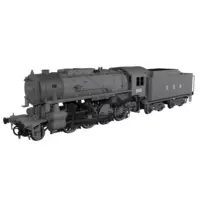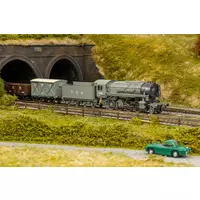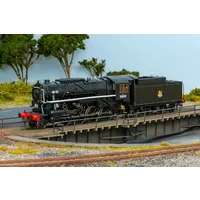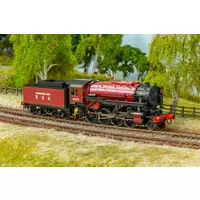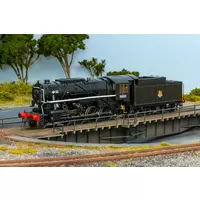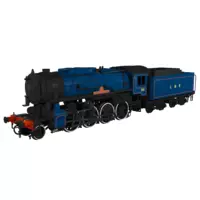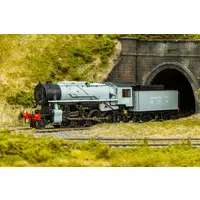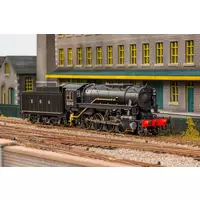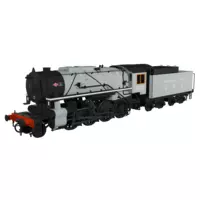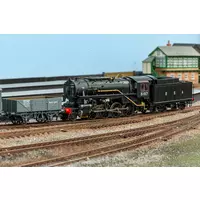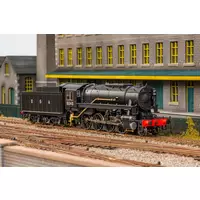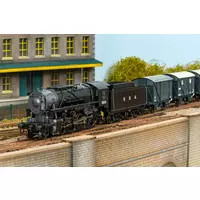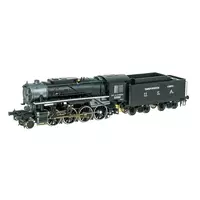
Manufacturer catalogue image - please note that pre-release images may be CAD renders or CGI/AI images rather than photographs
Prototype Era
Era 3 (1923 to 1947) The Big Four (LNER, LMS, GWR and SR)
Manufacturer description
EXCLUSIVE TO RAILS
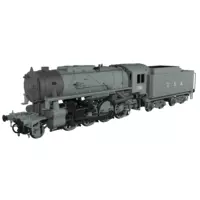
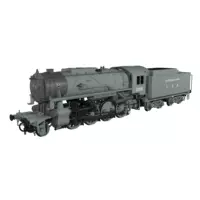
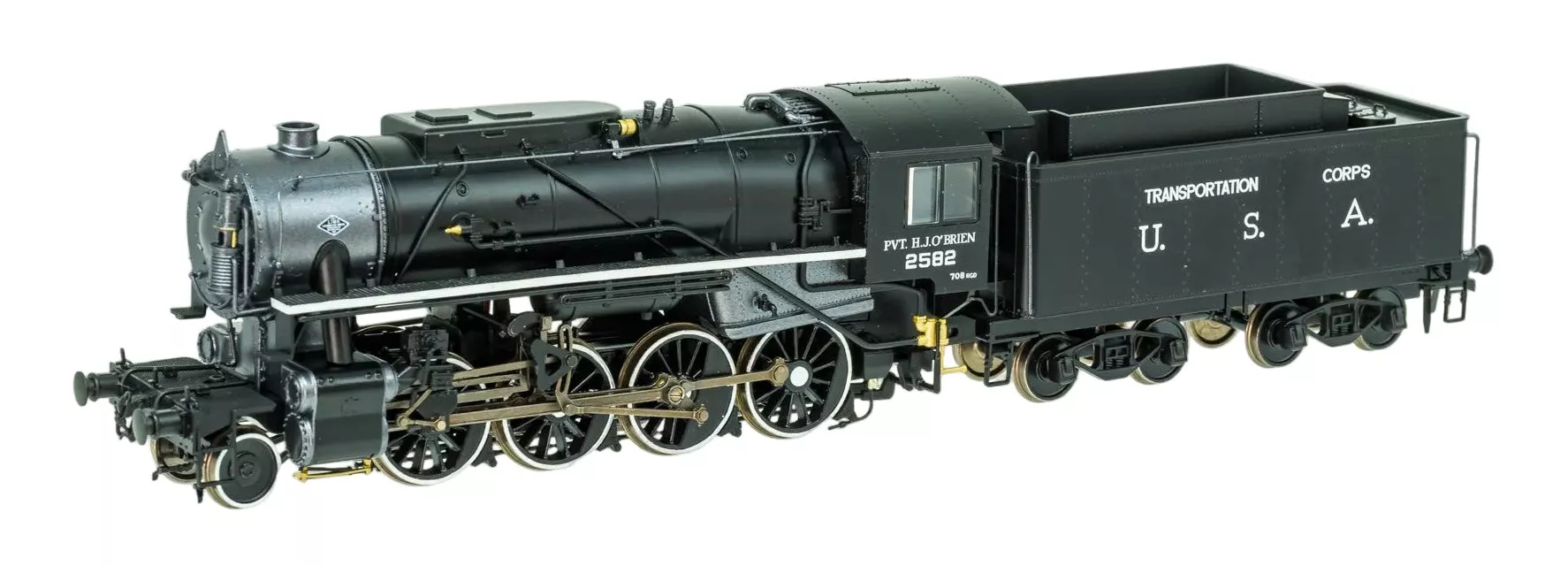
No.2582 was built in Ohio by Lima in 1943. The engine was sent to the UK in November 1943 and stored until August 1944 when it was sent to Europe. Eighteen S160s deployed to Northern Europe carried names. The first of these was No.2582. On 27th February 1945 amidst the ruins of Liège in Belgium, a ceremony was held where Major General Frank S. Ross dedicated a suitably bulled-up No.2582 to Pvt. H. J. O’Brien of the 741st Battalion, who had been killed in an air attack on 24th December 1944. The engine continued to be used until September 1945 when it was stored at the USATC dump in Louvain. In 1947 the engine was sold to the Polish State Railways and became No.Tr203.199 in the PKP fleet.
Tooling variations:
- Standard lamp irons
- Straight strap smokebox door
- Westinghouse air pump
- Pipework mounted behind chimney
- Straight running boards
- Right hand drive with pole reverser and original pattern firehole door
- Standard wartime tender
- Boiler-mounted ejector pipe fitted
Features:
- Two factory-fitted speakers, one in the loco and another in the tender.
- Dual LED firebox glow with dynamic fire draw effect.
- Twin flywheel motor.
- Detachable loco-to-tender connection.
- Pickups fitted on both the loco and tender.
- 21-pin DCC Decoder socket fitted.
Livery - Black with Transportation Corps U.S.A. on tender. Name and Batallion details painted on cabside alongside. Extra embelishments included alluminium painted smokebox, firebox cylinder covers and saddle, white-edged running boards, white wall tyres and axle ends.
Manufacturer - Lima Locomotive Works – Ohio - 1943
Date of model - 1945
History:
“In the days to come the British and American peoples will for their own safety, and for the good of all, walk together side by side in majesty, injustice, and in peace.” -Winston Churchill addressing a joint session of the US Congress, 26 December 1941.
The year is 1942, the world is at war and the United Kingdom has limited resources to combat the enemy, let alone launch an invasion of the European mainland. What is available is becoming stretched far too thinly, including the nation's railways. Due to years of consistent bombing, the railways were struggling to cope with the increased traffic and locomotives and rolling stock were in short supply. Thankfully our American Allies stepped up, aiding us in our hour of need.
Despite having joined the fray themselves in late 1941, and needing resources to pursue their own goals, they managed to reinforce the UK with a multitude of supplies, including a fleet of one of the most iconic locos to run on Britain’s Railways, the S160, a spectacular 2-8-0 powerhouse!
Designed by Major J. W. Marsh from the Railway Branch of the Corps of Engineers, this all-American loco had to fit the more restrictive loading gauge of the UK. They had to be easy to build, quick to repair and reliable. Taking inspiration from its predecessor the S200, and the British WD Austerity 2-8-0, the S160 lacked the finesse of many of the British locomotives it would work alongside, but other than a few teething problems and operational challenges it met its brief perfectly.
Constructed in the United States in multiple batches from 1942 to 1945, they were split between the ALCO, Baldwin, and Lima Locomotive Works. Collectively, almost 800 locomotives were shipped to the UK. Landing mainly in Newport, South Wales, as well as Birkenhead, Glasgow and London, the locomotives passed through major workshops before being sent on to the respective railway company. The first 396 were assigned to the 4 railway regions of the era and under the guise of them being run in, 174 were issued to the Great Western Railway, 168 to the London & North Eastern Railway, 50 to the London, Midland and Scottish Railway, and a much more modest 6 to the Southern Railway. The final 400 UK-issued locos were also stored in South Wales, where they were kept as part of the D-Day preparations. With the invasion on the horizon, June 1944 saw the stored engines sent for servicing and processing, all leaving by early September 1944.
Between 1942 and 1945 a whopping 2120 S160s were built by our American friends, these remaining locomotives along with those stored and gathered locos in the UK, were shipped to mainland Europe and further afield to facilitate wartime supply trains, aiding our European neighbours who had also had their railways ravaged by 6 years of conflict, and ensuring the Allied war effort prevailed.
Until the days of preservation, the only S160 retained in the UK post-war was WD 93257 (later No.700) Major General Carl R Gray Jr, used to train military personnel in driving and caring for steam locos at the Longmoor Military Railway.
Following WW2 the S160s were scattered across the globe, from China to Hungary. Whilst in the ownership of a plethora of different railways they were often refitted to accommodate their owners' needs. As time went on the original shape and details of many of the locos would evolve, which was in part, due to the interchangeable nature of their original design. Eight locos have been repatriated to the UK in preservation and all of them are different from their counterparts, some more subtly than others.
Despite all having key visual differences, several of the preserved versions have been returned to running order, with no less than three examples currently in operation with a number of others under restoration.
Catalogue listing
Model details
Prototype information
Wartime
Rest of World: some in use until 1990s
(Used during WW2 by various European countries, UK, South America and East Asia)
Baldwin Loocmotive Works
Lima Locomotive Works
Supplier Links
Special commissions are usually only available new from the commissioning organisation, and may well have sold out on pre-order before they even end up listed here! But you may be able to find used items on marketplace or auction websites.


Supplier links are provided for your convenience and do not guarantee that the product is currently available. RailwayModels.uk is not a representative of these suppliers, but may receive a commission when purchases are made through links on this page.