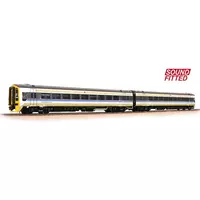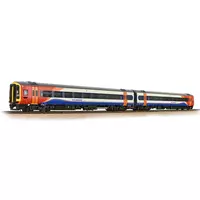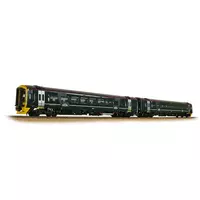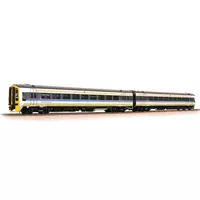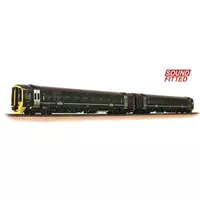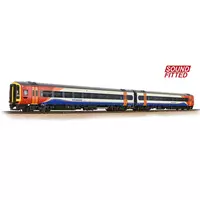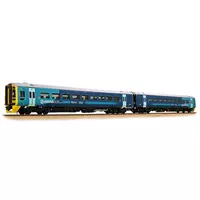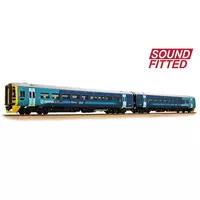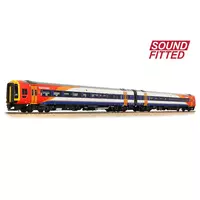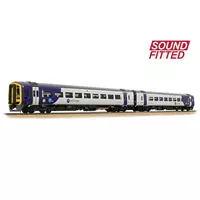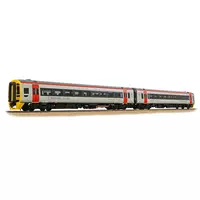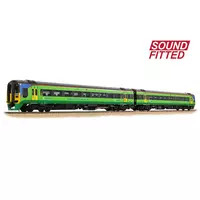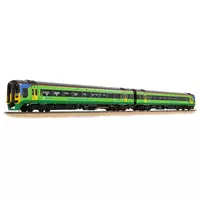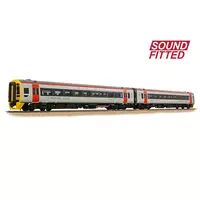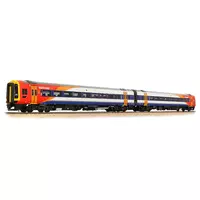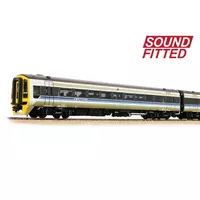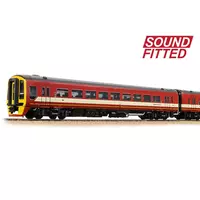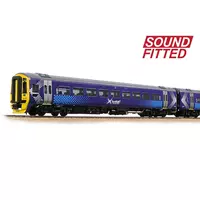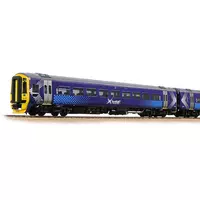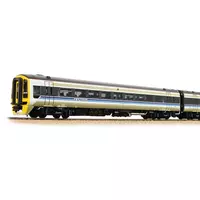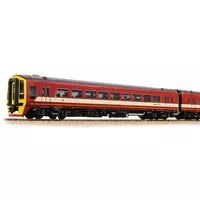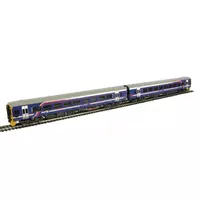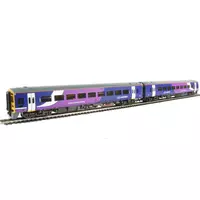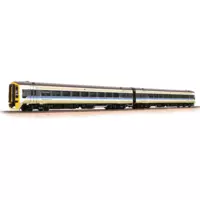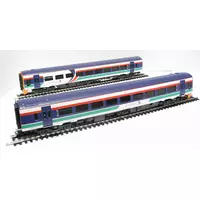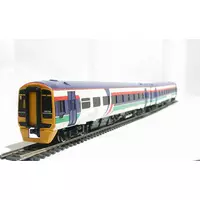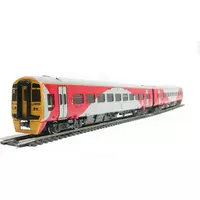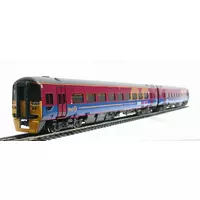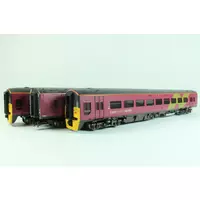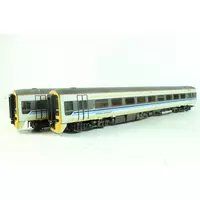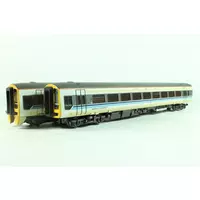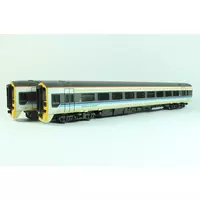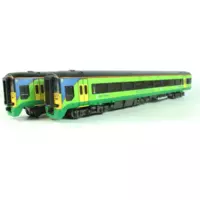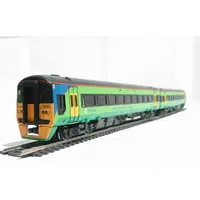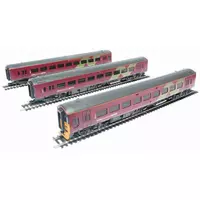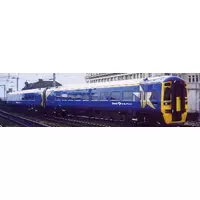
Manufacturer catalogue image - please note that pre-release images may be CAD renders or CGI/AI images rather than photographs
Prototype Eras
Era 9 (1995 to 2004) Initial Privatisation
Era 11 (2016 to 2026) The Last Days of Privatisation
Manufacturer description
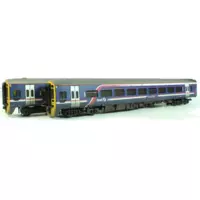
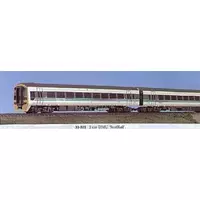
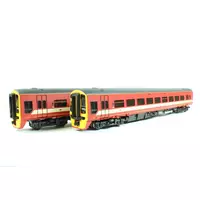
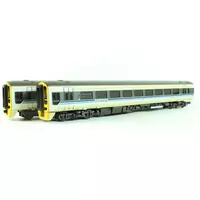
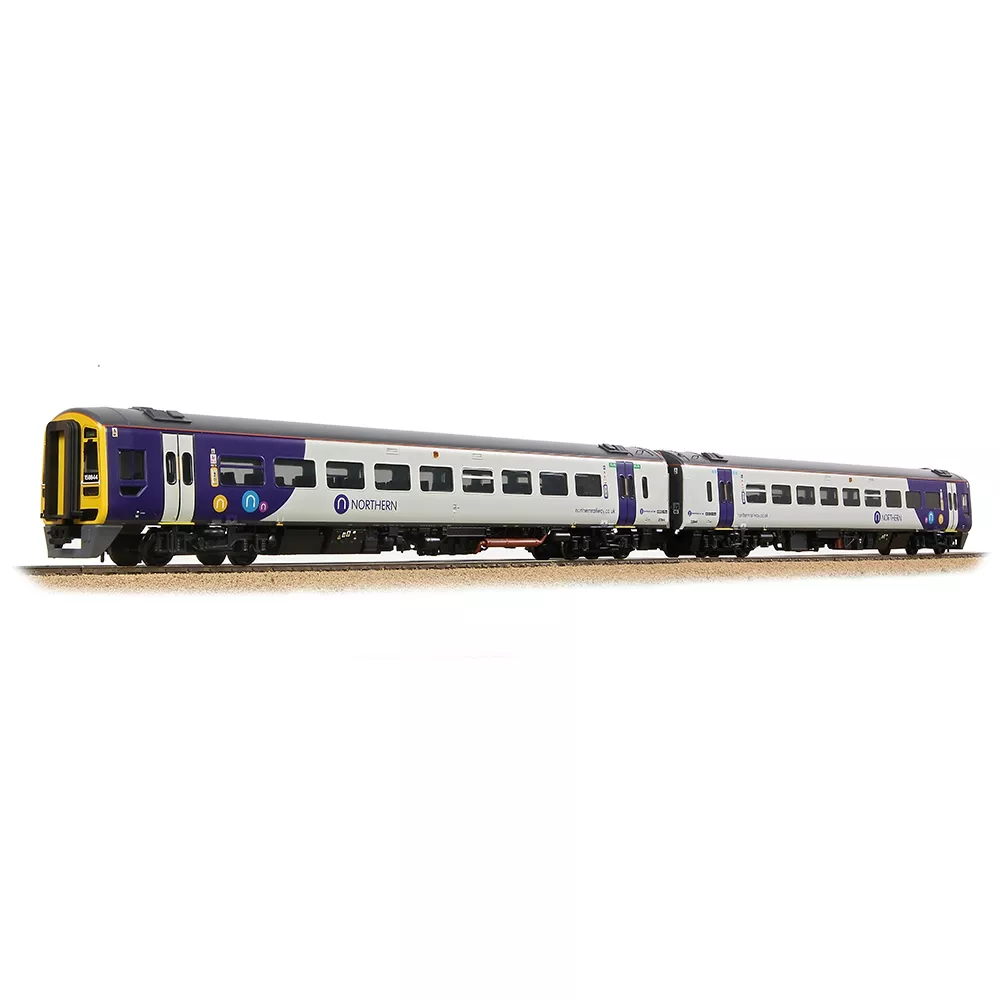
The Class 158 is one of British Rail’s most successful second generation Diesel Multiple Units (DMUs); first introduced in 1989, the entire fleet remains in traffic to this day with operators including Northern as depicted by this Bachmann Branchline model.
The pinnacle of OO scale second generation DMUs, the Branchline Class 158 combines high fidelity bodyshells with an underframe that’s adorned with separate components depicting the engines, electrical equipment, and auxiliary gear. It’s the livery application which really brings these models to life and every element has been replicated in miniature. Whilst the main colours are spray painted, the myriad smaller logos, symbols and lettering are applied using a specialist printing process, using BR and corporate specification fonts, logos and colours.
Driven by the low-level drive mechanism, which is fitted to each vehicle, the conductive couplings ensure that the two vehicles work together in harmony and enable the use of a single decoder for DCC operation. Fitting that decoder couldn’t be easier thanks to the clip-off underframe panel behind which the decoder socket is fitted and combined with the pre-fitted speaker in each car, it’s easy to fit sound to your model, or why not let us do the work for you by choosing a SOUND FITTED model for a fully immersive operating experience straight out of the box.
MODEL FEATURES:
- Bachmann Branchline OO Scale
- Era 9
- Pristine Northern livery
- Running No. 158844
- Two-Car Unit comprising car Nos. 52844 & 57844
- Destination blinds for Leeds
- Equipped with a Plux22 DCC Decoder Socket – recommended Decoder item No. 36-570A
- Length 610mm
MECHANISM:
- EACH TWO-CAR UNIT COMPRISES TWO POWERED VEHICLES WITH THE FOLLOWING FEATURES:
- Three pole motor with flywheel providing drive to the inner bogie
- Twin axle drive
- Separate metal bearings fitted to each driven axle
- Trailing axles run in metal pinpoint bearings
- Electrical pickup from all wheels
- Diecast metal, multi-stage gearbox, with gearing arranged for prototypical running speeds and haulage capabilities
- 16.5mm (OO gauge) wheels to NEM310 & NEM311 standards with authentic profile and detailing
- Working miniature BSI Couplings at the cab end
- Conductive couplings with integral close coupling mechanism at the inner end
- Designed to operate on curves of second radius (438mm) or greater
DETAILING:
- Separately applied metal detail parts, including exhaust guards and interior luggage racks
- Bogies constructed from multiple components featuring brake and suspension detail
- Separately fitted underframe components
- Each model is supplied with an accessory pack comprising exhaust pipes, frame extensions and coupling tool
LIGHTING:
- Directional lighting, including illuminated destination panels, with Day/Night mode – selectable via the chassis-mounted switches or via a dedicated DCC function
- Directional lights can be turned on/off at each end independently via the chassis-mounted switches or via separate DCC functions
- Passenger saloon lighting – switchable on/off via the chassis-mounted switches or via a dedicated DCC function
- Cab lighting at the trailing end*
- Door interlock lights* (*when used on DCC)
- Authentic light colours and temperatures selected for each lighting application
DCC:
- Plux22 DCC decoder interface – one decoder required per unit
- Easy-access DCC decoder socket located behind removable panel on underside of Car A
SOUND:
- Two speakers fitted, one in each vehicle, for optimum sound reproduction – fitted to every model as standard
- Zimo MX645P22 DCC Sound Decoder fitted to SOUND FITTED versions
- Sound files produced specifically for the Bachmann Branchline Class 158 DMU using recordings from real units
- SOUND FITTED models operate on DCC and Analogue control as supplied
LIVERY APPLICATION:
- Authentic liveries applied to both vehicles including interior decoration
- Multiple paint applications employed using BR and corporate specification colours
- Logos, numerals and text added as appropriate using multi-stage tampo printing using authentic typefaces, logos and colours
CLASS 158 DMU HISTORY
The British Rail Class 158 Express Sprinter is a Diesel Multiple Unit (DMU), built specifically for British Rail's Provincial Services sector between 1989 and 1992 by British Rail Engineering Limited (BREL) at Derby Litchurch Lane Works and outshopped in Regional Railways Provincial livery. They were built to replace many locomotive-hauled passenger trains, thereby reducing cost of operation, and to allow cascading of existing Sprinter units to replace elderly 'heritage' DMUs. The majority of the 182-strong fleet of Class 158 units were built as two-car sets, with 17 three-car units constructed specifically for use on Trans-Pennine services. Similar three-car units were built for use by Network SouthEast but these were converted to Class 159 specification before introduced into service, with toilet retention tanks and other modifications to operate over the third-rail network.
All but one of the Class 158s remain in service today (2023), with operators including ScotRail, Northern, Great Western (GWR), East Midlands Trains (now EMR), and Transport for Wales (formerly Arriva). Former operators include Central Trains. The Class has worked extensively across the UK network, even into East Anglia as far as Stansted Airport and Norwich. Some 158s have been converted to additional Class 159s and now operate for South Western alongside their original classmates.
Catalogue listing
Model details
Interior lighting
Prototype information
British Rail
Central Trains
East Midlands Trains
East Midlands Railway
First Great Western
First North Western
Great Western Railway
Northern Spirit/ Arriva Trains Northern
Northern Rail
Northern Trains
ScotRail
South Western Railway
Transport for Wales
TransPennine Express
Virgin CrossCountry
Wales & West/ Wessex Trains
* Class names often change over the lifespan of a locomotive, so this is not necessarily the class name used by the operator in the period modelled.
Supplier Links


Supplier links are provided for your convenience and do not guarantee that the product is currently available. RailwayModels.uk is not a representative of these suppliers, but may receive a commission when purchases are made through links on this page.