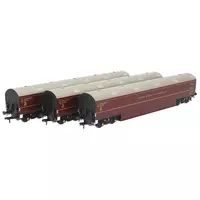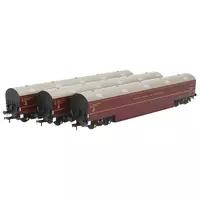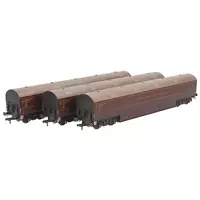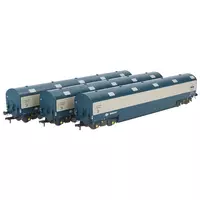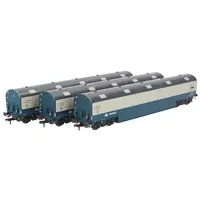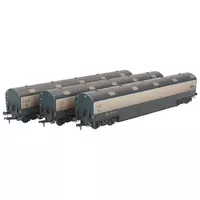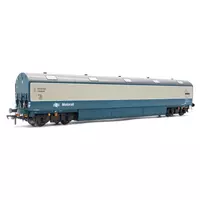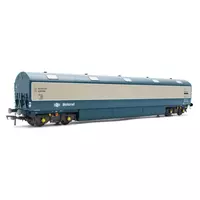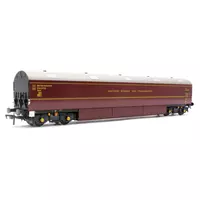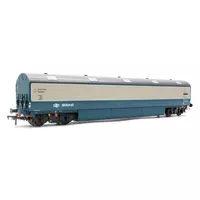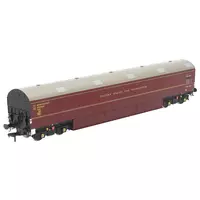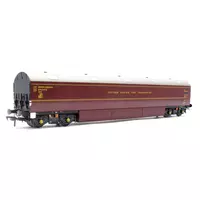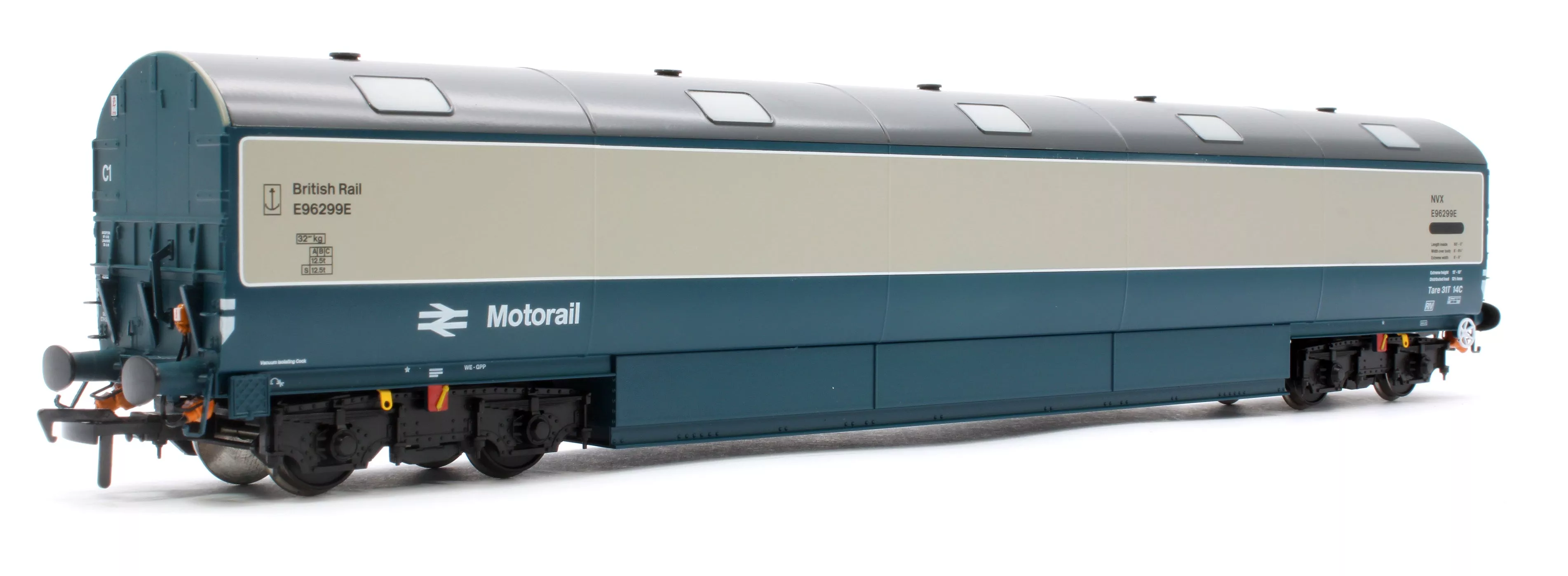
Manufacturer catalogue image - please note that pre-release images may be CAD renders or CGI/AI images rather than photographs
Prototype Era
Era 8 (1983 to 1994) British Rail Sectorisation
Manufacturer description
DETAILS
Featuring a high specification and fine detail throughout, the vehicles will be offered in matching triple packs in BR Lined Maroon and BR ‘Motorail’ Blue/Grey covering their entire 25-year career. Close attention to detail means that vehicles will feature either the original or revised pattern of fibreglass roof lights plus vacuum brake/steam heat and dual brake/dual heating vehicles with the Electric Train Heat (ETH) and air brake equipment added to several car transporters towards the end of their life.
Fine details include separately fitted handbrake wheels, end door details, air pipes, etched train ferry lashing eyes, steam heat, vacuum brake and ETH equipment. NEM couplers and sprung buffers are fitted as standard.
HISTORY
Originally designated as TCVs, the vehicles later became NVV (vacuum braked) and NVX (dual braked) under BR’s TOPS computer system. Unusually, they featured a hydraulically operated central well capable of storing two cars as well as four cars on the upper deck – a 50% increase in capacity over more conventional car carrying vehicles of the time.
When introduced in the early-1960s, the TCV car transporters were used between London, York and Edinburgh in sets of five or six vehicles with a handful of BR maroon Mk1 coaches, hauled by ex-LNER ‘Pacifics’ and later BR green ‘Deltics’, Class 40s, 45s, 46s or 47s. From the late-1960s onwards, they were painted in BR blue/grey and started to venture further afield on ‘Motorail’ services from London and northern England to the West of England, being hauled by Class 45s, 46s, 47s and ‘Westerns’. However, they were closely associated with the East Coast Main Line throughout their career.
FEATURES- Finely Applied Livery Details
- NEM Couplings
- Early/late rooflight arrangement
- Steam/dual heating parts
- Vacuum/dual braking parts
- Fine bogie/underframe detail
- Authentic livery differences between vehicles in each pack
- Weathered finish
Catalogue listing
Model details
Prototype information
Supplier Links


Supplier links are provided for your convenience and do not guarantee that the product is currently available. RailwayModels.uk is not a representative of these suppliers, but may receive a commission when purchases are made through links on this page.