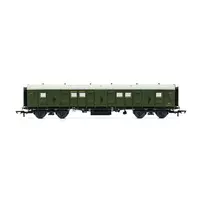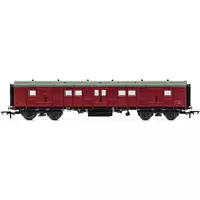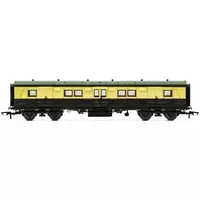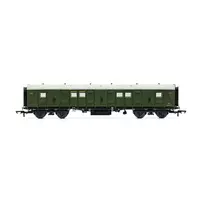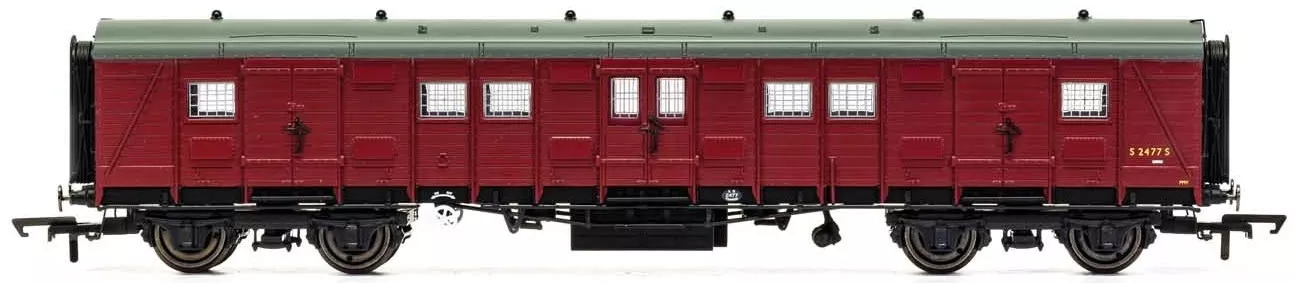
Manufacturer catalogue image - please note that pre-release images may be CAD renders or CGI/AI images rather than photographs
Prototype Eras
Era 4 (1948 to 1956) British Railways Early Crest
Era 5 (1956 to 1966) British Railways Late Crest
Manufacturer description
During 1927 and 1928, the Southern Railway found itself with a large surplus amount of ex-LSWR underframes, as many of the former LSWR Bogie Block 4-coach sets were converted to EMUs on new 62' underframes. The spare underframes proved an ideal base for the new Gangwayed Bogie Luggage Vans (GBL) that the SR were looking to build at the time. The GBL vans were mainly used across the SR's Western Section, with just a few working in the Eastern Section on Parcels traffic and Chatham passenger trains.
In the west, their use extended to Newspaper, Parcels, Dairy and Bicycle traffic, as well as for passenger baggage on the South Coast express trains and in 1939, at the Ministry of Health's request, thirty were converted at Lancing Works for use in Casualty Evacuation Trains with more converted to ambulance coaches before the end of the war. The GBL vans were rapidly replaced in traffic by BR bogie GUV vans and virtually all were withdrawn during 1959 and 1960, with just a few survivors continuing in service as Pigeon vans until November 1961.
Other examples were transferred into Departmental use, with some modifications taking place such as the widening of doors and the removal of gangways, however one van, No. 2464, found fame by being re-entered into traffic to convey Sir Winston Churchill's body from London to Handborough on 30 January 1965.
Catalogue listing
Model details
Prototype information
Newpapers, Parcels & Dairy Products
Wartime Casualty Evacuation Trains
Pigeon Vans
British Railways
Supplier Links



Supplier links are provided for your convenience and do not guarantee that the product is currently available. RailwayModels.uk is not a representative of these suppliers, but may receive a commission when purchases are made through links on this page.