Bachmann 32-940
Class 150/2 2-Car DMU 150216 GWR Green (FirstGroup)
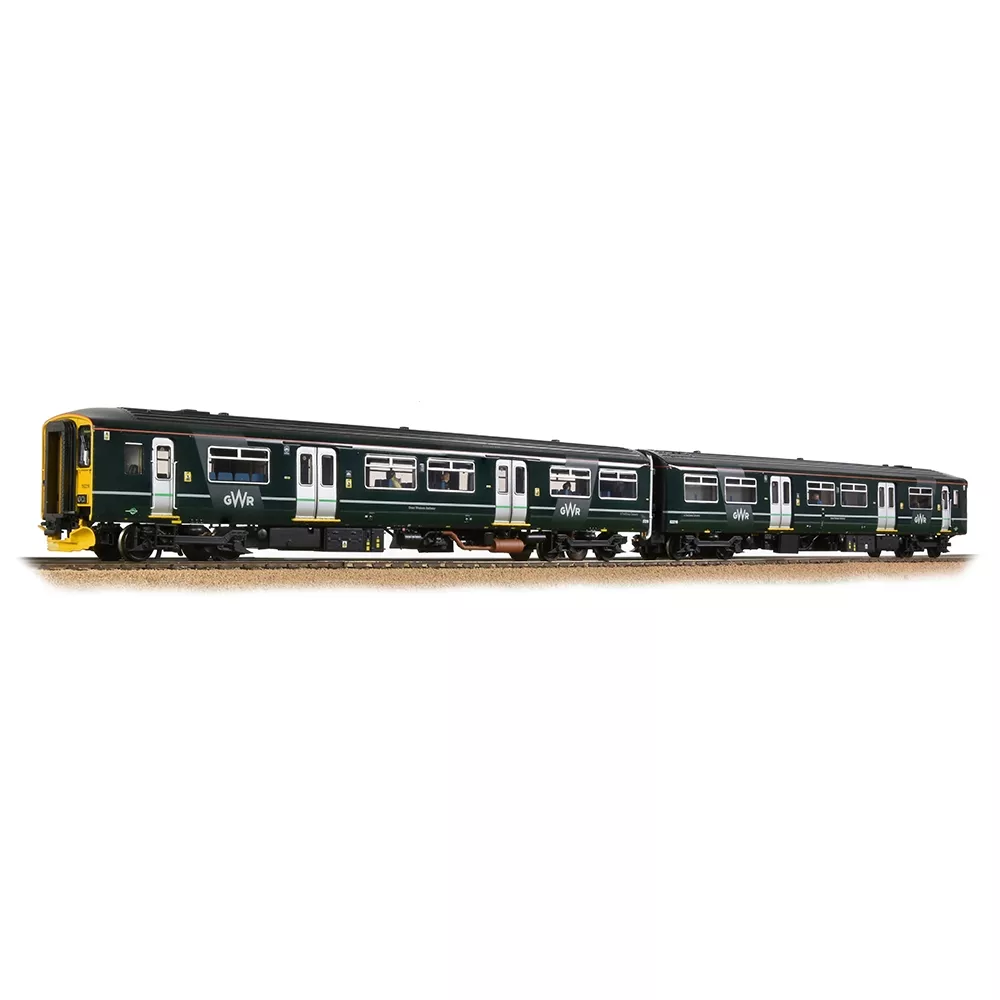
Manufacturer catalogue image - please note that pre-release images may be CAD renders or CGI/AI images rather than photographs
Prototype Eras
Era 9 (1995 to 2004) Initial Privatisation
Era 11 (2016 to 2026) The Last Days of Privatisation
Manufacturer description
The story of the Class 150 Diesel Multiple Unit is brought right up to date with this Bachmann Branchline model of Class 150/2 2-Car DMU No. 150216 in GWR Green livery – as seen running on the UK rail network today and complete with PASSENGERS FITTED.
With accurate tooling to depict the changes made in recent years to the real units to provide disabled access, this OO scale model comprises two vehicles – one of which is motorised. Featuring a high level of detail across the bodyshells, underframes and bogies; the interiors are not overlooked either, and these are complemented by the passenger figures fitted inside. Capturing the light blue livery of BR Provincial, the model is decorated using authentic colours, graphics and logos to provide an exquisite finish. Powered by a five pole motor, the conductive coupling between the two vehicles means just a single DCC decoder is required for DCC operation and with space for a speaker, it’s easy to add sound to this model too.
MODEL FEATURES:
- Bachmann Branchline OO Scale
- Era 9
- Pristine GWR Green (FirstGroup) livery
- Running No. 150216
- Comprises Car Nos. 52216 and 57216
- Destination blinds for Penzance
- Accessory Pack
- NEM Coupling Pockets
- Powerful 5 Pole Motor with Flywheel
- Interior Detailing
- Interior Lighting
- PASSENGERS FITTED
- Directional Lighting
- Ready to Accept a Speaker
- Equipped with a 21 Pin DCC Decoder Socket – recommended Decoder item No. 36-557
- Length 540mm
CLASS 150 DMU HISTORY
The British Rail Class 150 ‘Sprinter’ is a class of diesel multiple unit passenger train built by BREL York from 1984 to 1987. A total of 137 units were produced in three main subclasses, replacing many of the earlier, first generation ‘heritage’ DMUs. The first subclass, the 150/0, comprised a pair of prototype units.
The second batch which comprised fifty units was classified 150/1s and numbered in the range 150101-150. Like the prototype units, they did not have front-end corridor connectors which are fitted to allow passengers to move between units when working in multiple. Originally based at Derby Etches Park depot, these units were introduced in 1986, mainly concentrated around Birmingham and Manchester, and in later years restricted mainly to commuter services. Today the entire fleet is concentrated on the Northern franchise, mainly working around Manchester to places like Buxton, Sheffield, Liverpool, Southport and Carnforth.
The final batch of 85 two car units were built with front-end corridor connectors. These units were classified as Class 150/2s and numbered in the range 150201-285. The Class 150/2s were used on longer-distance services and have operated in Scotland, Wales, the West of England and the North.
Catalogue listing
Model details
NEM pockets
Interior lighting
Pickup in tender
Prototype information
Arriva Trains Northern
Arriva Trains Wales
Central Trains
First North Western
Great Western Railway
London Midland
London Overground
Northern Rail
Northern Trains
ONE
ScotRail
Silverlink
Transport for Wales
Wales & West
Wessex Trains
West Midlands Trains
* Class names often change over the lifespan of a locomotive, so this is not necessarily the class name used by the operator in the period modelled.
Supplier Links


Supplier links are provided for your convenience and do not guarantee that the product is currently available. RailwayModels.uk is not a representative of these suppliers, but may receive a commission when purchases are made through links on this page.
Related products
-
Bachmann
32-941
Class 150/2 2-Car DMU 150220 Northern
-
Bachmann
32-935XS
Class 150/2 2 Car DMU number 150 216
-
Bachmann
32-935X
Class 150/2 2 Car DMU number 150 216
-
Bachmann
32-939DS
Class 150/2 2-Car DMU 150236 Arriva Trains Wales (Revised)
-
Bachmann
32-931SF
Class 150/1 2-Car DMU 150143 Northern Rail
-
Bachmann
32-931
Class 150/1 2-Car DMU 150143 Northern Rail
-
Bachmann
32-930SF
Class 150/1 2-Car DMU 150133 BR GMPTE (Regional Railways)
-
Bachmann
32-942SF
Class 150/2 2-Car DMU 150247 BR Provincial (Sprinter)
-
Bachmann
32-930
Class 150/1 2-Car DMU 150133 BR GMPTE (Regional Railways)
-
Bachmann
32-929
Class 150/1 2-Car DMU 150115 BR Provincial (Original)
-
Bachmann
32-942
Class 150/2 2-Car DMU 150247 BR Provincial (Sprinter)
-
Bachmann
32-929SF
Class 150/1 2-Car DMU 150115 BR Provincial (Original)
-
Bachmann
32-937
Class 150/2 2 car DMU 150202 in Regional Railways Centro blue stripe livery
-
Bachmann
32-925
Class 150/1 150144 2-car DMU in First North Western livery - Destinations Preston & Blackpool
-
Bachmann
32-925A
Class 150/1 2 Car DMU in First North Western livery - weathered
-
Bachmann
32-925K
Class 150/1 2 Car DMU 150123 Richard Crane in Silverlink Livery- Collectors club ltd edn
-
Bachmann
32-925Z
Class 150/1 2 car DMU Original Provincial livery. Limited edition
-
Bachmann
32-926
Class 150/1 Sprinter 2 car DMU 150125 in Central Trains livery - Destination: Dorridge/Snow Hill
-
Bachmann
32-935
Class 150/2 2 car DMU Arriva Trains Wales/Trenau Arriva Cymru livery. Shrewsbury/ Cardiff
-
Bachmann
32-935Y
Class 150/2 Sprinter 2 Car DMU 150252 in ScotRail Blue Red & White Livery
-
Bachmann
32-935Z
Class 150/2 2 car DMU in Merseyrail livery. Hattons Limited edition of 512. Manchester Vic/ Liverpool
-
Bachmann
32-936
Class 150/2 Sprinter 2-car DMU 150270 in Regional Railways livery - Destinations Leeds & York
-
Bachmann
32-938
Class 150/2 2-car DMU 150204 in Northern Rail livery
-
Bachmann
32-928
Class 150/1 2-car DMU 150150 in BR Regional Railways Sprinter livery - weathered
-
Bachmann
32-927
Class 150/1 2 car DMU 150128 in First Great Western livery
Bachmann Branchline OO‑scale model of a British Rail Class 150/2 two‑car Diesel Multiple Unit, representing unit 150216 in Great Western Railway green livery (FirstGroup era). The model is described as being in pristine condition, with accurate external and internal detailing, directional and interior lighting, and fitted passenger figures.
The set comprises two carriages, one motorised, and measures 540 mm in length. It is DCC ready, offering a 21‑pin socket and a recommended decoder (item 36‑557). The model includes a five‑pole motor with a flywheel, NEM coupling pockets, destination blinds for Penzance, and the provision for a speaker.
Key specifications: built period 1986‑1987, wheel arrangement two‑car unit, maximum speed 75 mph, minimum curve radius 2nd radius (438 mm). The model reflects the initial privatisation era of the Class 150 fleet.
The Class 150 “Sprinter” series were built by BREL York between 1984 and 1987, with the 150/2 subclass comprising 85 two‑car units numbered 150201‑285, used on longer‑distance services across Scotland, Wales, the West of England and the North.