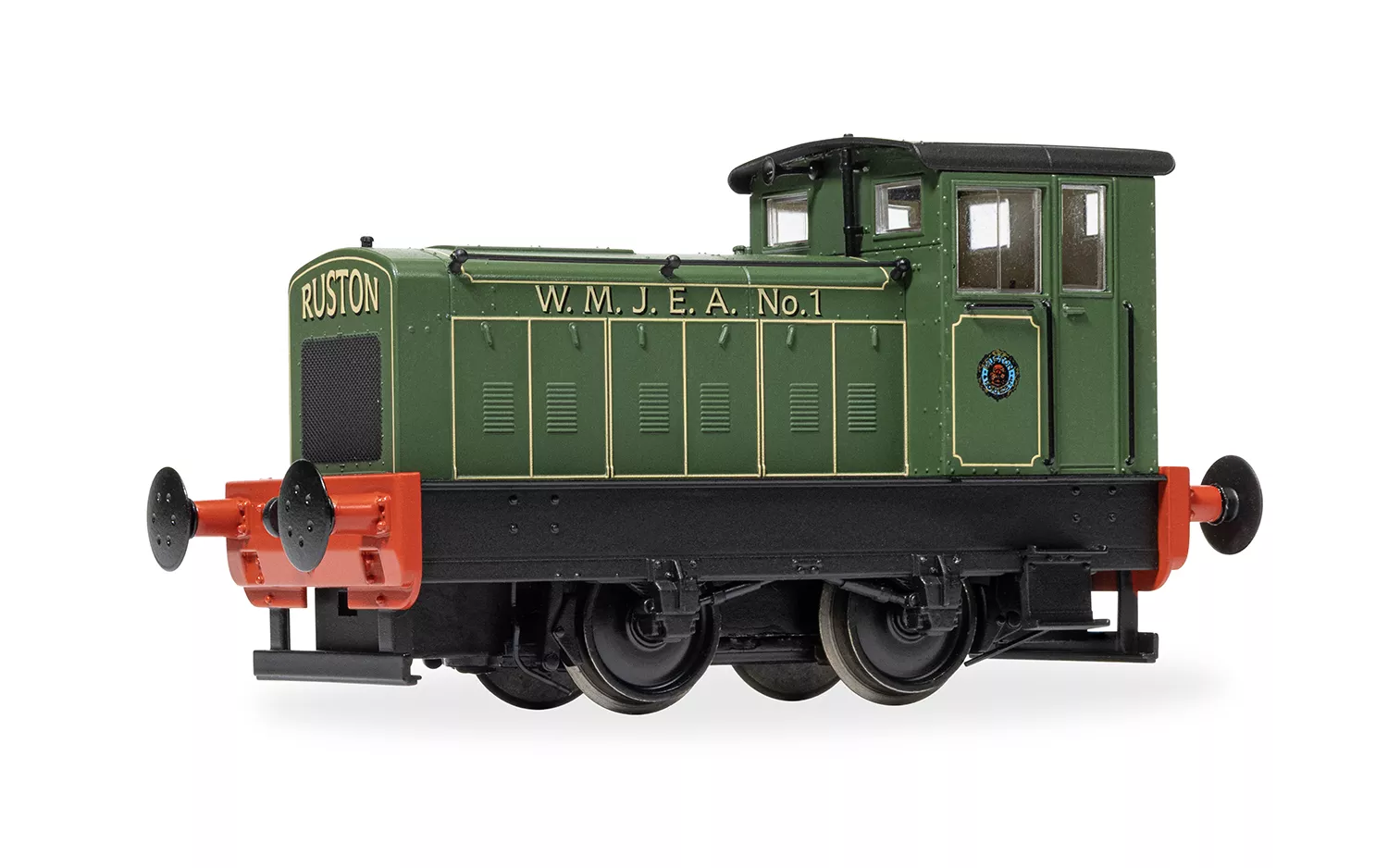
Manufacturer catalogue image - please note that pre-release images may be CAD renders or CGI images rather than photographs
Prototype Era
Era 4 (1948 to 1956) British Railways Early Crest
Manufacturer description
A small shunter that makes a big impact, the Ruston & Hornsby - W.M.J.E.A. - 88DS - No1 locomotive is a lovely addition to any model railway layout. The model comes with a coupling blanking plate for the most secure and tidy finish, complementing the dark green livery. It is also DCC ready with a six-pin socket.
History
Ruston & Hornsby Works No. 262997 was supplied new to the West Midlands Joint Electricity Authority in January 1949 for its Birchills Power Station in Walsall. From September the same year, it moved to the newly-opened Walsall ‘B’ Power Station and, even after nationalisation of the industry in 1948 as the CEGB, continued to carry its WMJEA identity.
Catalogue listing
Model details
Prototype information
* Class names often change over the lifespan of a locomotive, so this is not necessarily the class name used by the operator in the period modelled.
Supplier Links



Supplier links are provided for your convenience and do not guarantee that the product is currently available. RailwayModels.uk is not a representative of these suppliers, but may receive a commission when purchases are made through links on this page.