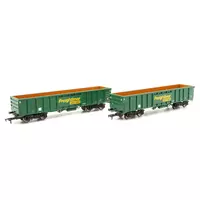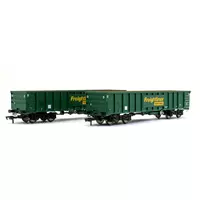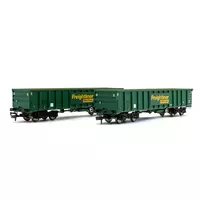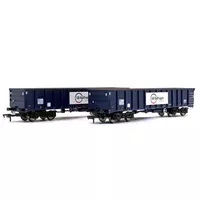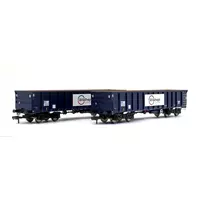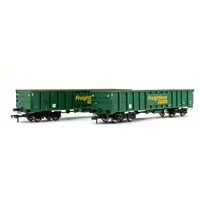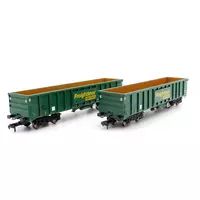
Manufacturer catalogue image - please note that pre-release images may be CAD renders or CGI/AI images rather than photographs
Prototype Eras
Era 10 (2005 to 2015) Rebuilding of the Railways
Era 11 (2016 to 2026) The Last Days of Privatisation
The MJA bogie ballast wagon was introduced in 2003 and was built by Wagony Swidnica in Poland and operated exclusively by Freightliner Heavy Haul Limited. The primary use of the wagon is for the carrying of stone, minerals and other aggregates. The wagons operated almost always in pairs with buffers at one end and the other end bar coupled to the twin wagon. The wagon is still used widely today including Mountsorrel to Luton and from Croft to Harwich. GB Railfreight have taken ownership of a number of these vehicles.
Supplier links are provided for your convenience and do not guarantee that the product is currently available. RailwayModels.uk is not a representative of these suppliers, but may receive a commission when purchases are made through links on this page.
Dapol
4F-025-007
MJA Freightliner Heavy Haul Bogie Box Vans 502011 & 012
Dapol
4F-025-006
MJA Freightliner Heavy Haul Bogie Box Vans 502005 & 006
Dapol
4F-025-005
MJA Freightliner Heavy Haul Bogie Box Van 502019 & 020
Dapol
4F-025-012
MJA Bogie Box Wagon Freightliner Heavy Haul 502039/040
Dapol
4F-025-011
MJA Bogie Box Wagon Freightliner Heavy Haul 502013/014
Dapol
4F-025-016
MJA Bogie Box Wagon GB Railfreight 502051/052
Dapol
4F-025-014
MJA Bogie Box Wagon GB Railfreight 502009/010
Dapol
4F-025-013
MJA Bogie Box Wagon Freightliner Heavy Haul 502039/048
Dapol
4F-025-003
MJA Freightliner Heavy Haul Bogie Box Van 502021 & 022
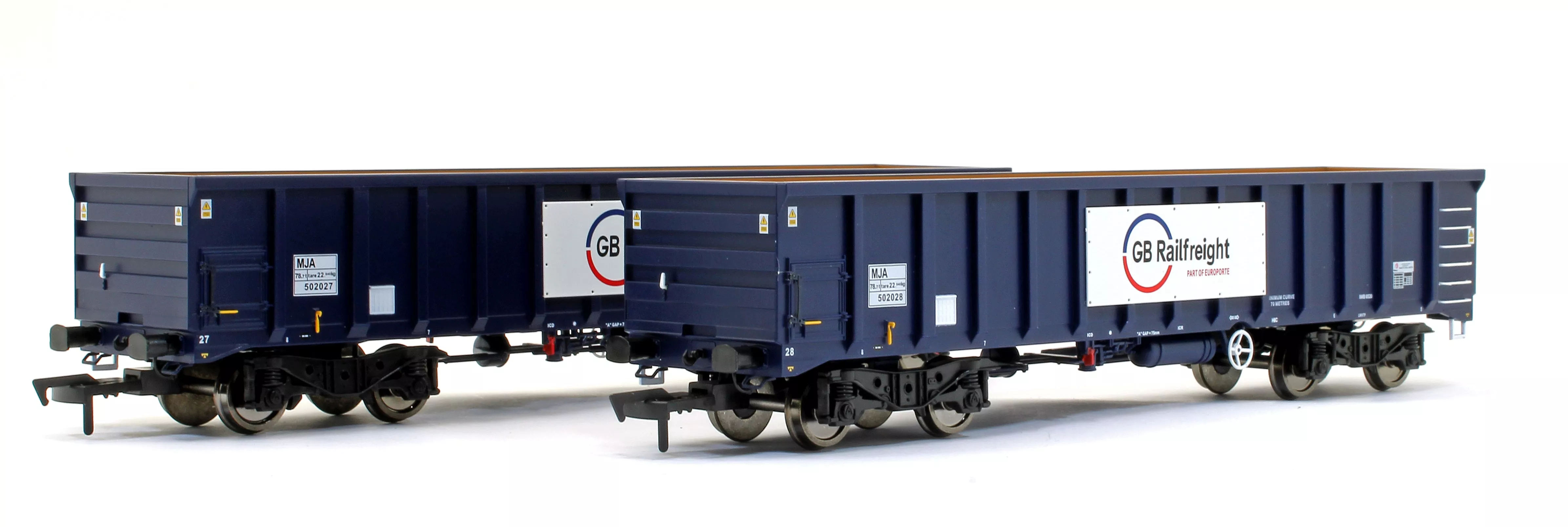
Dapol's OO gauge MJA GBRF Bogie Box Van is a model of a real-life freight wagon used by GB Railfreight. The model is designed to represent a pair of bogie ballast wagons built in 2003 by Wagony Swidnica in Poland, which were operated exclusively by Freightliner Heavy Haul Limited.
The wagons were primarily used for carrying stone, minerals, and other aggregates, and were often seen in pairs with buffers at one end and a coupling bar at the other. GB Railfreight now owns several of these vehicles, which continue to be used on routes such as Mountsorrel to Luton and Croft to Harwich.
The model features a finely moulded body with separately added details and a finely applied livery with accurately printed detail. It also includes profiled wheels, NEM pockets, and self-centring couplings. The model is available as a twin wagon set with a coupling bar, complete with wagon numbers 502027 and 502028 in GBRF livery.