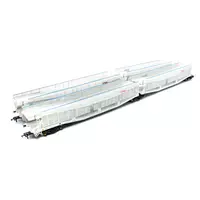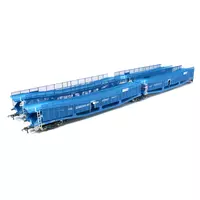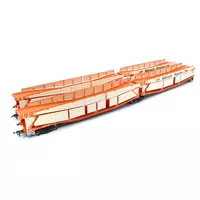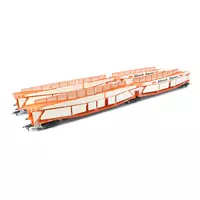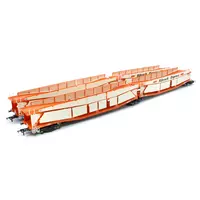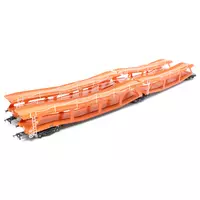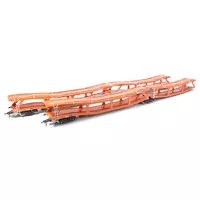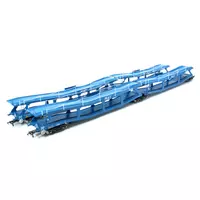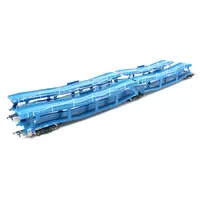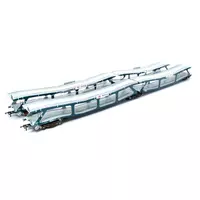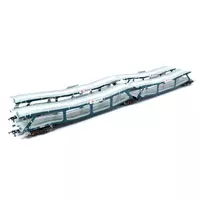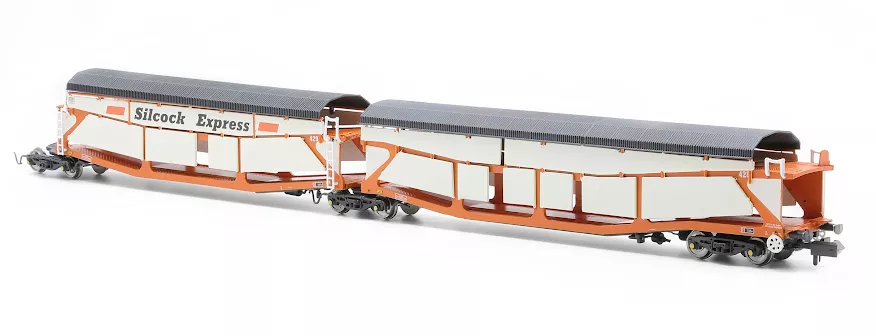
Manufacturer catalogue image - please note that pre-release images may be CAD renders or CGI/AI images rather than photographs
Prototype Eras
Era 6 (1967 to 1972) British Rail Blue (Pre-TOPS)
Era 7 (1972 to 1982) British Rail Blue (TOPS)
The iconic 4-car articulated Cartic-4 car carriers were built between 1966 and 1972 and lasted until the mid-2000s. The Cartic-4 car carriers were developed jointly by BR and Ford and adopted a radical design at the time for freight stock – comprising a permanently coupled four-part vehicle in which the inner cars were linked via shared bogies on articulated joints. The majority were built for private vehicle transporters MAT, Silcock & Collings and Tolemans, however some were also built by BR and used to launch its Motorail brand in 1966. This offered motorists the opportunity to take their car on holiday with them, with an extensive network of services between cities including London, Birmingham and Sheffield and Scotland, the South West and North Wales. Once Motorail stopped the Cartic-4s were used to transport cars around the country both in block flows from factories to delivery points and in Speedlink flows to dealers.
All of our models feature:
Supplier links are provided for your convenience and do not guarantee that the product is currently available. RailwayModels.uk is not a representative of these suppliers, but may receive a commission when purchases are made through links on this page.
Revolution Trains
RT-OO-CAR4-437B
Quad set Cartic-4 car carrier - STVA light grey with mesh screens (set B)
Revolution Trains
RT-OO-CAR4-437A
Quad set Cartic-4 car carrier - STVA light grey with mesh screens (set A)
Revolution Trains
RT-OO-CAR4-436B
Quad set Cartic-4 car carrier - MAT blue with mesh screens (set B)
Revolution Trains
RT-OO-CAR4-436A
Quad set Cartic-4 car carrier - MAT blue with mesh screens (set A)
Revolution Trains
RT-OO-CAR4-425A
Quad set Cartic-4 car carrier - Silcock Express livery with roof + side screens (set A)
Revolution Trains
RT-OO-CAR4-414B
Quad set Cartic-4 car carrier - Silcock Express livery with side screens (set B)
Revolution Trains
RT-OO-CAR4-414A
Quad set Cartic-4 car carrier - Silcock Express livery with side screens (set A)
Revolution Trains
RT-OO-CAR4-403B
Quad set Cartic-4 car carrier - Silcock and Collings orange (set B)
Revolution Trains
RT-OO-CAR4-403A
Quad set Cartic-4 car carrier - Silcock and Collings orange (set A)
Revolution Trains
RT-OO-CAR4-402B
Quad set Cartic-4 car carrier - MAT-Transauto blue (set B)
Revolution Trains
RT-OO-CAR4-402A
Quad set Cartic-4 car carrier - MAT-Transauto blue (set A)
Revolution Trains
RT-OO-CAR4-401B
Quad set Cartic-4 car carrier - BR Motorail blue (set B)
Revolution Trains
RT-OO-CAR4-401A
Quad set Cartic-4 car carrier - BR Motorail blue (set A)
Revolution Trains Quad set Cartic‑4 car carrier – Silcock Express livery with roof and side screens (set B) is supplied as a four‑wagon pack, each wagon individually numbered and finished in the original British Rail blue livery as built, without side mesh or roof. The set carries the manufacturer part number RT‑OO‑CAR4‑425B and represents the period of British Rail blue prior to the introduction of TOPS.
The Cartic‑4 car carriers were produced between 1966 and 1972 and remained in service until the mid‑2000s. They were a joint development by British Rail and Ford, featuring a permanently coupled four‑part articulated design with shared bogies between the inner cars. Although most were built for private vehicle transporters such as MAT, Silcock & Collings and Tolemans, a number were operated by British Rail to launch its Motorail service in 1966, enabling motorists to travel with their cars on routes linking London, Birmingham, Sheffield, Scotland, the South West and North Wales. After Motorail ceased, the Cartic‑4s continued to move cars both in block freight flows from factories to delivery points and in Speedlink services to dealers.
All wagons in the set are fitted with NEM kinematic close couplers and measure 840 mm over the buffers. The quad set is offered in two variants, set A or set B, with each set displaying a different combination of numbers. The model is suitable for Era 6/7 layouts.