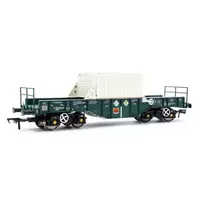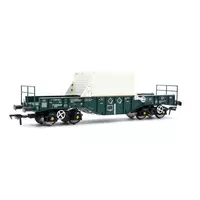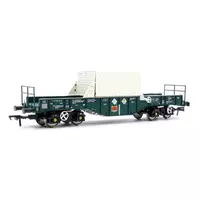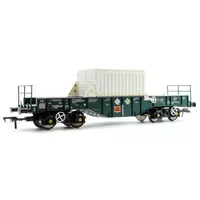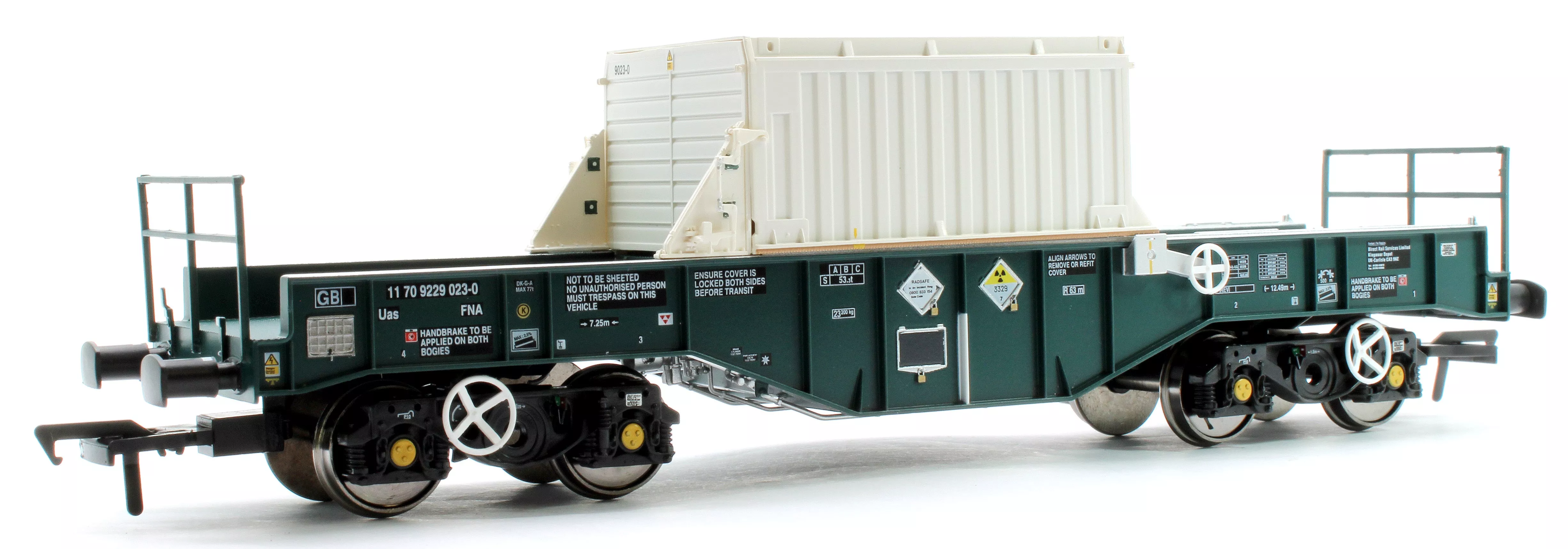
Manufacturer catalogue image - please note that pre-release images may be CAD renders or CGI/AI images rather than photographs
Prototype Eras
Era 10 (2005 to 2015) Rebuilding of the Railways
Era 11 (2016 to 2026) The Last Days of Privatisation
Manufacturer description
Prototype information:
Built by WH Davis from 2014 to replace older nuclear flask wagons. Used across the network to transport spent fuel from nuclear power stations to Sellafield. The flask wagons typically run in rakes of 1-4 wagons mostly with two locos either double-headed or top-and-tailed.
Model features:
- Produced under licence from DRS
- Highly accurate OO gauge model, 1:76.2 scale on 16.5mm track
- All models share the same livery with 8 different running numbers available
- Accurate underframe detailing
- Minimum Radius 438mm (2nd Radius)
- Bogies include separate brake shoes in line with wheels
- RP25-110 profile OO gauge wheels on 26mm length, 2mm diameter axles (to make conversion to EM/P4 easy)
- Sprung buffers
- Kinetic NEM coupler sockets mounted on the body with mini-tension-lock couplers
Catalogue listing
Model details
Prototype information
Direct Rail Services
FNA-D - Present
FNA-D - 2014 to 2019
FNA-D - WH Davis
Supplier Links


Supplier links are provided for your convenience and do not guarantee that the product is currently available. RailwayModels.uk is not a representative of these suppliers, but may receive a commission when purchases are made through links on this page.