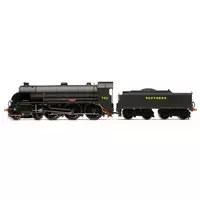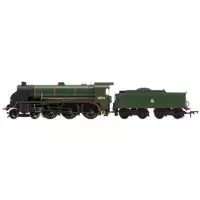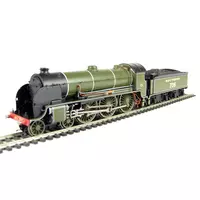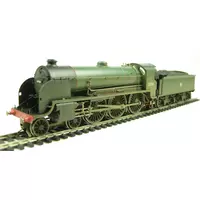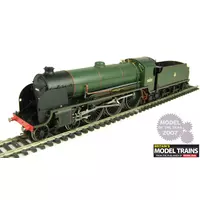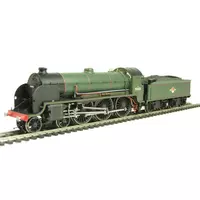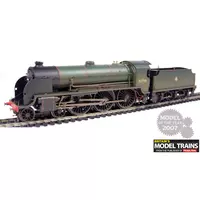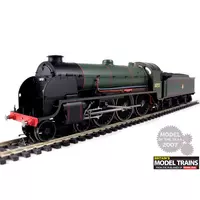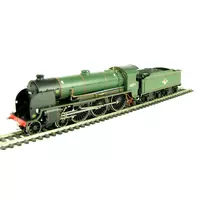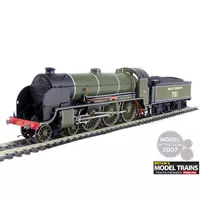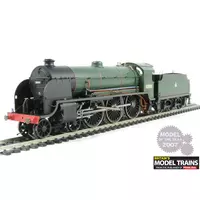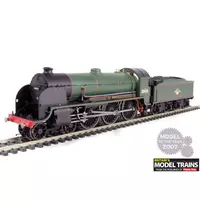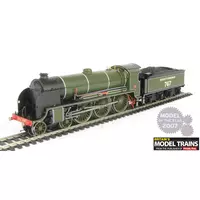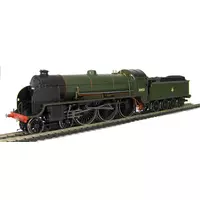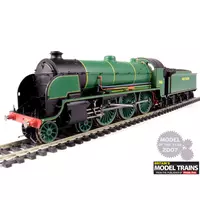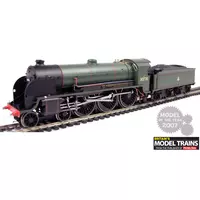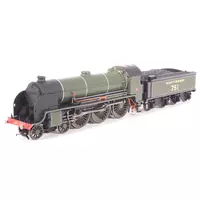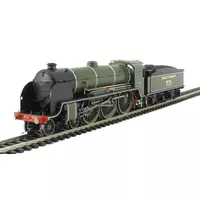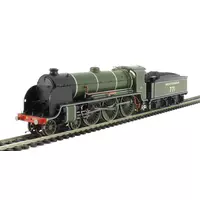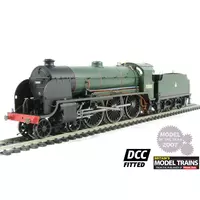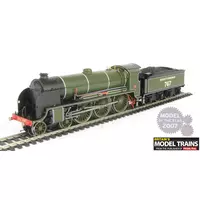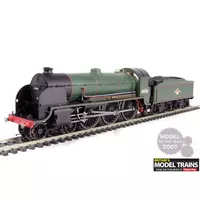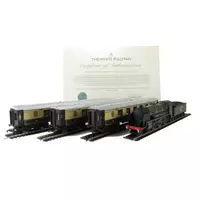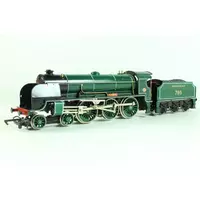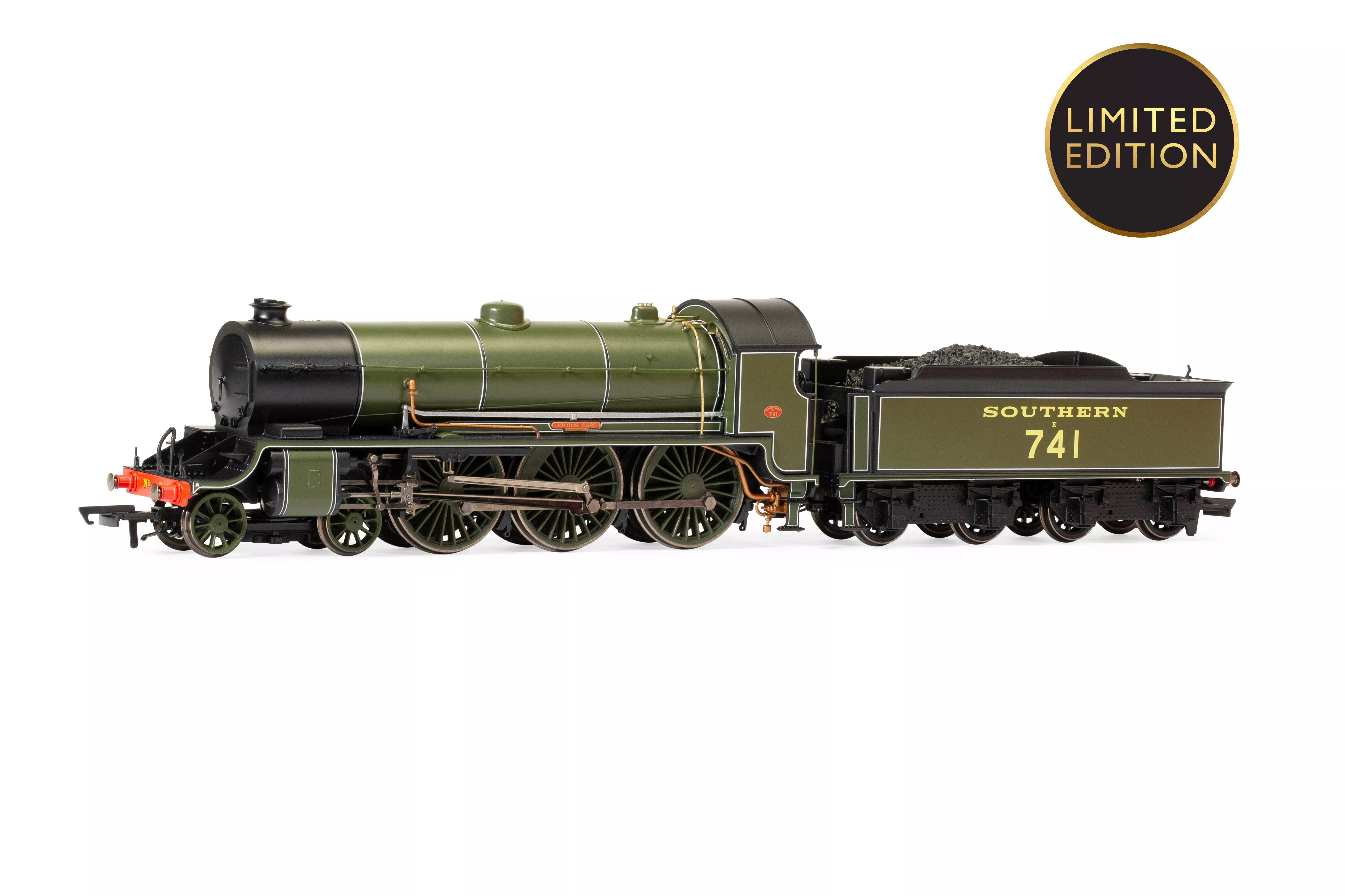
Manufacturer catalogue image - please note that pre-release images may be CAD renders or CGI/AI images rather than photographs
Prototype Era
Era 3 (1923 to 1947) The Big Four (LNER, LMS, GWR and SR)
Manufacturer description
The N15 Class, introduced in 1918 from a design by Robert Urie, was also known as the King Arthur Class, being named after persons and places associated with the legend of King Arthur and the Round Table. This class of two cylinder 4-6-0 passenger steam locomotives proved to be one of the most successful during the post-grouping era of 1928-1948, with 74 locomotives being built during this time.
The whole class was built in a total of six batches, with the first two batches being built at the London & South Western Railway's Eastleigh Works between 1918-19 and 1922-23. Carrying the characteristics of Urie's stove pipe chimney, Drummond style of cab and inspired by the shape of the H15, the first batches of locomotives became known as 'Urie Arthurs'.
Upon assuming the position of CME of the Southern Railway, Richard Maunsell built a third batch of ten locomotives at the Eastleigh Works and these became known as the 'Eastleigh Arthurs'. Maunsell's batch incorporated a small number of significant modifications including changes in the draft, valve gear, chimney, blastpipe and an overall increase in boiler pressure that significantly improved the performance.
In 1924 two more batches were ordered from the Scottish based North British Locomotive Company. These 30 locomotives, referred to as 'Scottish Arthurs' were built to the Southern Railways new composite loading gauge and were connected to eight wheel bogie tenders, which had a 5,000 imperial gallon capacity.
The last batch of 15 locomotives were built at Eastleigh between 1926-27 and adopted a six wheel 3,500 imperial gallon tender. Despite the order the batch was never completed, with the last locomotive being replaced by the prototype of the Lord Nelson Class of locomotives. Having proved to be one of the greatest designs of its day, the King Arthur Class combined reliability with impressive performance.
The introduction of electrification, plus the Lord Nelson Class and ultimately, the Bulleid Pacific locomotives, all hastened the N15's departure.
'Joyous Gard' was the sixth example of the class to be built, numbered 741 it would leave the shed at Eastleigh in April 1919. During its life the locomotive would receive various modifications such as the class wide installation of smoke deflectors as well as being fitted with a Lemaitre exhaust, becoming one of only five of the class to have the upgrade fitted.
The locomotive would become 30741 under British Railways, before being withdrawn and scrapped in February 1956. Only one member of the class would be preserved, a North British Loco built example, 777 Sir Lamiel, part of the National Collection, under the care of the 5305 Locomotive Association, being based at the Great Central Railway in Leicestershire.
The Hornby N15 model is fitted with a 5 pole motor which pairs well with its diecast chassis to provide excellent traction and pulling power. The model is 21 pin DCC ready for digital users who may wish to upgrade the locomotive to DCC.
Product videos


Video links are generated algorithmically and may not necessarily be this precise product.
Catalogue listing
Model details
Prototype information
North British Locomotive Co.
Southern Railway
British Railways
* Class names often change over the lifespan of a locomotive, so this is not necessarily the class name used by the operator in the period modelled.
Supplier Links



Supplier links are provided for your convenience and do not guarantee that the product is currently available. RailwayModels.uk is not a representative of these suppliers, but may receive a commission when purchases are made through links on this page.