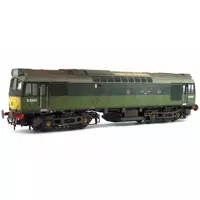
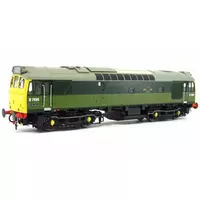
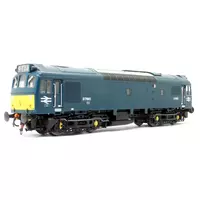
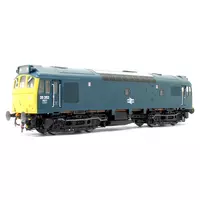
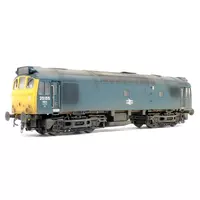
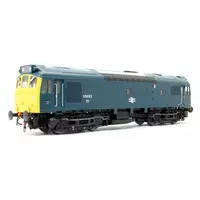
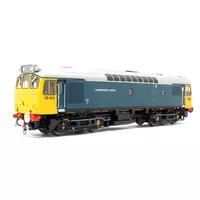
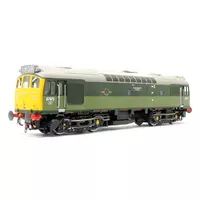
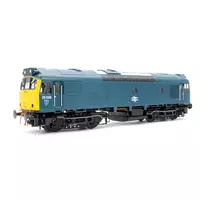
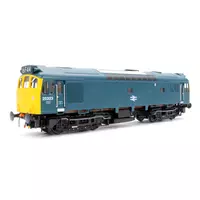
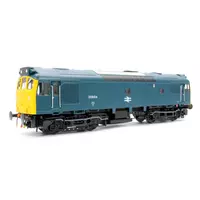
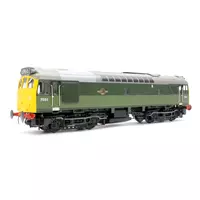
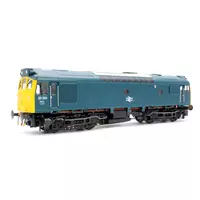
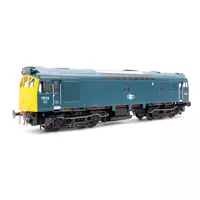
Manufacturer catalogue image - please note that pre-release images may be CAD renders or CGI images rather than photographs
Prototype Era
Era 6 (1967 to 1972) British Rail Blue (Pre-TOPS)
The model represents the final development of the 478 Derby/Sulzer Type 2s, which started with Class 24 in the late-1950s. This model will cover the D5238-99 and D7500-D7677 batches, built by Derby Works and Beyer, Peacock of Manchester between December 1963 and April 1967.
For the first time, models will also be offered as the famous Scottish Region ‘ETHEL’ (Electric Train Heating Ex-Locomotive) train heating units converted from Class 25/3s as a short-term solution prior to the delivery of Class 37/4s in 1985. These machines later found work with InterCity’s Charter Unit, lasting into the 1990s.
The new HELJAN Class 25/3 will feature our renowned high-performance chassis with all-wheel drive and all-wheel pick-up, illuminated headcode panels and marker lights, a 21-pin DCC decoder interface and provision for DCC sound.
FEATURES
SPECIFICATIONS
MEASUREMENTS
* Class names often change over the lifespan of a locomotive, so this is not necessarily the class name used by the operator in the period modelled.
Supplier links are provided for your convenience and do not guarantee that the product is currently available. RailwayModels.uk is not a representative of these suppliers, but may receive a commission when purchases are made through links on this page.
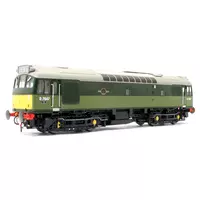
Heljan
2530
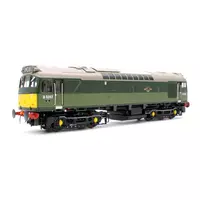
Class 25/3 - D7647 BR Two Tone Green with small yellow panels
Heljan
2531
Class 25/3 - D5244 BR Two tone Green with small yellow panels (Weathered)
Heljan
2532
Class 25/3 - D7550 BR Two Tone Green with full yellow ends and BR Blue data panel
Heljan
2533
Class 25/3 - D7661 BR Early Blue with small yellow panels
Heljan
2535
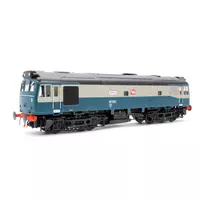
Class 25 252 (LMR) BR Rail Blue with full yellow ends (single, central double arrows) and head code panel still in place
Heljan
2536
Class 25 155 (WR) BR Rail Blue with full yellow ends (single, central delve arrows) and headcode still in place (Weathered)
Heljan
2537
Class 25 093 (ScR/LMR) BR Rail Blue with bodyside numbers (single, centrally placed double arrows) and domino headcodes
Heljan
2538
Class 25 912 BR 'Tamworth Castle' Ice Cream Van Livery with silver roof
Heljan
2539
Class 25/3 - D7672 'Tamworth Castle' BR Special Two-Tone Green
Heljan
2540
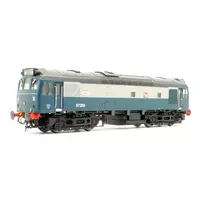
Class 25/3 ADB97250 BR Blue/Grey ETHEL1
Heljan
2541
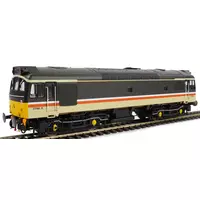
Class 25/3 Intercity 'ETHEL3' ADB97252
Heljan
2543
Class 25/3 D5243 BR Two Tone Green Small Yellow Panels
Heljan
2545
Class 25/3 97251 'ETHEL 2' BR Blue/Grey Alternative Livery
Heljan
2544
Class 25/3 25095 BR Blue with Cab Front Numbers
Heljan
2549
Class 25/3 25323 BR Blue (Pre-1976)
Heljan
2546
Class 25/3 25904 BR Blue
Heljan
2548
Class 25/3 7561 BR Two Tone Green Full Yellow Ends
Heljan
2547
Class 25/3 25301 BR Blue with Domino Headcodes
Heljan
2570
Class 25/3 7513 BR Blue
Online offers are generated automatically based on brand name and product code, and may not necessarily be this precise item.
Heljan Class 25/3 locomotive D7667 is presented in British Rail Rail Blue with full yellow ends and twin double arrows, marking the 1000th locomotive built at Derby Works. The model carries the running number D7667 and replicates the appearance of the pre‑TOPS British Rail Blue livery.
The kit is designed for OO gauge, measures 200 mm in length and features a Bo‑Bo wheel arrangement. It includes all‑wheel drive and all‑wheel power pickup, a 21‑pin DCC ready socket, sprung buffers, chain and NEM couplings, directional lighting, illuminated headcode panels and marker lights, and provision for DCC sound. The chassis is described as a high‑performance, all‑wheel drive chassis.
The model represents the final development of the Derby/Sulzer Type 2 series, covering the D5238‑99 and D7500‑D7677 batches built by Derby Works and Beyer, Peacock of Manchester between December 1963 and April 1967. The real locomotives were built between 1961 and 1967, with a total production run of 327 units, and served on British Rail from 1961 to 1987 in both freight and passenger traffic.
For the first time the locomotive is offered in the Scottish Region “ETHEL” (Electric Train Heating Ex‑Locomotive) configuration, reflecting its use as a temporary train‑heating unit before the arrival of Class 37/4s in 1985 and its later service with InterCity’s Charter Unit into the 1990s.