Bachmann 30-426SF
BR 'Western Pullman' 6-Car DEMU SOUND FITTED Train Pack
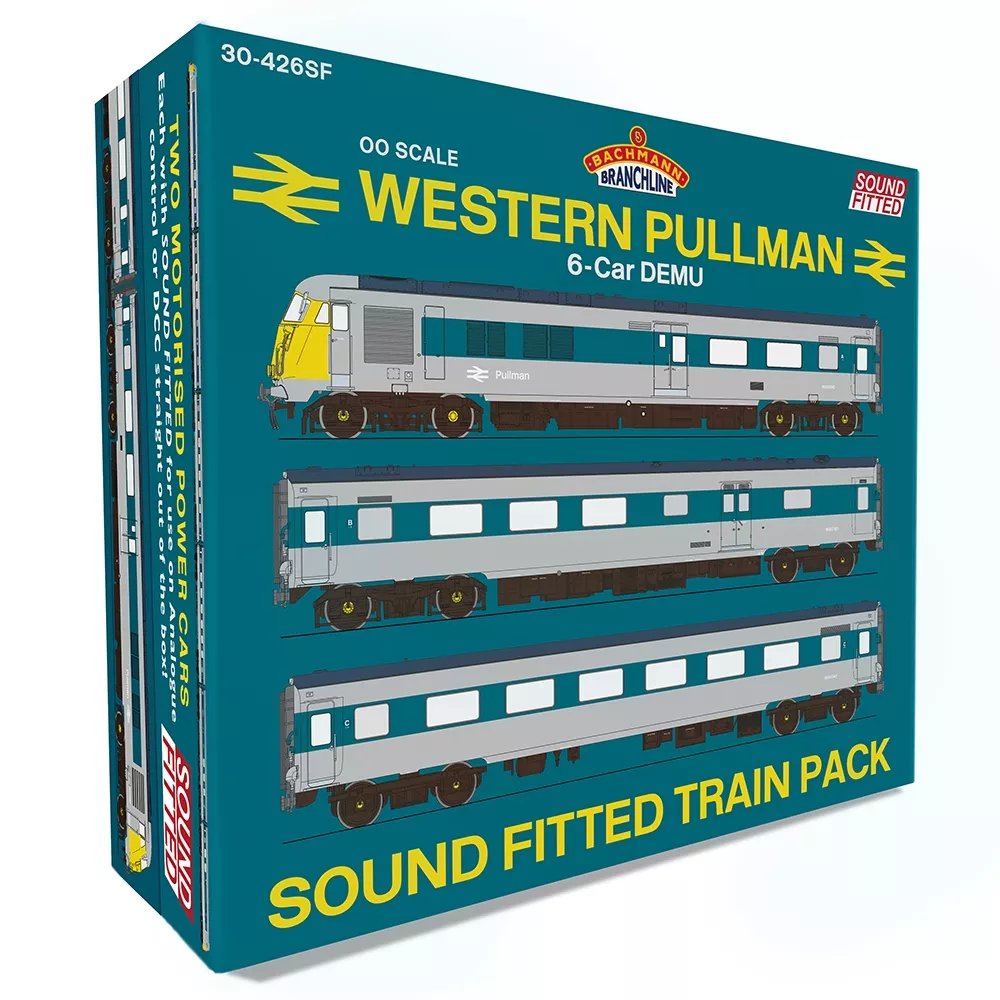
Manufacturer catalogue image - please note that pre-release images may be CAD renders or CGI/AI images rather than photographs
Prototype Era
Era 6 (1967 to 1972) British Rail Blue (Pre-TOPS)
Manufacturer description
A highlight of our Winter 2022 British Railway Announcements, we are proud to present the Western Pullman Train Pack. The impressive six-car train includes two motorised power cars, both with SOUND FITTED for a truly immersive operating experience.
This majestic model was born from the Bachmann Branchline Midland Pullman – a multiple award winner including being named model of the decade in 2020 – and this new train pack accurately depicts the Midland units following their transfer to the Western Region. Exquisitely decorated in the iconic Pullman livery of reverse blue and grey, this six car unit features two motorised power cars, each fitted with a Zimo sound decoder to provide sophisticated, synchronised sounds from each power car whether you’re running on analogue or DCC. The features continue as directional lighting, interior saloon lights and lighting in the leading end cab - with auto-off when moving – all comes as standard. When used on DCC, 28 independent sound and light functions can be enjoyed – including the operation of the individual table lights fitted inside each of the six cars.
MODEL FEATURES:
- Bachmann Branchline OO Scale
- Era 6
- Pristine BR Pullman Grey & Blue livery
- Six-Car Unit
- SOUND FITTED - Fitted with two Zimo MX644C DDC Sound Decoders – See below for the function list
- Length 1640mm
MECHANISM:
POWER CARS FEATURE:
- Five pole motor with flywheel providing drive to the leading bogie
- Twin axle drive
- Separate metal bearings fitted to each driven axle
- Trailing axles run in metal pinpoint bearings
- Electrical pickup from all wheels
- Diecast metal chassis block
- Multi-stage gearbox, with gearing arranged for prototypical running speeds and haulage capabilities
- 16.5mm (OO gauge) wheels to NEM310 & NEM311 standards with authentic profile and detailing
- Detachable coupling pockets to NEM362 standards fitted to each driven bogie at the cab end
- Conductive couplings with integral close coupling mechanism at the corridor end
- Designed to operate on curves of second radius (438mm) or greater
TRAILING CARS FEATURE:
- Axles run in metal pinpoint bearings
- Electrical pickup from all wheels
- 16.5mm (OO gauge) wheels to NEM310 & NEM311 standards with authentic profile and detailing
- Conductive couplings with integral close coupling mechanism fitted at each end
- Designed to operate on curves of second radius (438mm) or greater
DETAILING:
- Separately applied metal detail parts, including handrails, roof panel access handles and etched fan grilles
- Bogies constructed from multiple components featuring brake and suspension detail
- Separately fitted underframe components
- Precision moulded jumper cables and equipment fitted to the cab ends and at the vehicle ends
- Each train pack supplied with an accessory pack comprising metal screw-link couplings (dummy), headcode discs and coupling tool
- Authentically decorated bufferbeam pipework fitted at each cab end
LIGHTING:
- Directional lighting
- Passenger saloon lighting
- Cab lighting at the leading end, with auto-off function when moving (operable via a dedicated function when used on DCC)
- Illuminated table lamps (when used on DCC)
- Authentic light colours and temperatures selected for each lighting application
DCC:
- 21 Pin DCC decoder interface in each power car (with DCC sound decoders pre-fitted)
SOUND:
- Two speakers fitted, one in each power car, for optimum sound reproduction
- Two Zimo MX644C DCC Sound Decoders fitted, one in each power car
- Sound decoders are fully synchronised and independently configured to play different sounds from each power car, depending on which functions are selected, direction of travel etc.
- Sound files produced specifically for the Bachmann Branchline Western Pullman 6-Car DEMU
- SOUND FITTED models operate on DCC and Analogue control as supplied. On Analogue control basic prime mover sounds are produced that will vary according to use, and directional lights and passenger compartment lights will illuminate when power is applied. If sufficient voltage is available, the leading cab lights will illuminate when stationary.
LIVERY APPLICATION:
- Authentic liveries applied to all vehicles including interior decoration
- Multiple paint applications employed using BR specification colours
- Logos, numerals and text added as appropriate using multi-stage tampo printing using authentic typefaces, logos and colours
SOUNDS
F0 - Directional and Passenger Saloon Lights - On / Off (plus Light Switch Sound)
F1 - Sound - On / Off
F2 - Brake
F3 - Single Horn
F4 - Two-Tone Horn
F5 - Compressor
F6 - Engine Idle / Coasting
F7 - Drive Hold
F8 - Table Lamps - On / Off
F9 - Flange Squeal (Speed Related)
F10 - Detonators
F11 - Cab Light On / Off (Leading End, Auto-Off when Moving)
F12 - Auxiliary Engines
F13 - Station Ambience
F14 - Spirax Valves
F15 - On - Guard's Twin Buzzer / Off - Driver's Response
F16 - On - Door Open / Off - Door Slam
F17 - Fan
F18 - Guard's Whistle
F19 - Volume Down
F20 - Volume Up
F21 - On - Guard's Single Buzzer / Off - Driver's Response
F22 - Single Horn (2)
F23 - Single Horn (3)
F24 - Single Horn (4)
F25 - Two-Tone Horn (2)
F26 - No User Access
F27 - Rapid Spirax Valves
F28 - Fade All Sounds
Analogue Users: Please note that basic prime mover sounds will operate and will vary according to use when this model is used on analogue control (DC) straight from the box! Directional lights and passenger compartment lights will also illuminate when power is applied. If sufficient voltage is available, the leading cab lights will illuminate when stationary.
WESTERN PULLMAN HISTORY
Born as a result of the 1955 British Railways Modernisation Plan, Midland Pullman 6-car units were built by Metro-Cammell of Birmingham from 1956-59. Part of a batch of five Blue Pullman sets, the two ’Midland Pullmans’ were designed to herald a new age in high-speed, luxury rail travel. The design was a striking streamlined body profile carrying a bold and bright ‘Nanking Blue’ livery. With its pair of 1000hp NBL/MAN engines and a top speed of 90mph, the Blue Pullman offered passengers luxurious high-speed travel with innovative new features, such as air-conditioning, a public-address system and reclining seats. Operations commenced on the Manchester Central to London St. Pancras service on 4th July 1960.
Completion of the West Coast Main Line electrification scheme in 1966 and the introduction of the new high-speed electric services from Manchester to London meant the end of Pullman operations on the BR Midland Region. Both sets were withdrawn and stored at Swindon until it was decided that they would be best utilised on the Western Region, operating alongside the three 8-car ‘Western Pullman’ sets already in service. Whilst at Swindon, modifications were carried out before they were formally transferred in March 1967.
Once in service both ex-LMR sets were based at Bristol Bath Road. The sets operated in a 12-car formation on the morning Bristol Temple Meads to Paddington service where they were then split – with one set working a mid-day return journey to Oxford, and the other a mid-day return to Bristol. Once back at Paddington, the sets would be recoupled back into a 12-car formation and work the return service back to Bristol Temple Meads in the evening.
Further modifications began in December 1969, when a cosmetic overhaul, including a refresh of the interior carpets and upholstery occurred, along with the downgrading of the first-class accommodation in the DMBFL and MFLRK vehicles to second-class. The most striking aspect of the overhaul was the application of a new livery which more closely followed the new corporate-image, a reversed version of the striking new BR Blue and Grey InterCity stock livery, in-keeping with what had already been applied to the new Mk2 air-conditioned Pullman vehicles operating on the West Coast Mainline. The BR ‘Double Arrows’ insignia and the word ‘Pullman’ was then applied to the lower bodyside of the power cars.
The end came with the dawn of 1973 and the introduction of air-conditioned Mk2 coaching stock, there was now little difference between the standards of regular-service coaching stock and the Pullman units. Combined with the fact that the sets were a unique fleet of 5 with increasing maintenance costs, the inevitable came on Friday 4th May 1973 when Western Region Pullman services ceased. An enthusiast special was run the following day with an itinerary which covered elements of the former Western Region routes operated by the trains throughout their service lives.
Catalogue listing
Model details
Directional lighting
Pickup in tender
Prototype information
* Class names often change over the lifespan of a locomotive, so this is not necessarily the class name used by the operator in the period modelled.
Supplier Links


Supplier links are provided for your convenience and do not guarantee that the product is currently available. RailwayModels.uk is not a representative of these suppliers, but may receive a commission when purchases are made through links on this page.
Related products
-
Bachmann
30-420
BR 'Western Pullman' 6-Car DEMU Dynamis Ultima Sound Fitted Train Set
-
Bachmann
30-425
BR 'Midland Pullman' 6-Car DEMU Train Pack
-
Bachmann
31-255DC
Class 251 Blue Pullman 6 car Midland set in Nanking blue. DCC Fitted
-
Bachmann
31-256DC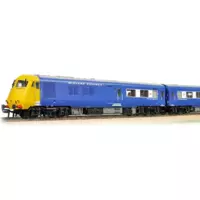
Class 251 Blue Pullman 6-car Midland set in Nanking blue with full yellow ends. DCC Fitted
The Bachmann Branchline OO Scale Western Pullman 6-Car DEMU is a highly detailed model of a train that was part of British Rail's Pullman service. The model is a branch off from the successful Bachmann Branchline Midland Pullman, which was named model of the decade in 2020.
The new train pack features six cars, with two motorised power cars fitted with Zimo sound decoders, providing a sophisticated and immersive operating experience. The model is decorated in the iconic Pullman livery of reverse blue and grey, and features directional lighting, interior saloon lights, and lighting in the leading end cab.
The model is designed to operate on curves of second radius (438mm) or greater, and is fitted with a five-pole motor with flywheel, twin axle drive, and separate metal bearings on each driven axle. The trailing cars feature axles running in metal pinpoint bearings and electrical pickup from all wheels.
The model is available in a pristine finish and is part of the Branchline range. It features a range of lighting and sound functions, including passenger saloon lights, cab lighting, and illuminated table lamps, which are operable via a dedicated function when used on DCC. The model also features a range of sound functions, including prime mover sounds, horns, and other operational sounds.
The Western Pullman 6-Car DEMU was a result of the 1955 British Railways Modernisation Plan, and was built by Metro-Cammell of Birmingham from 1956-59. The train was designed to provide high-speed, luxury rail travel with innovative new features such as air-conditioning and reclining seats. The train operated on the Manchester Central to London St. Pancras service, and later on the Western Region, before being withdrawn in 1973.