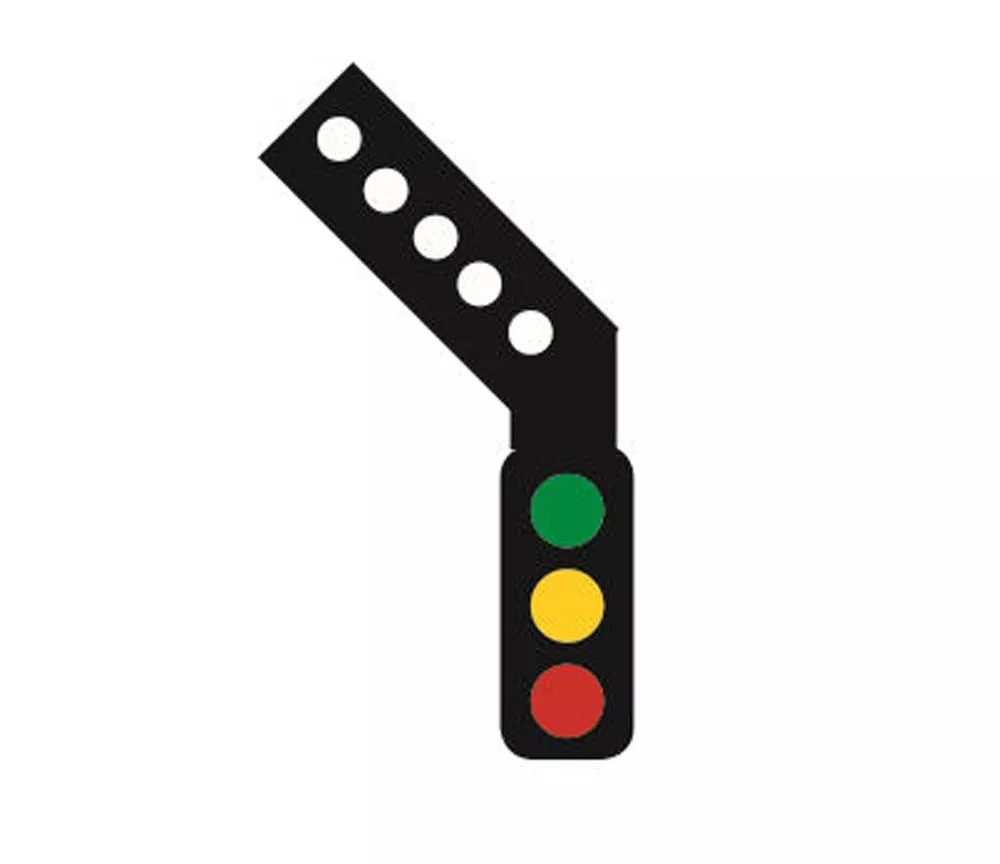
Manufacturer catalogue image - please note that pre-release images may be CAD renders or CGI/AI images rather than photographs
Manufacturer description
ith the use of the Sensor Signal developed by Train Tech you can easily add automatic signalling into your layout in seconds. The signals work by detecting a locomotive, or full train passing by it using a very small infrared sensor built in to the signal base. As soon as the locomotive has passed the sensor the signal changes to red and will stay red for about seven seconds to let the train clear the block. It then reverts back to yellow for a further seven seconds; then reverts back to green.
If more than one signal is being used in a section, such as a distant and home combination, the two signals can be linked by a single wire. This enables a signal sequence to be activated when the train passes the first signal. As the locomotive passes the first sensor the signal changes to red (as before) but as the train passes the second sensor the previous signal reverts to yellow and the additional signal changes to red which gives fully automatic block signalling, just like the real railway.
If you have multiple aspect signals (3 and 4) the yellows are also incorporated into this sequence. These signals are easy to set up and only require a single wire to link them all together to the sequence.
These signals can be used on both DC and DCC layouts using two methods of installation.
MEASUREMENTS
- HEIGHT 76mm
Catalogue listing
Supplier Links


Supplier links are provided for your convenience and do not guarantee that the product is currently available. RailwayModels.uk is not a representative of these suppliers, but may receive a commission when purchases are made through links on this page.