Rapido 982505
Caledonian Railway Single 4-2-2 CR Dark Blue No.123 Steam Locomotive - DCC Sound
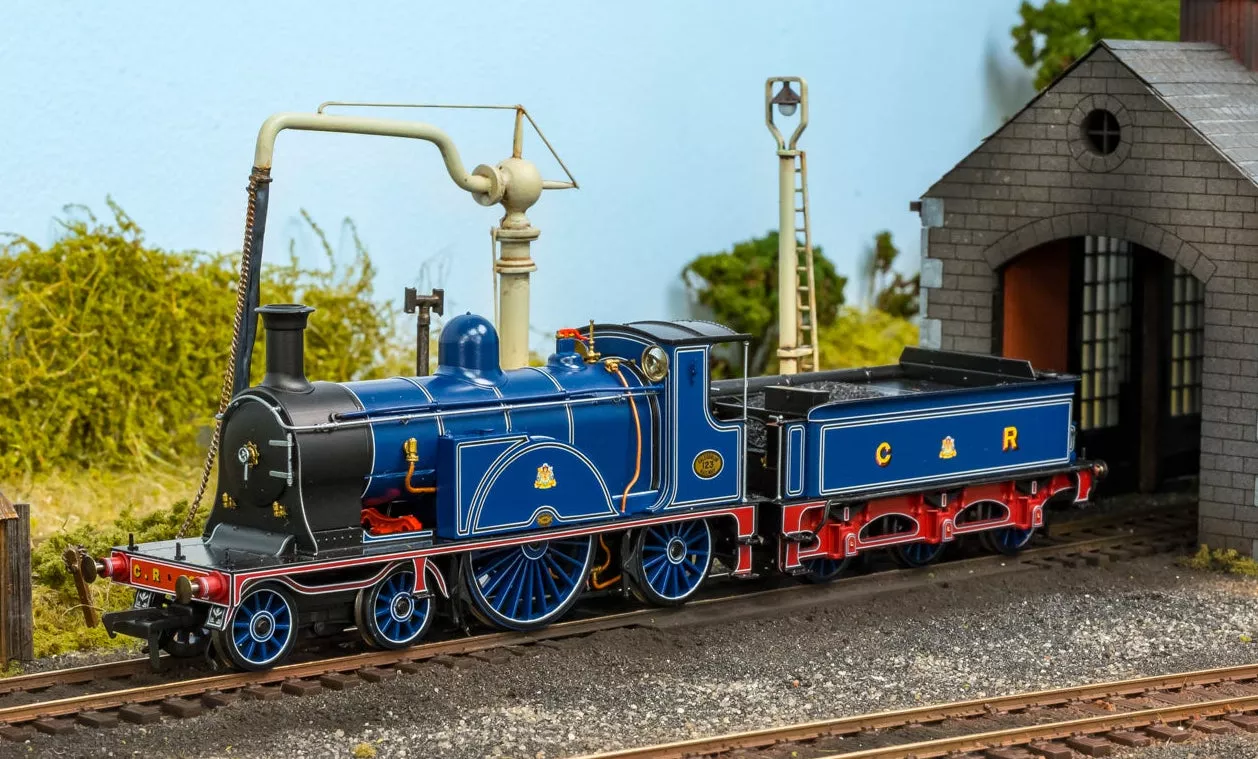
Manufacturer catalogue image - please note that pre-release images may be CAD renders or CGI/AI images rather than photographs
Prototype Era
Era 2 (1875 to 1923) Pre-grouping
Manufacturer description
RAILS EXCLUSIVE
Please note this model features the CR dark blue livery as carried by the locomotive during the pre-grouping era. During this period the locomotive carried a different boiler which is not featured in the Rapido tooling suite – hence it is described as a “what if”.
Caledonian Railway locomotive No.123 is one of the most distinguished locomotives ever to run on Britain's rails. She began her public life as an exhibition piece, was one of the headline acts of the famous Race to the North, and then became the pride of the fleet, working Directors specials and Royal trains. In the days of Nationalisation, she wowed crowds of people as a railtour celebrity, travelling the entire country, before finally returning to museum life and retiring gracefully in preservation as a national treasure.
No.123 was originally conceived as a display locomotive, to be shown off as the Caledonian Railway’s best at the 1886 International Exhibition of Industry, Science and Art in Edinburgh. However, CR No.123 was more than just a pretty face.
This unique locomotive was less a pinnacle of all that could be achieved and more of a respectful tribute to the designs of a bygone era. The true reason for her designer, Mr Dugald Drummond’s’ decision to use the single-wheeled design is yet to be discovered, but when Neilson & Co. built CR No.123 in 1886 it became a beautiful sunset moment for the single-wheeler concept.
Despite being the Caledonian's flagship loco, it wouldn’t be unjust to describe CR No.123 as dated technology, even by the standards of the day. With multiple-driving wheeled locomotives proving their worth and exceeding performance standards across the country, the once glorified ‘Single Wheeler’ design was sadly becoming a thing of the past as they were outpaced by their modern counterparts.
CR No.123 entered service on the Caledonian Railway shortly after the conclusion of the Exhibition. As a fully working locomotive, it was only logical to utilise it for more than just a publicity stunt.
It was used primarily for working Inspectors and Directors' trains with short rakes of saloon coaches, but would also be utilised as the pilot loco for Royal Trains heading to Balmoral Castle. This involved running slightly ahead of Royal Trains, clearing the line, and ensuring it was safe.
Although ‘Single Wheelers’ were a dated idea CR No.123 was still a vessel for the builders to demonstrate engineering innovations and make it something special. She was fitted with a newly developed sanding system, which used compressed air supplied from the main reservoir of the Westinghouse air brakes. This made CR No.123 the ideal candidate to conquer the climbs of Beattock and Shotts Summits while maintaining a respectable average speed.
With the Race to the North of 1888 becoming a highly promoted event by the British press, CR No.123 would be chosen to haul the Carlisle to Edinburgh leg of this non-official race, gaining further national fame.
Having already been renumbered by the Caledonian a few years before, the LMS renumbered her once more when they claimed ownership of the Caledonian Railway.
Assigned the power class 1P she was issued No.14010 and painted in LMS Maroon. In 1927 her existing Drummond boiler was replaced by a standard N17 class boiler. The most noticeable difference being that her safety valves were moved from the top of the dome to in front of the cab, and an extension ring fitted to the rear of the smokebox to accommodate the shorter boiler. In this eye-catching livery, the LMS returned her to a life of working Inspectors and Directors' trains.
Her final contribution to mainline duties was on the Dundee to Perth mainline, where she ran regular services. During this period, she was repainted into LMS Lined Black livery. When she was withdrawn in 1935 and set aside for preservation, she was the last single-wheeled express engine running in Britain.
Safely stored at St. Rollox, CR No.123 would remain there until 1953, when she was repainted back into her striking Caledonian Blue livery. This was in preparation for her to take part in a tour of the UK as a static display to celebrate the Coronation, named the Exhibition of Rail Travel for Kings & Queens.
In the late 50s, she was restored by British Railways and returned to steam. This last hurrah involved CR No.123 participating in a variety of railtours. She toured much of Scotland heading the Scottish Rambler, and even found her way as far South as the Bluebell Railway in 1963 with the Blue Belle railtour.
In 1965 CR No.123 finally retired, and was placed in the Glasgow Transport Museum (and then moved to The Riverside Museum) where she remains to this day.
The Rapido Trains UK highly detailed OO Gauge rendition of CR No.123 will be available in its post-1927 rebuilt condition. You can choose from the beautiful Caledonian Livery (Railtour Condition), both LMS liveries, and a sleek ‘What if’ BR Lined Early Crest variant too.
Detail variations include an array of different parts meaning that no two liveries are physically the same. The Caledonian Blue models will also include prototypical front buffers with embellished thistles.
You can look forward to a smooth-running mechanism, factory-installed speakers, NEM Coupler pockets, an ESU 21-pin decoder socket, cosmetic inside motion, and firebox flicker with a dynamic fire draw effect.
- Caledonian Railway ‘Single’ 4-2-2
- ‘What If’ Caledonian Railway Dark Blue No.123
- Suitable for operation on 2nd Radius curves (438mm or greater)
- Working dynamic firebox flicker
- 21-pin DCC decoder socket
- MoPower stay-alive capacitors
- 2 factory-fitted speakers in all models
- Sprung buffers
- Museum quality paint finish
- Smooth & powerful mechanism
- Highly detailed
- NEM coupler pockets
- 1:76 scale, (OO gauge)
This model is physically different to our other light blue model of No.123 making it a completely unique model. This model features an 8-point smokebox dart backer, later standard type buffers with plain housing and external pipework on the left-hand side of the tender along with a high tender rear backplate.
Function List:
- F0 Dynamic Firebox Flicker
- F1 Sound On/Off
- F2 Brake
- F3 Whistle (Playable)
- F4 Whistles (Short)
- F5 Guard’s Whistle/Driver ‘Right Away’
- F6 Heavy Mode
- F7 Train Set Mode
- F8 Coupling/Uncoupling
- F9 Shovelling
- F10 Coasting
- F11 Injectors
- F12 Blower
- F13 Safety Valve
- F14 Draincocks
- F15 Ejector
- F16 Water Tank Filling
- F17 Flange Squeal/Track Creak
- F18 Fade Out Sound
- F19 Shunt Mode
- F20 Air Pump (slow)
- F21 Air Pump (fast)
Catalogue listing
Model details
Supplier Links
Special commissions are usually only available new from the commissioning organisation, and may well have sold out on pre-order before they even end up listed here! But you may be able to find used items on marketplace or auction websites.


Supplier links are provided for your convenience and do not guarantee that the product is currently available. RailwayModels.uk is not a representative of these suppliers, but may receive a commission when purchases are made through links on this page.
The Rapido model of the Caledonian Railway's No.123 locomotive is a highly detailed OO gauge representation of this historic engine. This locomotive was built in 1886 by Neilson & Co. and was originally designed as a display piece for the Caledonian Railway's 1886 International Exhibition of Industry, Science and Art in Edinburgh.
No.123 was a single-wheeled locomotive, a design that was considered dated by the standards of the day. However, it was still a powerful and innovative engine that was used for working Inspectors and Directors' trains, as well as Royal trains to Balmoral Castle. The locomotive was also used to haul the Carlisle to Edinburgh leg of the 1888 Race to the North.
Over the years, No.123 underwent several changes, including a renumbering by the LMS in 1923 and a boiler replacement in 1927. The locomotive was eventually withdrawn in 1935 and stored at St. Rollox, where it remained until 1953, when it was repainted and used as a static display for the Coronation railtour.
In the late 1950s, the locomotive was restored by British Railways and returned to steam, participating in a variety of railtours until its final retirement in 1965. The locomotive is now on display at the Riverside Museum in Glasgow.
The Rapido model of No.123 is available in three liveries: Caledonian Railway livery, LMS Maroon, and a 'What if' BR Lined Early Crest variant, as well as a version in the Caledonian Railway's dark blue livery. The model features a highly detailed mechanism, factory-installed speakers, and a range of other features including NEM Coupler pockets and a dynamic fire draw effect. It is suitable for operation on 2nd radius curves of 438mm or greater.