Oxford Diecast SCA02CS
Scania R420 Topline C/Side Pollock (Scotrans) Ltd - 1:7
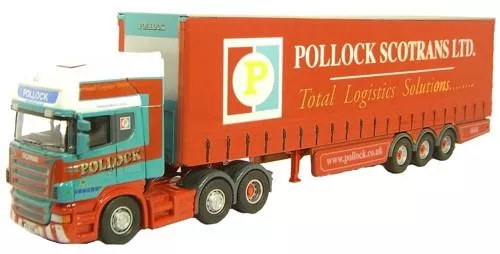
Manufacturer catalogue image - please note that pre-release images may be CAD renders or CGI/AI images rather than photographs
Prototype Eras
Era 9 (1995 to 2004) Initial Privatisation
Era 10 (2005 to 2015) Rebuilding of the Railways
Era 11 (2016 to 2026) The Last Days of Privatisation
Manufacturer description
It was in 1935 that George (WGD) Pollock started his local cartage business in Corstorphine just to the west of the city of Edinburgh. The business grew steadily until 1949 when road transport was nationalised. As a consequence the fleet became part of British Road Services and George was appointed Group Manager for East Lothian and the Borders. In 1954, when partial de-nationalisation occurred, George took the opportunity to buy some vehicles and licences, and opened for business again, now in Musselburgh, and the famous turquoise, gold and red livery was born. As the fleet continued to grow and the business expanded George's two sons Ian (now Chairman) and George joined the family business. In 1963 Ian came up with the idea of individually naming vehicles and combining a Scottish tartan, the tradition continues to this day.
Catalogue listing
Supplier Links


Supplier links are provided for your convenience and do not guarantee that the product is currently available. RailwayModels.uk is not a representative of these suppliers, but may receive a commission when purchases are made through links on this page.
Oxford Diecast Scania R420 Topline C/Side Pollock (Scotrans) Ltd – 1:7 is a die‑cast model produced under part number SCA02CS. The model depicts a Scania R420 truck as it appeared during the rebuilding of the railways, and is intended for collectors of historic commercial vehicle replicas.
The subject vehicle originates from the fleet of George Pollock’s cartage company, which was founded in 1935 in Corstorphine, west of Edinburgh. Following the nationalisation of road transport in 1949, the fleet became part of British Road Services and Mr Pollock was appointed Group Manager for East Lothian and the Borders. After partial de‑nationalisation in 1954 he purchased vehicles and licences, re‑establishing the business in Musselburgh and introducing the distinctive turquoise, gold and red livery.
The company expanded under the leadership of George Pollock’s sons, Ian and George, with Ian becoming Chairman. In 1963 Ian introduced the practice of giving each vehicle an individual name and pairing it with a Scottish tartan, a tradition that continues to the present day.