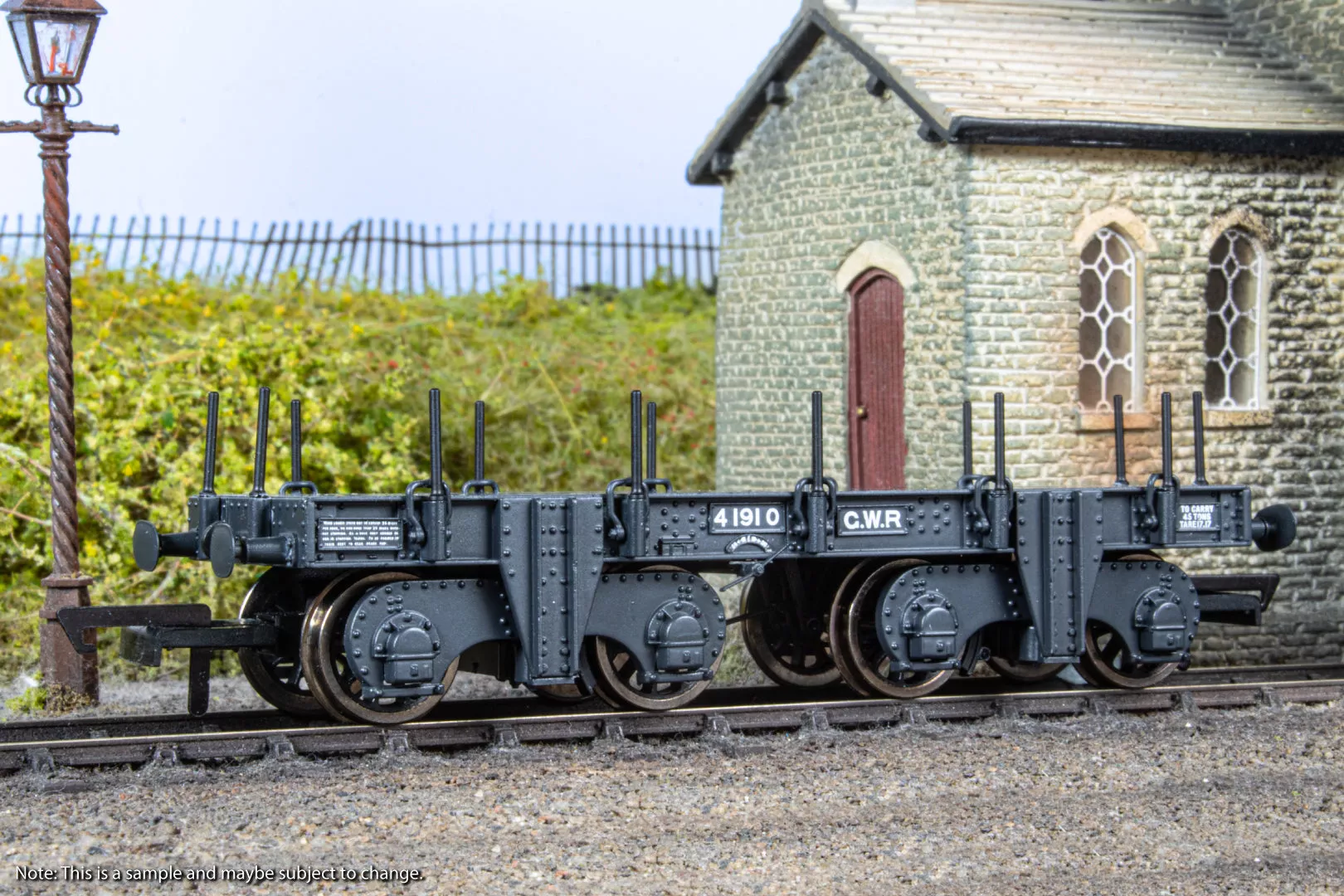
Manufacturer catalogue image - please note that pre-release images may be CAD renders or CGI/AI images rather than photographs
Prototype Era
Era 3 (1923 to 1947) The Big Four (LNER, LMS, GWR and SR)
Manufacturer description
Oxford Rail GWR Totem A - GWR (post 1936) No. 41910
Built in 1899, the Totem A (Diagram B2) was a short 25ft 1in armour plate bogie wagon with a load capacity of 45T (later uprated to 50T). The wagons primary purpose was to carry large cast iron parts for industrial use. A documented example was a large anvil loaded at Cardiff docks for B.S.A Birmingham.
Under load this wagon was limited to 25mph and could not exceed a travel distance of 25 miles without stopping. Because of this, the wagon was most commonly found in stopping goods trains next to the brake van.
The wagon was originally fitted with a Thomas handbrake but was later replaced with a Dean-Churchward style handbrake.
Catalogue listing
Supplier Links


Supplier links are provided for your convenience and do not guarantee that the product is currently available. RailwayModels.uk is not a representative of these suppliers, but may receive a commission when purchases are made through links on this page.