Oxford OR76J26004XS
NER P2 (lined black) 1678 0-6-0 Class J26 Sound Fitted
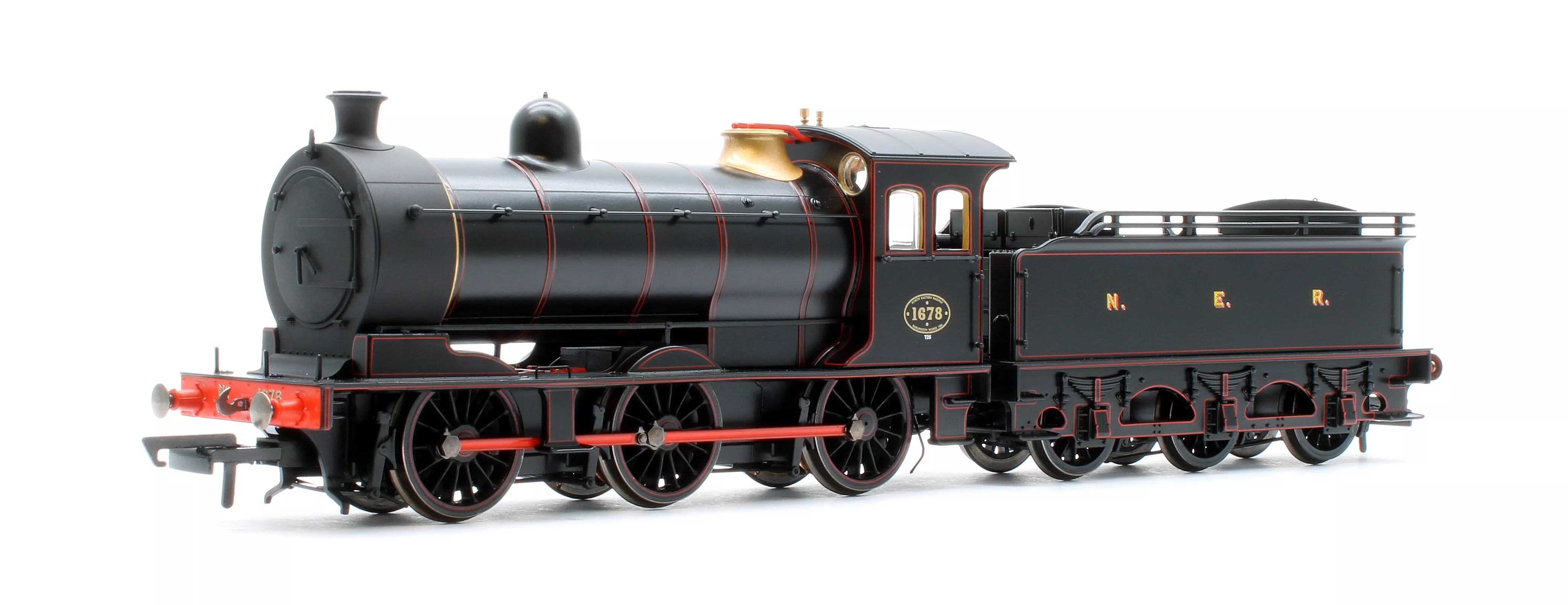
Manufacturer catalogue image - please note that pre-release images may be CAD renders or CGI/AI images rather than photographs
Prototype Era
Era 2 (1875 to 1923) Pre-grouping
Manufacturer description
Oxford Rail OR76J26004 NER 1678 0-6-0 Class J26 Sound Fitted
Note: The products shown are pre-production samples. Please be aware that the final production versions may have minor changes or improvements.
The North Eastern Railway (NER) required a powerful engine to handle the increasing size of freight trains on their network. The NER P2 design came into existence and stood out from anything which had previous been built by the NER with a massive 5ft 6in diameter boiler. 30 were built in 1904/05 at Darlington and a further 20 built in 1905 in Gateshead. The design was modified in 1906 to produce the NER P3 later J27 design. The J26 was mainly used on goods traffic. None of the 50 J26 survived into preservation with the final J26 locomotives being withdrawn in 1962.
Catalogue listing
Model details
Supplier Links


Supplier links are provided for your convenience and do not guarantee that the product is currently available. RailwayModels.uk is not a representative of these suppliers, but may receive a commission when purchases are made through links on this page.
The Oxford NER P2 locomotive model is a 0-6-0 Class J26 locomotive sound fitted with DCC capabilities. This model falls under the Oxford Rail product range and is representative of the pre-grouping era.
The model, designated as OR76J26004, is a replica of the NER P2 design, which was a powerful engine built to handle large freight trains on the North Eastern Railway network. A total of 50 locomotives were constructed between 1904 and 1906, with the first 30 built at Darlington and the remaining 20 at Gateshead.
The locomotives were characterised by a large 5ft 6in diameter boiler, setting them apart from previous NER designs. The J26 class was primarily used for goods traffic and underwent a design modification in 1906 to produce the NER P3, later referred to as the J27. Unfortunately, none of the 50 J26 locomotives survived into preservation, with the last ones being withdrawn from service in 1962.