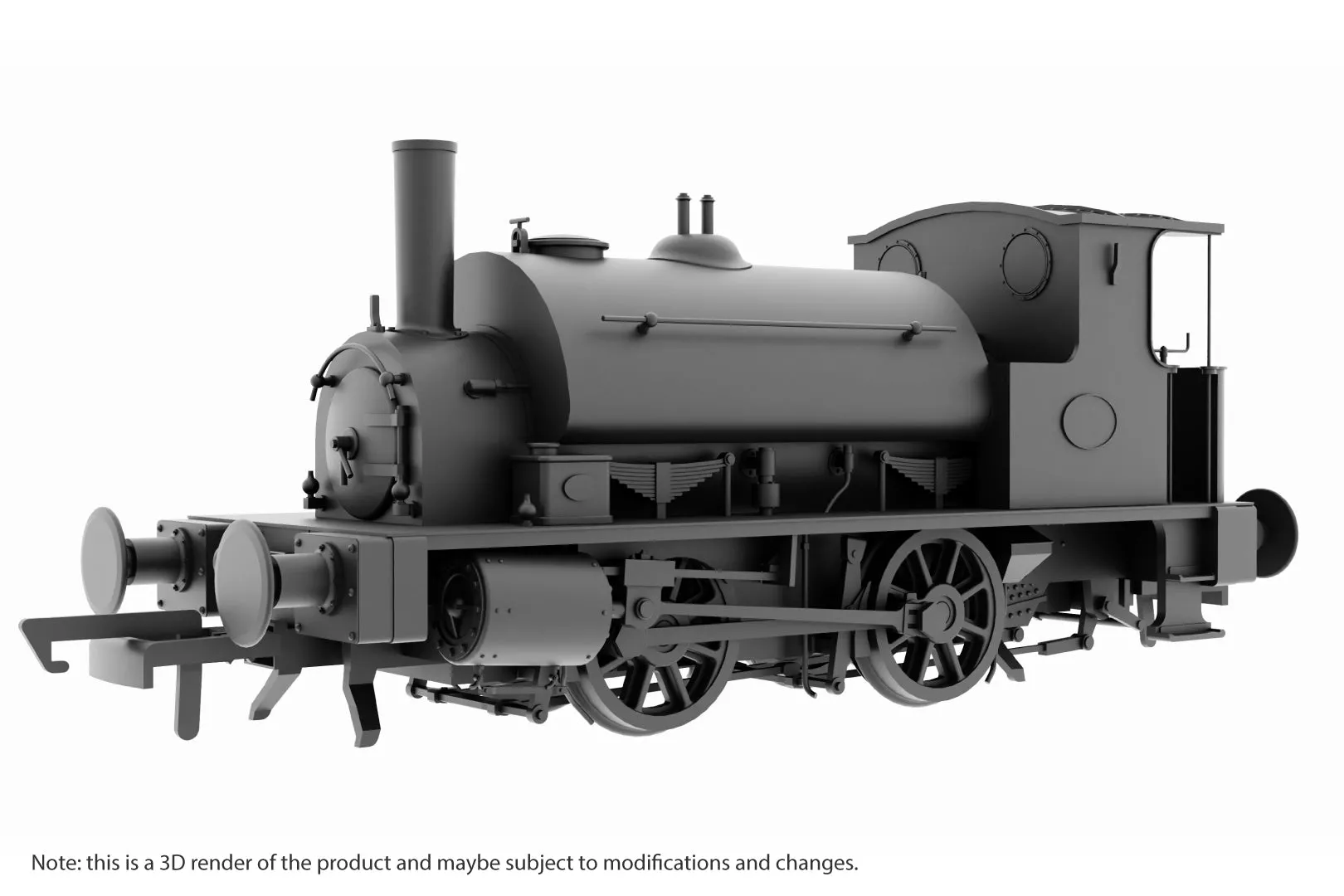
Manufacturer catalogue image - please note that pre-release images may be CAD renders or CGI images rather than photographs
Prototype Eras
Era 2 (1875 to 1923) Pre-grouping
Era 5 (1956 to 1966) British Railways Late Crest
Manufacturer description
The Caledonian Railway 264 and 611 Classes, commonly known as the “Pug,” were 0-4-0 saddle tank locomotives built for the Caledonian Railway. The Class 264 was introduced in 1883 to a design by Dugald Drummond and built by Neilson and Company, with the related Class 611 following from 1895 under John F. McIntosh and built at St Rollox Works.
Some of these were paired with a small, improvised coal tender attached behind them, providing extra coal capacity beyond what the original saddle tank could hold. After the 1923 Grouping they passed into the London, Midland and Scottish Railway, and subsequently to British Railways in 1948. Withdrawals were completed between 1959 and 1962. No examples of the class were preserved.
Catalogue listing
Model details
Supplier Links


Supplier links are provided for your convenience and do not guarantee that the product is currently available. RailwayModels.uk is not a representative of these suppliers, but may receive a commission when purchases are made through links on this page.