Oxford Diecast 76TRF003
Thompson Refueller RAF
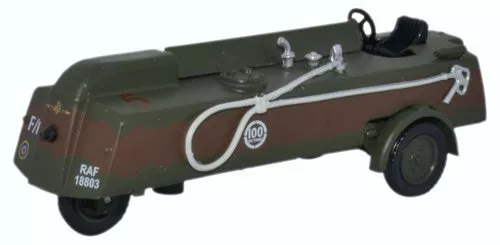
Manufacturer catalogue image - please note that pre-release images may be CAD renders or CGI/AI images rather than photographs
Prototype Eras
Era 5 (1956 to 1966) British Railways Late Crest
Era 6 (1967 to 1972) British Rail Blue (Pre-TOPS)
Era 7 (1972 to 1982) British Rail Blue (TOPS)
Era 8 (1983 to 1994) British Rail Sectorisation
Era 9 (1995 to 2004) Initial Privatisation
Manufacturer description
Decorated in dark green and brown camouflage colours with black interior and exterior white lettering, the vehicle is registered to the RAF as RAF 18803. Further identification sees the number 5 in red printed on the upper surface for the benefit of traffic from the air and operatives are reminded of the 100 octane fuel requirements with respective markings on the sides of the body. A final detail comprises the Thompson Bros Aircraft Refueller badge faithfully replicated on the front of the vehicle. Although developed in the 1930s, F/11 is thought to have seen service on WWII airfields around 1943, when it was no doubt working flat out keeping our Allied aircraft topped up between sorties.
Catalogue listing
Supplier Links


Supplier links are provided for your convenience and do not guarantee that the product is currently available. RailwayModels.uk is not a representative of these suppliers, but may receive a commission when purchases are made through links on this page.
Oxford Diecast Thompson Refueller RAF – model 76TRF003
This die‑cast vehicle represents a Thompson Bros aircraft refueller used by the Royal Air Force. It is painted in dark green and brown camouflage with black interior panels and white lettering. The vehicle carries the RAF registration “RAF 18803” and displays a red “5” on the upper surface, indicating priority for aerial traffic. Side markings denote the requirement for 100‑octane fuel, and the Thompson Bros Aircraft Refueller badge is reproduced on the front.
The model depicts the vehicle as it would have appeared during the British Rail Blue (pre‑TOPS) period. Although the original design dates from the 1930s, the type is believed to have operated on WWII airfields from around 1943, providing rapid fuel replenishment for Allied aircraft between sorties.