Oxford Diecast 76TP006
Triumph 2500 British Racing Green
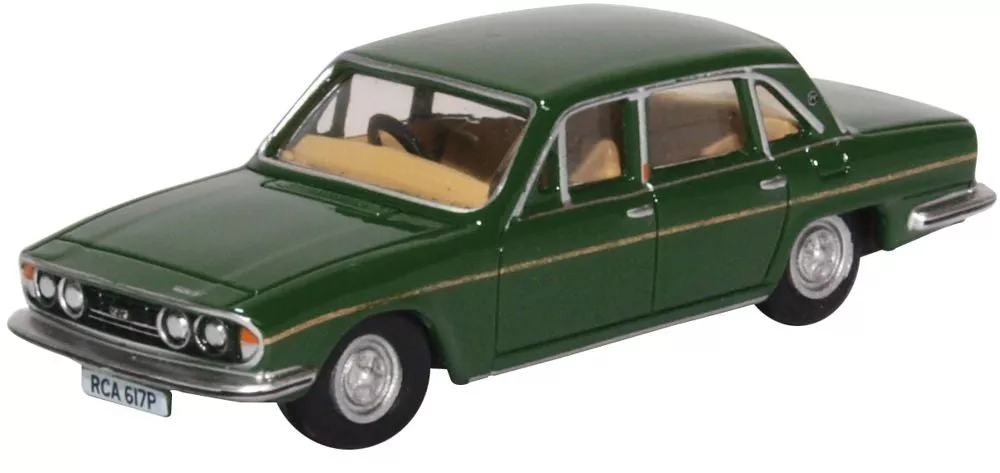
Manufacturer catalogue image - please note that pre-release images may be CAD renders or CGI/AI images rather than photographs
Prototype Eras
Era 5 (1956 to 1966) British Railways Late Crest
Era 6 (1967 to 1972) British Rail Blue (Pre-TOPS)
Era 7 (1972 to 1982) British Rail Blue (TOPS)
Era 8 (1983 to 1994) British Rail Sectorisation
Manufacturer description
The Triumph 2500 TC was one of the Company's Mk 2 series designed by Triumph's in-house designer Giovanni Michelotti around 1968, to update the car for the 1970s. It was the result of several modifications to the original 2000 series, which had been launched in the previous decade as a mid-sized car with rear wheel drive. The new models now had larger engines and several minor improvements over their predecessors, mainly surrounding the ride and handling capabilities. The TC suffix had been added to indicate a higher equipment level.
Here you see it in the classic British Racing Green colour scheme with a gold stripe running along the sides, lots of contrasting silver trim and a tan interior. It is registered RCA 617P from 1975/76 - towards the end of its production lifetime.
Catalogue listing
Supplier Links


Supplier links are provided for your convenience and do not guarantee that the product is currently available. RailwayModels.uk is not a representative of these suppliers, but may receive a commission when purchases are made through links on this page.
Oxford Diecast Triumph 2500 British Racing Green is a die‑cast model (manufacturer part number 76TP006) that replicates a Triumph 2500 TC from the late 1970s. The model represents a vehicle in the British Rail Blue (pre‑TOPS) period.
The Triumph 2500 TC was part of Triumph’s Mk 2 series, designed by Giovanni Michelotti in 1968 and updated for the 1970s with a larger engine and improved ride and handling. The “TC” designation denotes a higher equipment level compared with earlier 2000 series cars.
This particular die‑cast version is finished in classic British Racing Green with a gold side stripe, silver trim and a tan interior. It is listed as registered RCA 617P for the years 1975/76, towards the end of the original car’s production run.