Oxford Diecast 76RE001
Riley Elf MkIII Arianca Beige/pale Ivory
Manufacturer catalogue image - please note that pre-release images may be CAD renders or CGI/AI images rather than photographs
Prototype Eras
Era 5 (1956 to 1966) British Railways Late Crest
Era 6 (1967 to 1972) British Rail Blue (Pre-TOPS)
Era 7 (1972 to 1982) British Rail Blue (TOPS)
Era 8 (1983 to 1994) British Rail Sectorisation
Manufacturer description
The Riley Elf Mk I was launched in 1961 and was seen as an alternative to the Mini, which had been on the British motoring scene since 1959. Classed as a small car, it came with front wheel drive and a 4-cylinder in-line, 850 cc engine and a top speed of 70 mph. It was upgraded in 1963 to the Mk.II, when the engine size was increased to 988 cc and a top speed of 75 mph. Our Oxford model, a replica of the Mk.III Elf, was the same mechanically as the Mk I and II but came with some refinements with inside door hinges (as did the Mk II) and an improved suspension. A plus over the Mini was the Elf had a separate boot.
Riley had been on the automotive scene since 1890 when, as a family business, they were successfully manufacturing bicycles before developing into motorcycles and then cars. The company was acquired by Morris Motors in 1938 under whose umbrella the Riley marque thrived until near the end of the 1960s when merged into British Leyland Motors in 1968. A year later, British Leyland announced the end of Riley production and the name disappeared sadly into the annals of motor history.
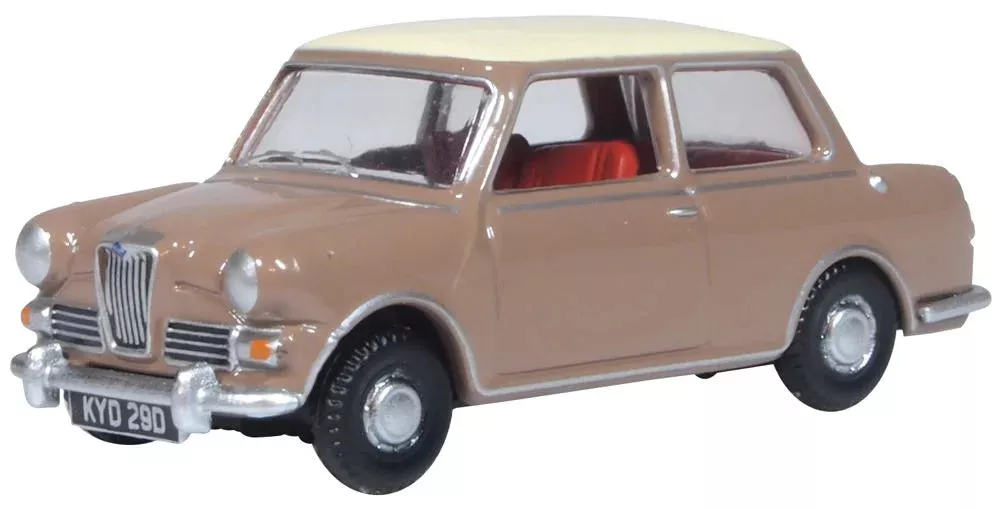
Our model is a replica of the two door, four seater Riley Elf Mk III which was launched in 1966 and its registration plate KYD 29D is from that first year of production. It was quite stylish for its day with mushroom beige paintwork and a contrasting cream roof. The interior dash is black but the seats are a lively bright red. Exterior chrome work enhances the detailed radiator which carries the famous diamond shaped Riley badge in vibrant blue and silver. Additional silver trim has been applied to bumpers, door handles, light surrounds and wheels. To round off the model, the boot also incorporates the Riley badge above the rear number plate.
Catalogue listing
Supplier Links


Supplier links are provided for your convenience and do not guarantee that the product is currently available. RailwayModels.uk is not a representative of these suppliers, but may receive a commission when purchases are made through links on this page.
Oxford Diecast Riley Elf Mk III Arianca Beige/pale Ivory is offered by Oxford with the manufacturer part number 76RE001. The model replicates the two‑door, four‑seater Riley Elf Mk III as it appeared in 1966, featuring a mushroom‑beige body with a contrasting cream roof. The interior shows a black dashboard and bright red seats. Chrome detailing highlights the radiator, which carries the diamond‑shaped Riley badge in blue and silver, while additional silver trim appears on the bumpers, door handles, light surrounds and wheels. The boot includes the Riley badge positioned above the rear number‑plate, and the registration plate shown is KYD 29D, appropriate to the car’s first year of production.
The Riley Elf was launched in 1961 as an alternative to the Mini, offering front‑wheel drive and a 850 cc inline‑four engine capable of 70 mph. In 1963 the Mk II version received a larger 988 cc engine and a top speed of 75 mph. The Mk III, released in 1966, retained the mechanical layout of its predecessors but incorporated refinements such as inside door hinges and an improved suspension, together with the practical advantage of a separate boot.
Riley began as a family‑run bicycle manufacturer in 1890, later expanding into motorcycles and automobiles. The brand was acquired by Morris Motors in 1938, flourished under that ownership, and was incorporated into British Leyland Motors in 1968. Production of Riley cars ceased in 1969, ending a long chapter in British motoring history.