Oxford Diecast 76MST001
Austin Maestro
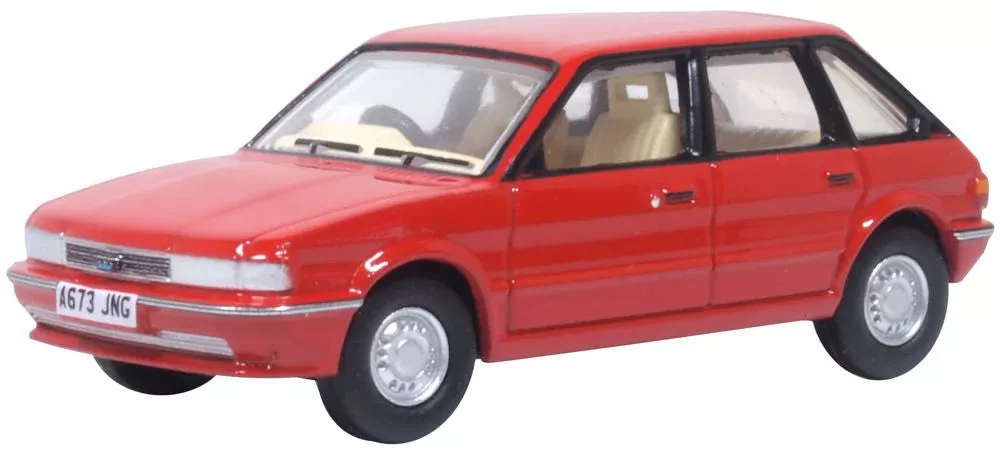
Manufacturer catalogue image - please note that pre-release images may be CAD renders or CGI/AI images rather than photographs
Prototype Eras
Era 7 (1972 to 1982) British Rail Blue (TOPS)
Era 8 (1983 to 1994) British Rail Sectorisation
Era 9 (1995 to 2004) Initial Privatisation
Era 10 (2005 to 2015) Rebuilding of the Railways
Manufacturer description
Introduced in 1983, the Maestro comprised a small family 5-door hatchback vehicle manufactured by British Leyland at their Morris Cowley works. It had a 5-speed manual gearbox and a basic 1.3L engine rising to 1.6L on later models. It incorporated many innovative features for its time. It had a bonded laminated windscreen, homofocal headlights, body-coloured plastic bumpers, an electronic engine management system, adjustable front seat belt anchorage positions, an asymmetrically split rear seat and a 12.000 mile service interval. When it was launched in 1983, the critics hailed it as roomy, comfortable and good to drive. Just over 600,000 Austin Maestro cars were sold and it was sixth in the best selling category in 1983 and 1984.
Our Oxford model incorporates the physical features of the original and is registered A673 JNG from the first year of production – 1983. Its authentic colour scheme of bright red is offset with black exterior trim, silver headlights and silver/black radiator grille. Note particularly the body-coloured bumpers. The interior features ivory seating and a black steering wheel. The Austin badge with blue flash is embedded into the radiator grille whilst to the rear, the Austin badge appears with green and blue graphics with the Maestro name printed in silver on the offside.
Despite its innovative features, the basic version of the Maestro was not long-lived with the MG and Vanden Plas upgrades proving more popular in both performance and appeal. However, the Maestro paved the way and as well as morphing into the MG Maestro, it was also available as a 2-door van.
Catalogue listing
Supplier Links


Supplier links are provided for your convenience and do not guarantee that the product is currently available. RailwayModels.uk is not a representative of these suppliers, but may receive a commission when purchases are made through links on this page.
Oxford Diecast Austin Maestro – model 76MST001, representing the British Rail sectorisation era. The die‑cast replica is registered A673 JNG, reflecting the first year of production (1983). It is finished in bright red with black exterior trim, silver headlights, a silver/black radiator grille and body‑coloured plastic bumpers. The interior is shown with ivory seats and a black steering wheel; the radiator grille carries an Austin badge with a blue flash and the rear displays an Austin badge with green and blue graphics together with the Maestro name in silver on the off‑side.
The original Austin Maestro was launched in 1983 as a small family five‑door hatchback built by British Leyland at the Morris Cowley works. It was equipped with a five‑speed manual gearbox and initially a 1.3 L engine, later increased to 1.6 L. Notable features for the period included a bonded laminated windscreen, homofocal headlights, body‑coloured plastic bumpers, an electronic engine‑management system, adjustable front seat‑belt anchor points, an asymmetrically split rear seat and a 12 000‑mile service interval. Critics at launch described it as roomy, comfortable and pleasant to drive; total sales exceeded 600 000 units, making it the sixth‑best‑selling car in the UK in both 1983 and 1984.
Although the basic Maestro was superseded by the higher‑performance MG and Vanden Plas versions, the model paved the way for those variants and was also offered as a two‑door van. The Oxford die‑cast version captures these original details for collectors.