Oxford Diecast 76JAG7001
Jaguar MK7 Ivory - 1:76 Scale
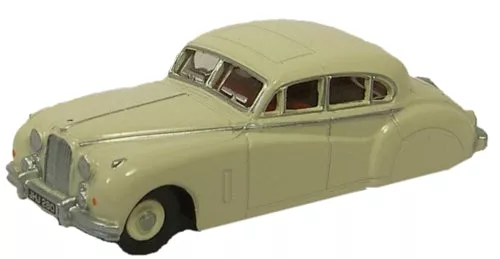
Manufacturer catalogue image - please note that pre-release images may be CAD renders or CGI/AI images rather than photographs
Prototype Eras
Era 4 (1948 to 1956) British Railways Early Crest
Era 5 (1956 to 1966) British Railways Late Crest
Era 6 (1967 to 1972) British Rail Blue (Pre-TOPS)
Manufacturer description
The Jaguar Mark VII was a large four door sports sedan launched by Jaguar Cars at the 1950 London Motor Show. The chassis came from the Jaguar Mark V with which the Mark VII shared its wheelbase. For this latest offering Jaguar designed a modern and streamlined looking body, featuring fully integrated headlights and mudguards along with an increased rear overhang which gave the car enhanced presence. As on the Mark V, the upper part of the rear wheels was covered by the body work. In place of its predecessor's flat windscreen, the Mark VII design included a two piece front screen, later versions had a gently curved one piece screen. The 3442 cc straight six engine provided the same 160 bhp (119.3 kW) power output. Despite its size, a top speed in excess of 100 mph (160 km/h) was claimed. The Jaguar Mark VII's arrival coincided with some relaxation of the desperate economic situation after the war. By the time of the models' 1954 upgrade, 20,908 had been produced
Catalogue listing
Supplier Links


Supplier links are provided for your convenience and do not guarantee that the product is currently available. RailwayModels.uk is not a representative of these suppliers, but may receive a commission when purchases are made through links on this page.
Oxford Diecast Jaguar MK7 Ivory – 1:76 Scale is a die‑cast model produced by Oxford Diecast, reference number 76JAG7001. The model represents a Jaguar Mark VII in the British Railways Late Crest period.
The Jaguar Mark VII was a large four‑door sports sedan first shown at the 1950 London Motor Show. It used the chassis and wheelbase of the earlier Mark V but featured a more streamlined body with integrated headlights and mudguards, a longer rear overhang and, initially, a two‑piece front screen (later replaced by a gently curved single pane). The 3442 cc straight‑six engine produced 160 bhp (119.3 kW), giving a claimed top speed of over 100 mph (160 km/h).
Production of the Mark VII continued until the 1954 upgrade, by which time 20,908 units had been built. The die‑cast model captures the car’s ivory finish and key design details at a 1:76 scale.