Oxford Diecast 76ETYP005
Jaguar E Type Union Jack - 1:76 Scale
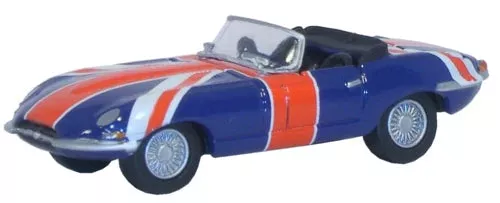
Manufacturer catalogue image - please note that pre-release images may be CAD renders or CGI/AI images rather than photographs
Prototype Eras
Era 5 (1956 to 1966) British Railways Late Crest
Era 6 (1967 to 1972) British Rail Blue (Pre-TOPS)
Era 7 (1972 to 1982) British Rail Blue (TOPS)
Manufacturer description
If you're collecting all things Union Jack, the Oxford Diecast Jaguar E Type Union Jack in 1:76 Scale is a good addition to your collection.
The Jaguar E-Type Series 1 was introduced in March 1961, using the triple SU carburetted 3.8 litre 6-cylinder Jaguar XK6 engine from the XK150S. The first 500 cars built had flat floors and external bonnet latches. These cars are rare and more valuable. After that, the floors were dished to provide more leg room and the twin hood latches moved to inside the car. The 3.8 litre engine was increased to 4.2 litres in late 1964. All E-Types featured independent coil spring rear suspension with torsion bar front ends, and four wheel disc brakes, in-board at the rear, power-assisted from 1964. Jaguar was one of the first auto manufacturer to equip cars with disc brakes as standard.
Catalogue listing
Supplier Links


Supplier links are provided for your convenience and do not guarantee that the product is currently available. RailwayModels.uk is not a representative of these suppliers, but may receive a commission when purchases are made through links on this page.
Oxford Diecast Jaguar E‑Type Union Jack – 1:76 Scale is a diecast model produced under part number 76ETYP005. The model represents the vehicle in the British Rail Blue livery used before the introduction of TOPS, and is presented at a 1:76 scale.
The model features the Union Jack colour scheme and is marketed as a suitable item for collectors who aim to assemble a range of Union Jack themed pieces. It is made from diecast metal and incorporates detailing appropriate to the period it depicts.
The real Jaguar E‑Type Series 1 was launched on 1 March 1961, fitted with a triple SU carburettor 3.8‑litre six‑cylinder XK6 engine derived from the XK150S. The first 500 examples were built with flat floors and external bonnet latches; these early cars are considered rare. Subsequent production introduced dished floors for increased legroom and moved the bonnet latches to the interior. In late 1964 the engine capacity was increased to 4.2 litres, and power‑assisted disc brakes became standard. All versions employed independent coil‑spring rear suspension, torsion‑bar front suspension and rear in‑board disc brakes.