Oxford Diecast 76DC004
Duple Commander II Greenslades
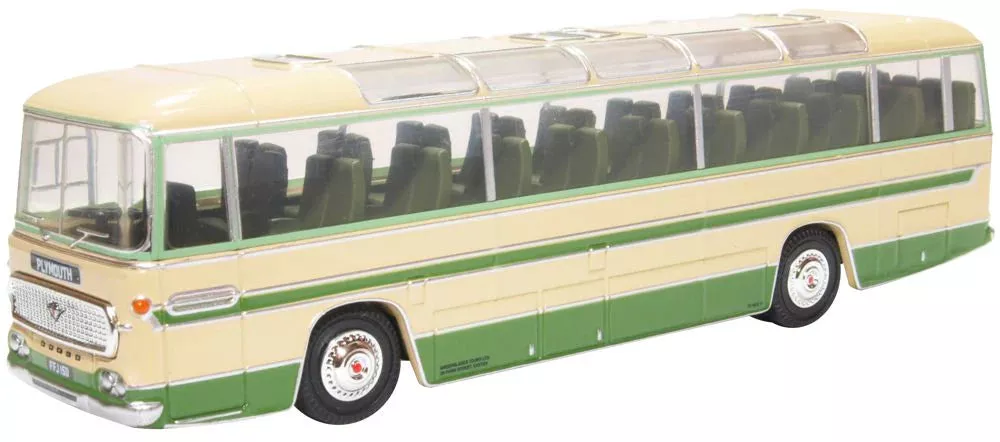
Manufacturer catalogue image - please note that pre-release images may be CAD renders or CGI/AI images rather than photographs
Prototype Eras
Era 5 (1956 to 1966) British Railways Late Crest
Era 6 (1967 to 1972) British Rail Blue (Pre-TOPS)
Era 7 (1972 to 1982) British Rail Blue (TOPS)
Era 8 (1983 to 1994) British Rail Sectorisation
Manufacturer description
Greenslades has been a familiar name in Bristol's world of transport since the early 1900s, when two brothers William and Gilbert Greenslade founded a small taxi service with a Model T Ford. Demand grew from people wanting a day out and so the business grew until they acquired a charabanc capable of carrying more passengers. As the years went by, the colours of their liveried transport changed with different company mergers and takeovers but for the bus collectors of today, the Greenslade pale green and cream colour scheme is the one which most usually comes to mind.
Between 1919 and 1989, Duple Coachbuilders were associated with the majority of the great names in British coach and bus designs, working with equally well-known UK chassis producers to bring a wide range of public transport vehicles to our roads. Duple Bodies & Motors was formed in 1919 by Herbert White in Hornsey, London. He developed the name Duple following an idea he had in which the name was intended to convey the principle of a single vehicle being suitable for a dual role. This enabled small business owners in particular who had a working van/private vehicle by merely removing the decking at the rear of the car and fitting a van top.
The 1950s saw Duple suffered quite badly for various economic reasons and they moved to Leicestershire and the business was renamed Duple Motor Bodies (Midland) Ltd. In 1961 the permitted length for coaches was increased to 36 ft with a maximum width of 8ft 2 ½ inches, which meant larger vehicles. Duple launched the Commander, built initially at the Hendon works but subsequently in the Blackpool factory, home of their Burlingham acquisition.
Just like the original, our Oxford tooling on the Duple Commander allows for variations to front and rear wheels, additional roof windows and vents and various front grille options.
The Greenslade Duple Commander II is registered FFJ 150 and is bound for Plymouth. Printed on the black variation of the radiator grille, note the distinctive inverted triangle with the Greenslades name through it. On this model too, the upper body has more windows along the side of the roof and on the roof itself, with the front skylight roof window tinted orange with a black surround. The wheels appear with small silver hubs and black surrounds. The interior features beige seating, a green floor and a grey dashboard with black steering wheel.
Greenslades may have finally ceased operations in 2011 but their West Country legacy lives on
Catalogue listing
Supplier Links


Supplier links are provided for your convenience and do not guarantee that the product is currently available. RailwayModels.uk is not a representative of these suppliers, but may receive a commission when purchases are made through links on this page.
Oxford Diecast Duple Commander II Greenslades is a 1:43 scale model (Manufacturer Part Number 76DC004) that reproduces a post‑war Duple Coachbuilders vehicle in the British Rail Blue livery used before the introduction of the TOPS system. The vehicle is shown as registration FFJ 150, bound for Plymouth, and features the black radiator grille with the inverted‑triangle Greenslades logo, additional side and roof windows, an orange‑tinted front skylight with a black surround, and wheels with small silver hubs and black rims.
The model reflects the historical collaboration between Duple Coachbuilders – founded in 1919 and operating until 1989 – and the Greenslades transport company, which originated in Bristol in the early 1900s and ceased trading in 2011. Duple’s Commander series was introduced after the 1961 increase in permitted coach length and was produced at both the Hendon and Blackpool factories.
Detailing includes beige seating, a green floor, a grey dashboard and a black steering wheel. The Oxford die‑cast tooling allows variations in wheel placement, roof vents and grille styles, making the model representative of the typical Greenslades pale‑green and cream colour scheme favoured by collectors.