Oxford Diecast 76CM010CC
Commer Q25 Van Coca Cola 1:76 scale
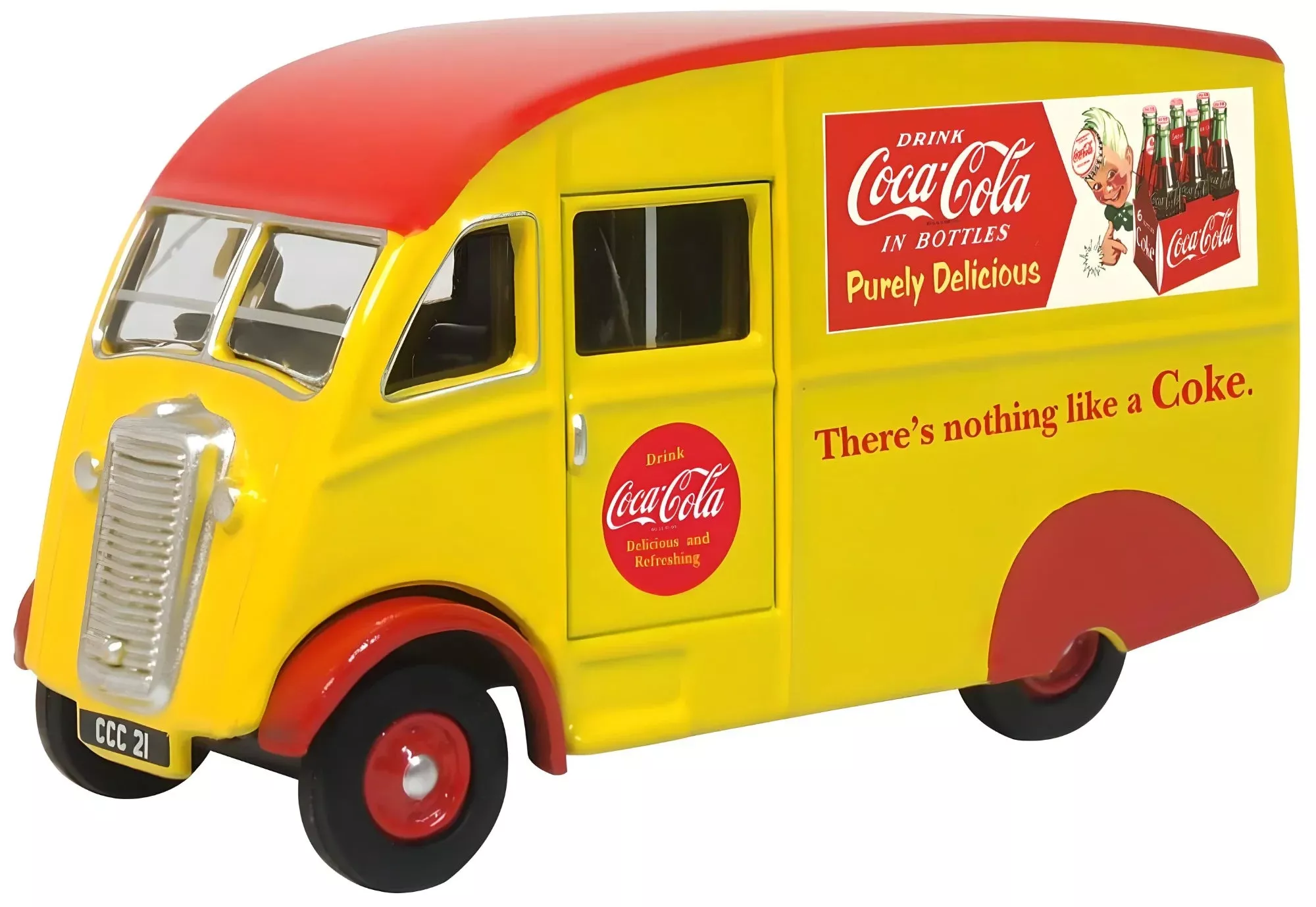
Manufacturer catalogue image - please note that pre-release images may be CAD renders or CGI/AI images rather than photographs
Prototype Eras
Era 3 (1923 to 1947) The Big Four (LNER, LMS, GWR and SR)
Era 4 (1948 to 1956) British Railways Early Crest
Era 5 (1956 to 1966) British Railways Late Crest
Era 6 (1967 to 1972) British Rail Blue (Pre-TOPS)
Manufacturer description
The Commer Q25 joins our range of Coca Cola vehicles. Just over 6cm in length it comes in a Coca Cola wrap on a plinth with a clear case lid. This refreshing model is a colourful reminder of how long the most famous drink in the world has been going and how its image has evolved over the years.
Commer Cars Ltd, founded in 1905, was a British manufacturer of commercial vehicles from that date right up to 1979, including light vans, medium to heavy commercial trucks, military vehicles and buses. The company had mixed fortunes and was sold on several times, firstly to Humber before becoming part of the Rootes Group. Rootes were also taken over by Chrysler in the 1970s when the Commer name was replaced by Dodge.
The Commer Q25 was a 25 cwt van was manufactured between 1939 and 1949. It was a popular choice for delivery vehicles due to its reliability, fuel efficiency, and ease of maintenance.The Q25 was powered by a 1,509 cc side-valve four-cylinder engine that produced 35 bhp at 3,000 rpm. It had a four-speed manual gearbox and a top speed of around 60 mph. The van had a payload capacity of 25 cwt (1,270 kg) and was available in a variety of body styles, including van, minibus, and ambulance.It was used by a wide range of businesses and organizations, including the British Army, Royal Mail, and Lyons Ice Cream. It was also a popular choice for private motorists who needed a reliable and versatile vehicle.
Our Q25 shows advertising featuring Sprite Boy who was a marketing character created by Coca-Cola in 1942 to help promote the company's Coca Cola drink. He was a sprite, or elf, with a mischievous grin and a twinkle in his eye. He was often depicted wearing a 'soda jerk's cap' or a hat designed to look like a Coca-Cola bottle cap.Sprite Boy appeared in Coca-Cola advertising throughout the 1940s and 1950s. He was seen on billboards, posters, and even in animated commercials. He was also featured on a variety of Coca-Cola merchandise, including toys, games, and dishes.In 1958, Coca-Cola phased out Sprite Boy from its advertising. However, he remains a popular figure among Coca-Cola collectors and fans. In 1961, Coca-Cola introduced a new lemon-lime drink called Sprite. The name Sprite was chosen because the company already had the legal rights to it, thanks to Sprite Boy.
Catalogue listing
Supplier Links


Supplier links are provided for your convenience and do not guarantee that the product is currently available. RailwayModels.uk is not a representative of these suppliers, but may receive a commission when purchases are made through links on this page.
Oxford Diecast Commer Q25 Van – Coca‑Cola livery, 1:76 scale (approximately 6 cm in length). The model carries the manufacturer part number 76CM010CC and is presented in a Coca‑Cola wrapped plinth with a clear‑case lid.
The van reproduces the Commer Q25, a 25 cwt (1 270 kg) commercial vehicle built between 1939 and 1949. It was powered by a 1 509 cc side‑valve four‑cylinder engine producing 35 bhp at 3 000 rpm, fitted with a four‑speed manual gearbox and capable of around 60 mph. The Q25 was offered in several body styles – van, minibus and ambulance – and was used by organisations such as the British Army, Royal Mail and Lyons Ice Cream, as well as by private owners.
The Coca‑Cola graphic depicts “Sprite Boy”, a marketing character introduced by the company in 1942. Sprite Boy appeared on advertising and merchandise throughout the 1940s and 1950s before being retired in 1958. The character’s association with Coca‑Cola later enabled the brand to launch the lemon‑lime drink Sprite in 1961.
The model is supplied in a sealed clear case on a branded plinth, making it a concise representation of both the historic Commer commercial van and the evolution of Coca‑Cola’s visual branding. It is suitable for collectors of die‑cast models, railway memorabilia and vintage advertising.