Oxford Diecast 76ALV004
British Racing Green Alvis Speed Twenty Cross & Ellis
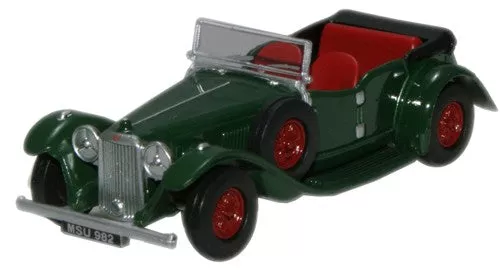
Manufacturer catalogue image - please note that pre-release images may be CAD renders or CGI/AI images rather than photographs
Prototype Eras
Era 3 (1923 to 1947) The Big Four (LNER, LMS, GWR and SR)
Era 4 (1948 to 1956) British Railways Early Crest
Manufacturer description
The Speed 20 Alvis was manufactured between 1932 and 1936, across four variants A-D. During its lifetime, only 1185 were made in total, 400 of which were on the first Speed 20 SA. The car had superseded the Silver Eagle and retained some similarities but was also extensively modified to give it some oomph! The updated version included a new chassis, engine refinements and improved brakes and suspension. The result was a 'tourer' capable of up to 89 mph. The large Lucas 12" headlamps became standard; the car featured a long running board . The forward four door saloon version was generally Charlesworth, whereas the sporty tourer coachwork came from Cross and Ellis, whose design we have taken for our miniature version. This model has the registration MSU 982 and is colored British Racing Green.
Catalogue listing
Supplier Links


Supplier links are provided for your convenience and do not guarantee that the product is currently available. RailwayModels.uk is not a representative of these suppliers, but may receive a commission when purchases are made through links on this page.
Oxford Diecast Alvis Speed Twenty model, finished in British Racing Green and featuring Cross & Ellis coachwork.
The miniature represents a vehicle from the period known as the Big Four (LNER, LMS, GWR and SR). The real Speed Twenty was built between 1932 and 1936 in four variants (A‑D). A total of 1,185 cars were produced, of which 400 were the original Speed Twenty SA. The model reflects the tourer version, capable of up to 89 mph, with a new chassis, refined engine and improved brakes and suspension. Standard Lucas 12‑inch headlamps and a long running board are included.
This die‑cast version carries the registration MSU 982, is painted in British Racing Green and bears the Oxford Diecast part number 76ALV004. The coachwork is based on the Cross & Ellis design rather than the Charlesworth four‑door saloon.