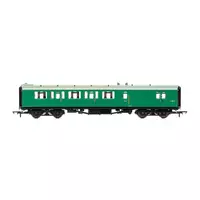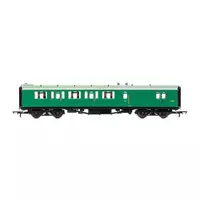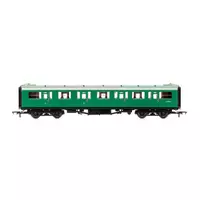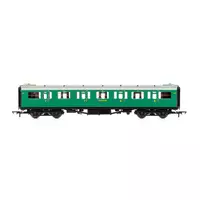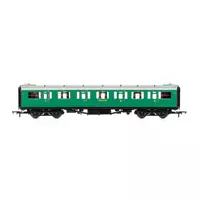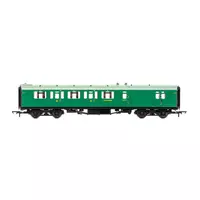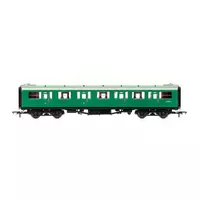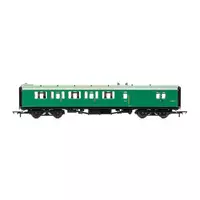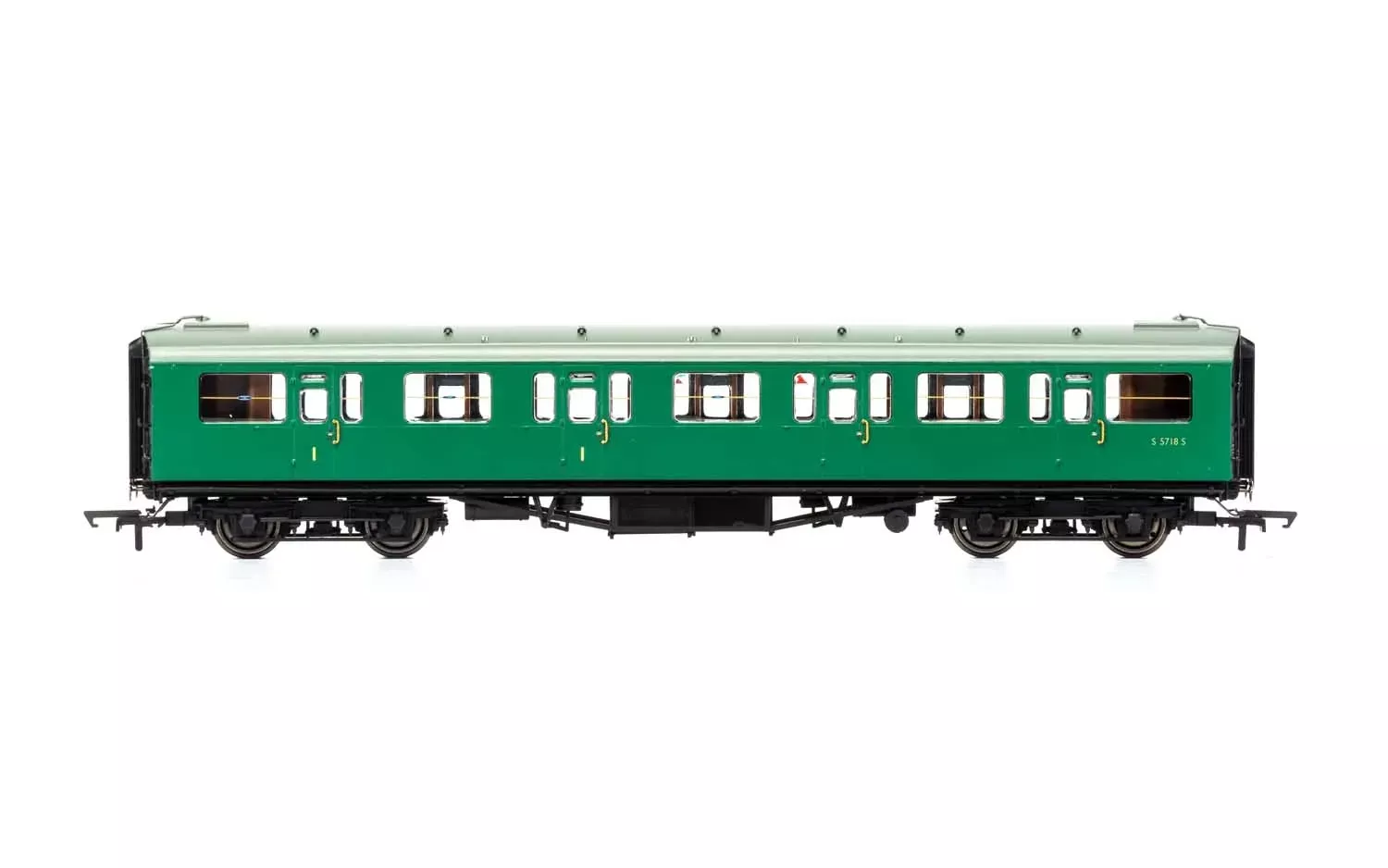
Manufacturer catalogue image - please note that pre-release images may be CAD renders or CGI/AI images rather than photographs
Prototype Era
Era 4 (1948 to 1956) British Railways Early Crest
Manufacturer description
When Oliver Bulleid took over as Chief Mechanical Officer of the Southern Railway following Richard Maunsell's retirement, the General Manager and Board were already aware that the SR's mainline coaching stock lagged behind the standards set by the other three Railway companies. In 1938, with the assistance of his Technical Assistant, L. Lynes, Bulleid began design work for new steam-hauled stock for the Bournemouth and Weymouth services, placing the order for fifty four 57' 11" underframes with Lancing Works.
With the onset of the Second World War, the supply of bodies for these was put on hold and it was not until 1944 before the orders for the bodies could be placed, the first of these being finished at Eastleigh Works in November 1945. Featuring a smooth, continuously curved bodyside, with small fixed windows above the door windows, the exterior was distinctly Bulleid in character and was a perfect match for his streamlined Pacifics and Light Pacifics.
However, the interim nature of the design was apparent in the retention of Maunsell's underframe and layout, with side doors providing access to each compartment. Two types of stock were built; a Composite of four First, and three Third Class compartments to Diag. 2316 and a Brake Third of five compartments, with a 22' long brake van to Diag, 2121.
The last coaches were withdrawn in July 1967, at the end of Southern steam. The first withdrawals started in December 1963, leaving just Sets 964/967/968/976 and 980 until 1965, when further withdrawals left just twenty loose coaches.
Catalogue listing
Model details
Prototype information
Supplier Links



Supplier links are provided for your convenience and do not guarantee that the product is currently available. RailwayModels.uk is not a representative of these suppliers, but may receive a commission when purchases are made through links on this page.