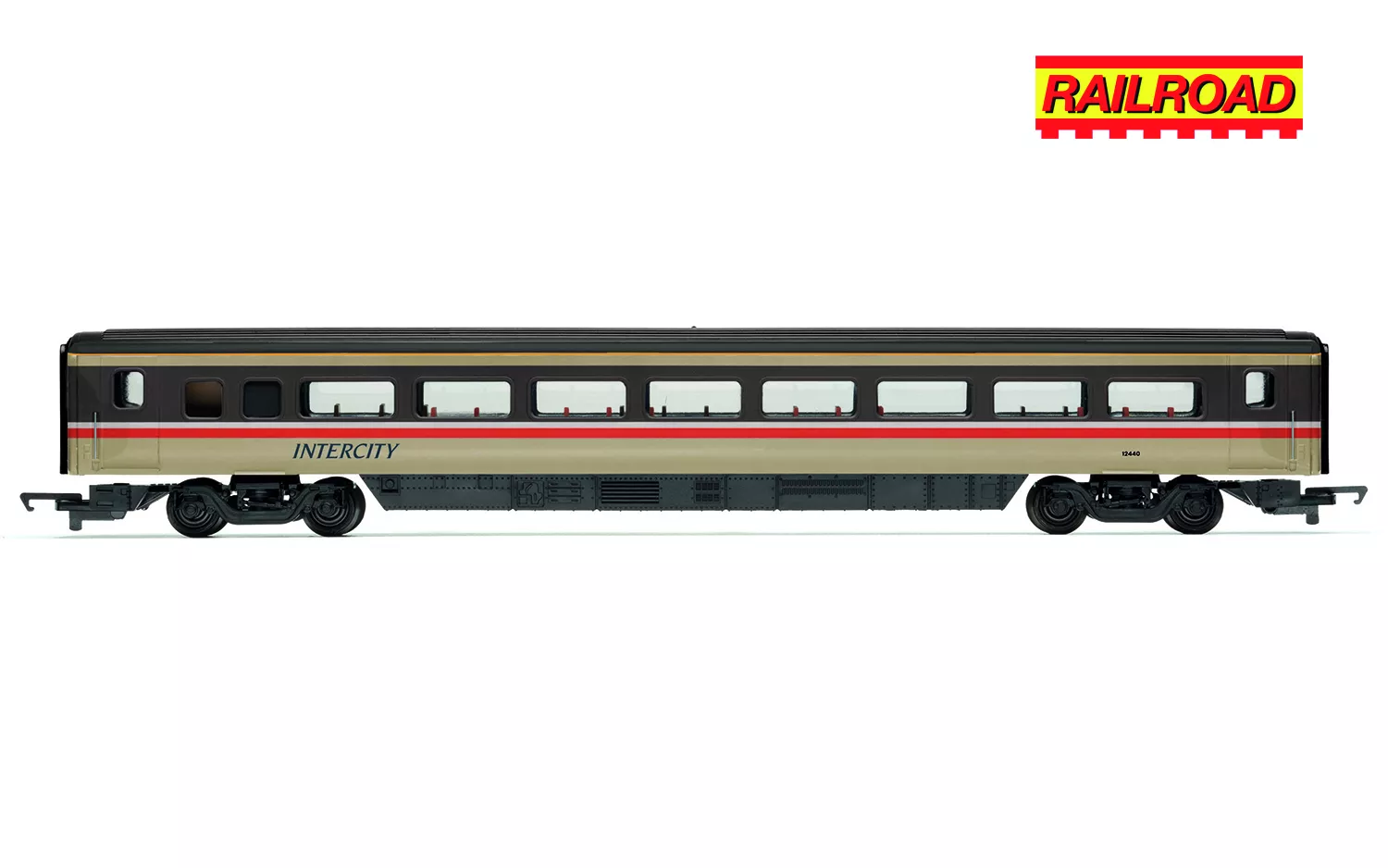
Manufacturer catalogue image - please note that pre-release images may be CAD renders or CGI/AI images rather than photographs
Prototype Era
Era 8 (1983 to 1994) British Rail Sectorisation
Manufacturer description
Following on from the Mk3 coach, the Mk4s were built between 1989 and 1992 at Metro-Cammell’s Washwood Heath facility for the newly-electrified InterCity 225 services on the East Coast Main Line.
A total of 282 carriages were built, to maintain a fleet of 30 fixed formations. Each comprised of nine vehicles, operating with a Class 91 locomotive and a Driving Van Trailer on the other end to allow trains to operate in both directions without needing to turn the locomotive.
The Mk4 is an all-steel design which incorporates a number of improvements over the previous Mk3s. Most notably, the inclusion of automatic push-button operated plug-type doors in place of the manually-operated slam doors. The body shells, which were built by BREL and Breda in Milan, also have fully sealed gangways and controlled emission toilets (CETs).
This OO gauge coach model is a replica of a Second Class (Trailer Second) open coach in BR InterCity livery.
Catalogue listing
Model details
Prototype information
Supplier Links



Supplier links are provided for your convenience and do not guarantee that the product is currently available. RailwayModels.uk is not a representative of these suppliers, but may receive a commission when purchases are made through links on this page.