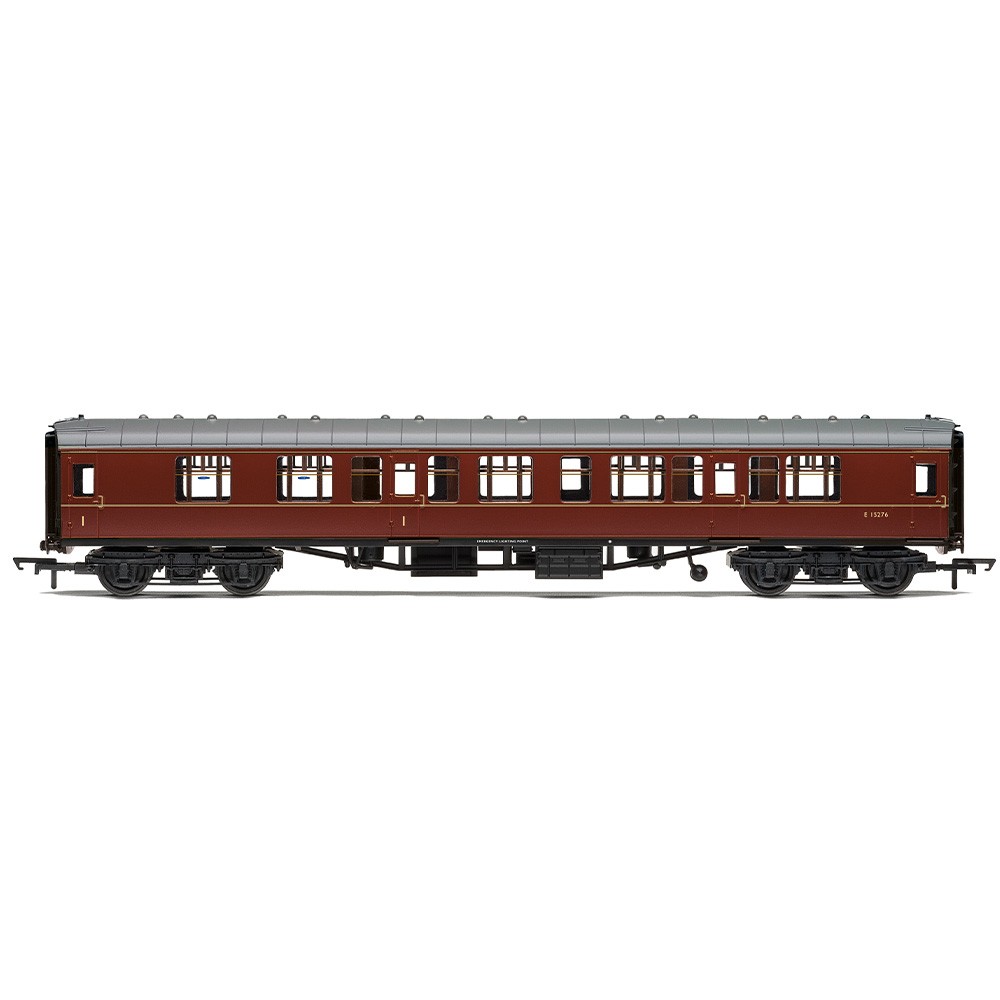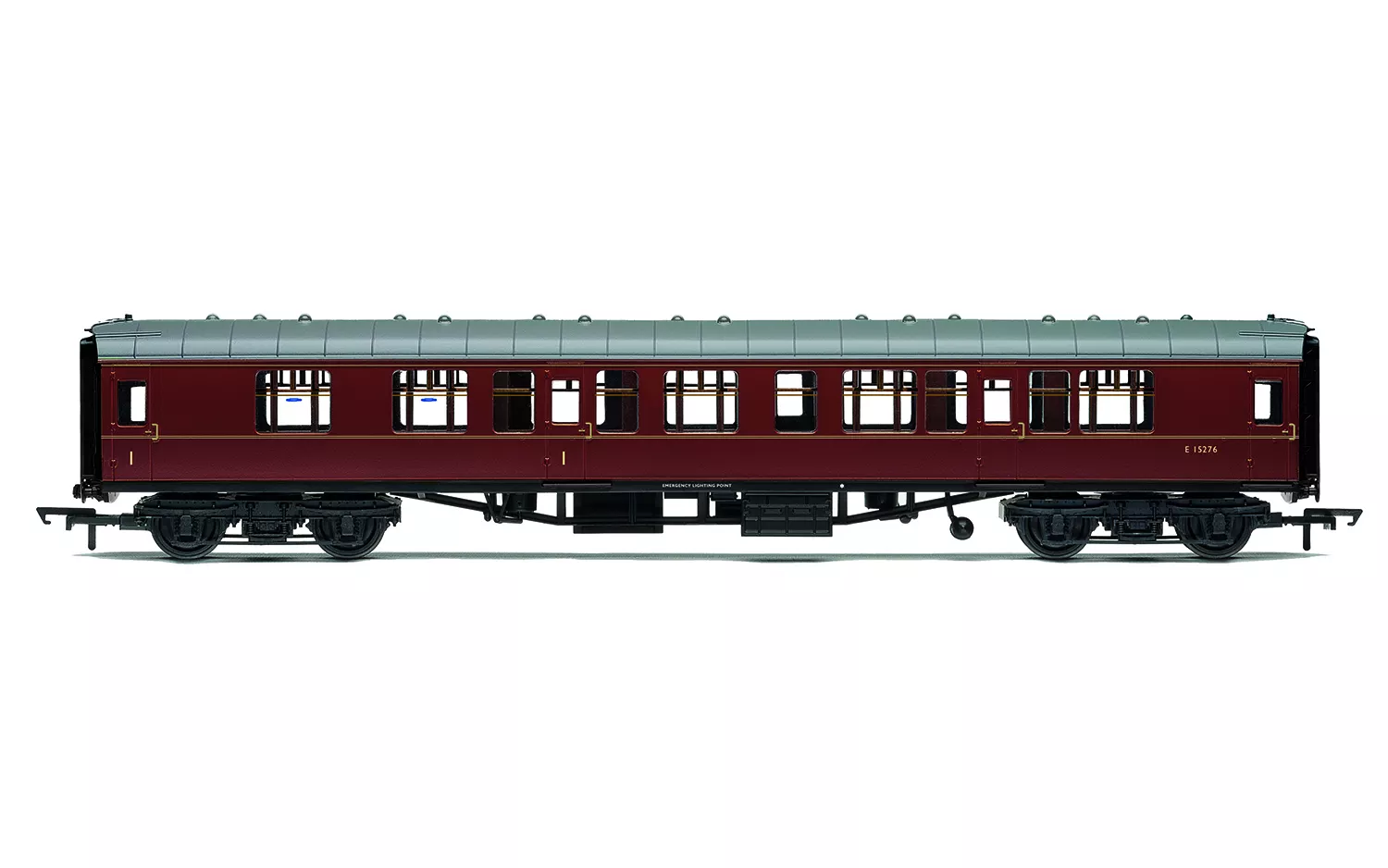
Manufacturer catalogue image - please note that pre-release images may be CAD renders or CGI/AI images rather than photographs
Prototype Eras
Era 4 (1948 to 1956) British Railways Early Crest
Era 5 (1956 to 1966) British Railways Late Crest
Manufacturer description
The MK1 was BR’s first standardised design of railway carriage with thousands built across BR’s carriage works in Derby, Wolverton, Doncaster, York, Eastleigh, and Swindon between 1951 and 1963. The design was also used on first generation Diesel Multiple Units (DMUs) until 1974 and for non-passenger stock such as parcel vans and full brake vehicles.
The new coaches gradually replaced older designs inherited from the ‘Big Four’ at nationalisation in 1968 and were used on all British Railways regions. The standard underframe length was 63ft 5in (19.33m) with gangwayed bodies 64ft 6in (19.7m), though suburban coaches and parcel vans were shorter.
Coaches were either fully open or were corridor coaches with seating compartments. Bodywork was of steel panels on wooden frames, with a separate underframe consisting of heavy steel sections braced with steel trusses, originally mounted on ‘BR1’ bogies, though these were superseded by a new cast-steel design from 1958 known as the ‘Commonwealth’ bogie. Later examples utilised a Swindon-designed ‘B4’ bogie which gave a much-improved ride and was adopted for use on Southern Region MK1 Electric Multiple Units (EMUs).
This is a highly detailed OO gauge scale model of a corridor composite coach from the Eastern Region.
Catalogue listing
Model details
Prototype information
Supplier Links



Supplier links are provided for your convenience and do not guarantee that the product is currently available. RailwayModels.uk is not a representative of these suppliers, but may receive a commission when purchases are made through links on this page.