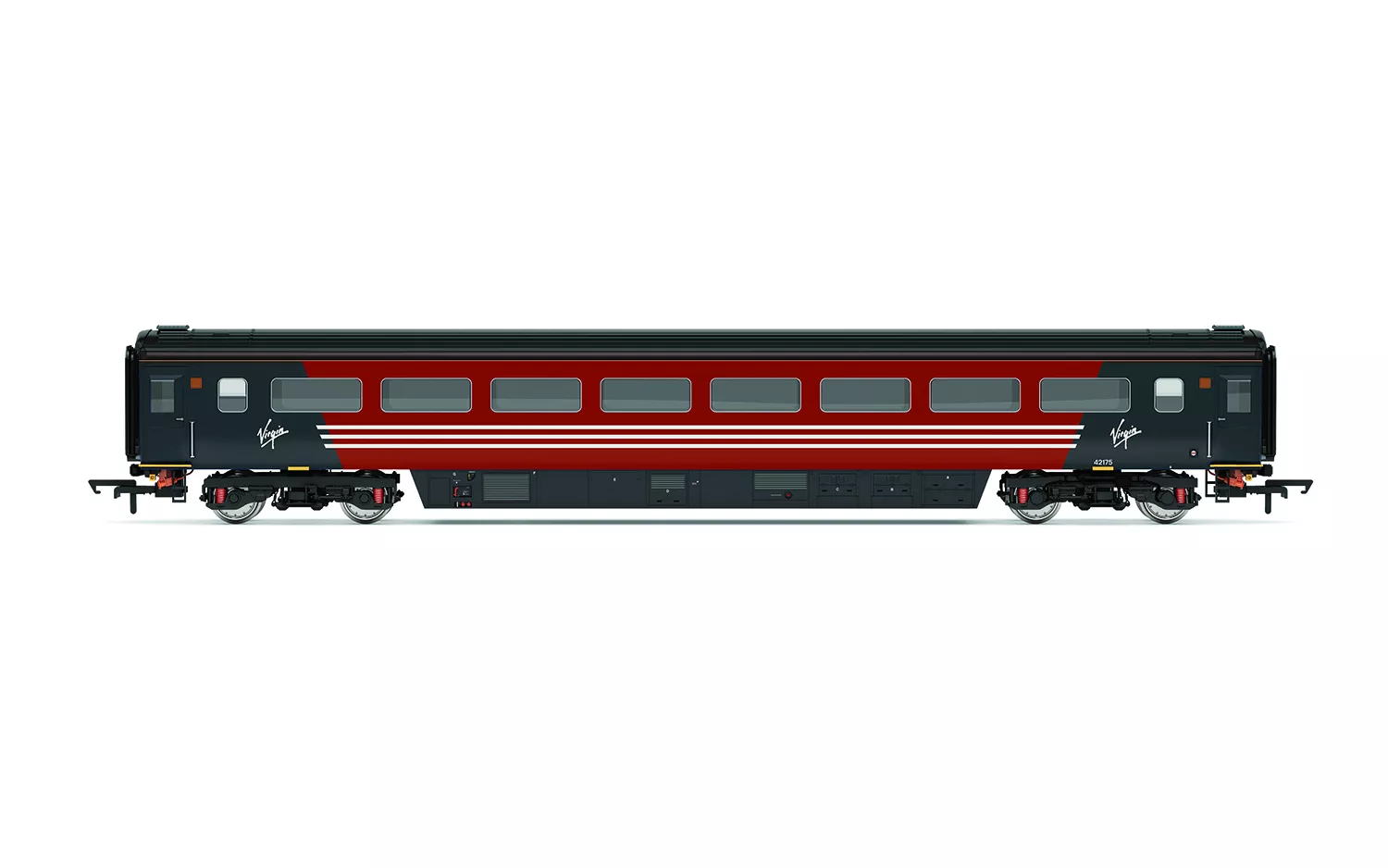
Manufacturer catalogue image - please note that pre-release images may be CAD renders or CGI/AI images rather than photographs
Prototype Era
Era 9 (1995 to 2004) Initial Privatisation
Manufacturer description
British Rail introduced the production version of the Mk3 coach in 1975 with improved standards of comfort in response to competition from airlines and increased use of private motor cars.
Designed and built by BREL, they were initially intended as locomotive-hauled stock, but with the development of the High Speed Train (HST), were soon adapted for use at speeds of up to 125mph (220km/h). The first version of the Mk3 coach had actually been built in 1972, with ten coaches produced for the prototype HST.
Mk3 coaches continued to be built until 1988, but multiple units based on the Mk3 body shell were built until the early 1990s. The standard length of a Mk3 coach is 75ft (23m), which is ten feet longer than its predecessor, the Mk2, and is of monocoque construction with an all-welded mild steel stressed skin.
Virgin operated several sets of these coaches for use with its HST power cars. Following introduction of its Pendolinos, most of Virgin’s Mk3 coaches moved on to other operators, though it did retain one set for peak time cover and had them refurbished at Doncaster and painted into the same livery as its Pendolino and Voyager trains. However, these too were stood-down in November 2014 when they were transferred to Abellio Greater Anglia.
This highly detailed OO gauge model coach is based on the ‘TS’, a Trailer Second coach with an open plan seating area for second class passengers.
Catalogue listing
Model details
Prototype information
Supplier Links



Supplier links are provided for your convenience and do not guarantee that the product is currently available. RailwayModels.uk is not a representative of these suppliers, but may receive a commission when purchases are made through links on this page.