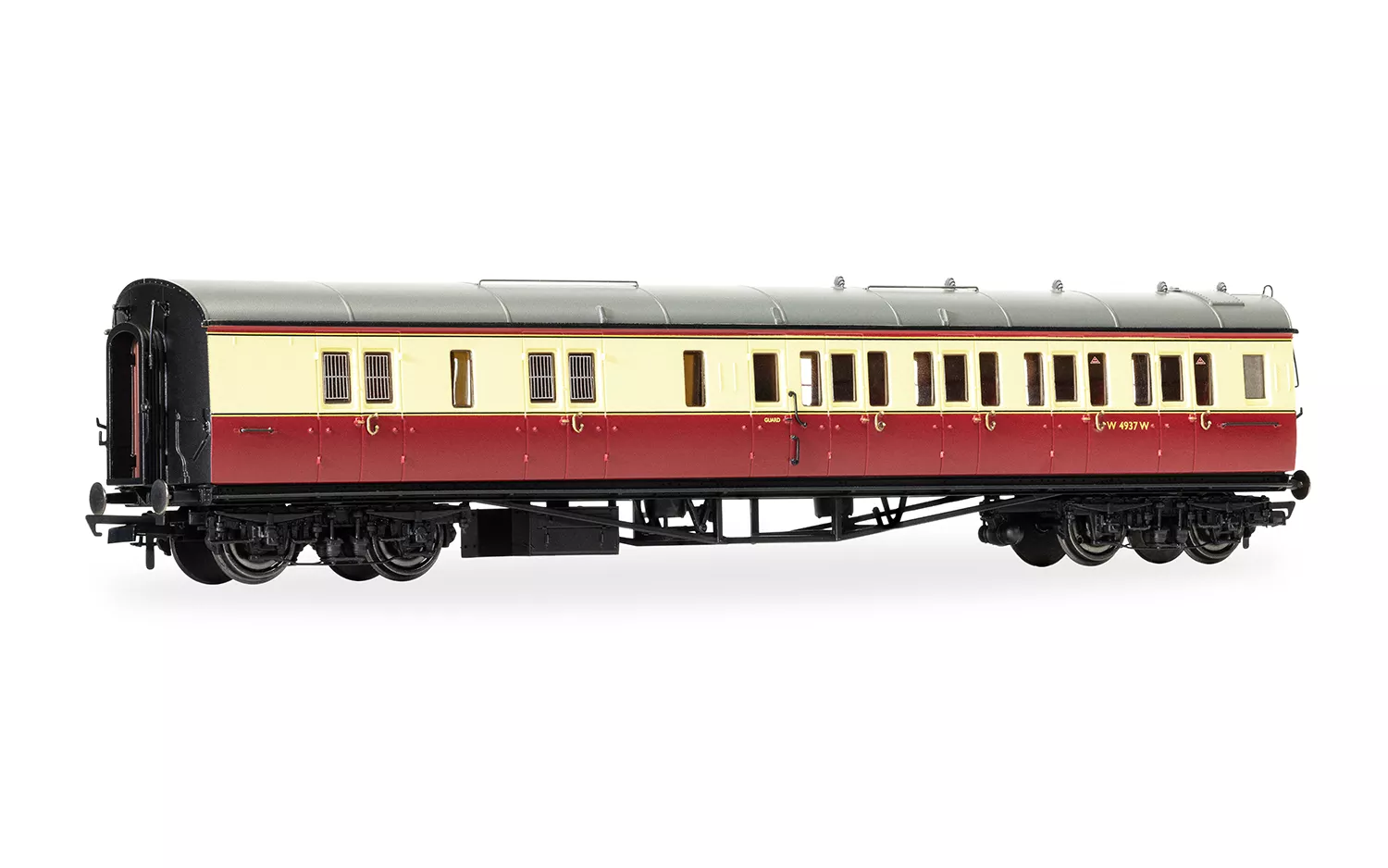
Manufacturer catalogue image - please note that pre-release images may be CAD renders or CGI/AI images rather than photographs
Prototype Era
Era 4 (1948 to 1956) British Railways Early Crest
Manufacturer description
Although introduced onto the GWR by Collett from 1925, many of these modern-for-their-time coaches lasted in service until the 1960s, with many examples passing into departmental use. Some retained their chocolate and cream livery after nationalisation of Britain’s railways in 1948 and others were painted in the new owner’s crimson and cream.
These wooden-framed, but steel-panelled ‘bow-ended’ coaches were also ‘handed’ in a throw-back to the days they were introduced, when coach sets were marshalled with the compartments to the south (sunny) side and the corridors alongside London Paddington’s Platform 1 for ease of loading/unloading. For example, a left-hand brake coach would have its corridor on the opposite side to a right-hand brake.
This highly detailed model coach perfectly replicates the BR era, with sprung metal buffers and NEM couplings for a smooth train connection.
Catalogue listing
Model details
Prototype information
Supplier Links



Supplier links are provided for your convenience and do not guarantee that the product is currently available. RailwayModels.uk is not a representative of these suppliers, but may receive a commission when purchases are made through links on this page.