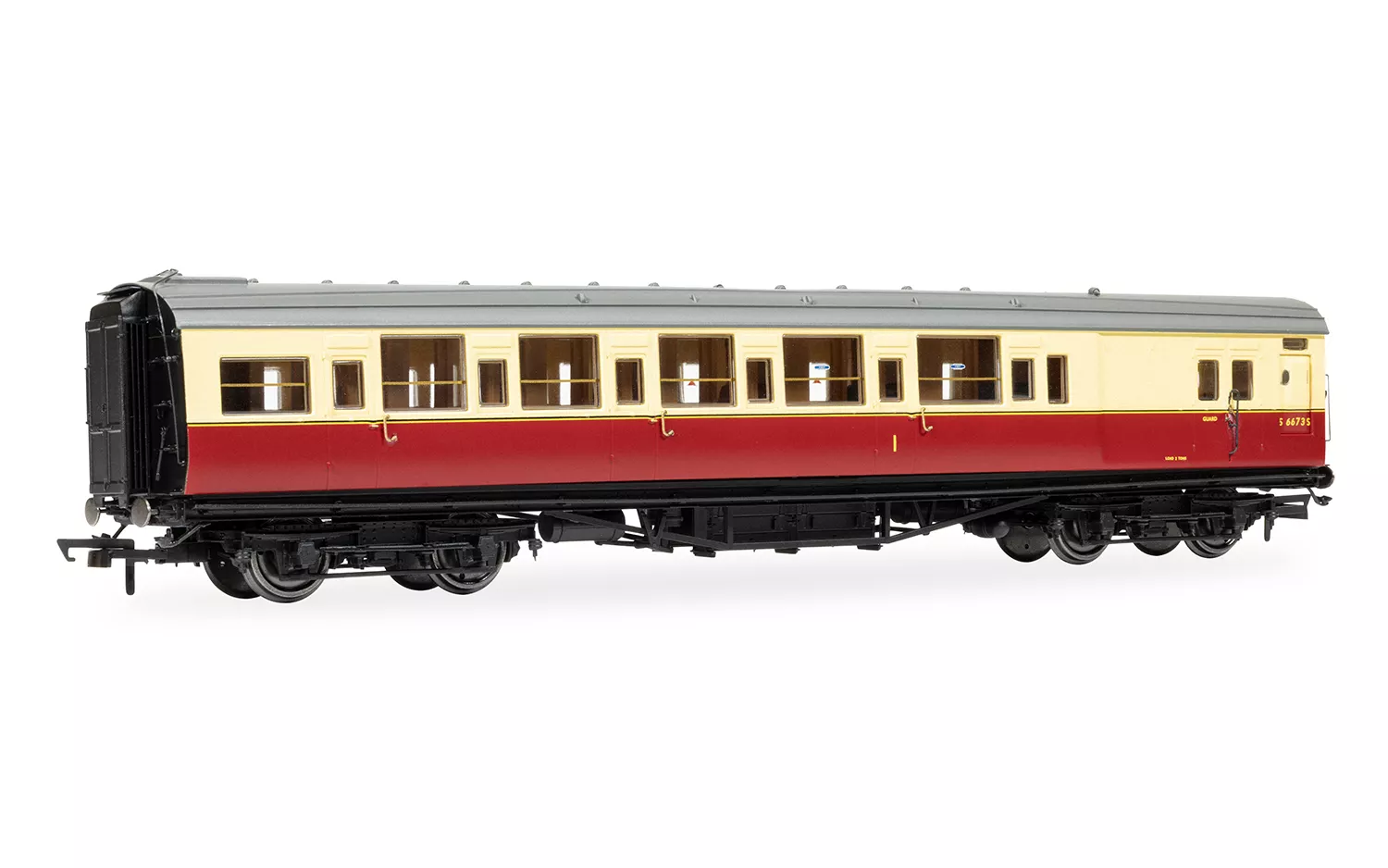
Manufacturer catalogue image - please note that pre-release images may be CAD renders or CGI/AI images rather than photographs
Prototype Era
Era 4 (1948 to 1956) British Railways Early Crest
Manufacturer description
When the Southern Railway was formed in 1923, it continued to build coach designs inherited from the main three constituent companies.
Richard Maunsell introduced the SR’s first ‘standard’ coaches, building over 1,200 of them. These were formed into 139 sets, as it was the SR’s practice to keep coaches together for long periods of time, with a set number at each end.
These replica coach models are the later 59ft type built from 1934 with flush sides, constructed with steel panels over a wooden framework. They were painted olive green in early SR days and, from 1939, in Bulleid’s malachite green, before most received the standard BR crimson and cream colouring following nationalisation in 1949.
These models have sprung metal buffers and NEM couplings for easy rake creation.
Catalogue listing
Model details
Prototype information
Supplier Links



Supplier links are provided for your convenience and do not guarantee that the product is currently available. RailwayModels.uk is not a representative of these suppliers, but may receive a commission when purchases are made through links on this page.