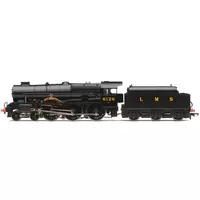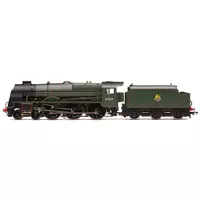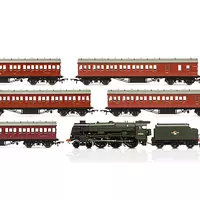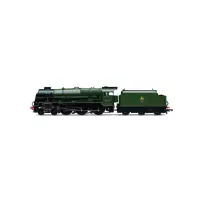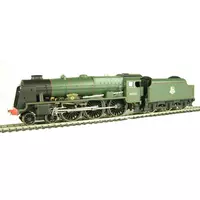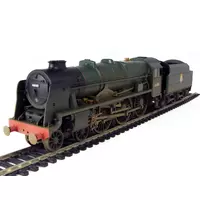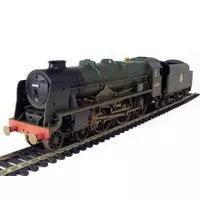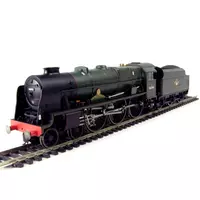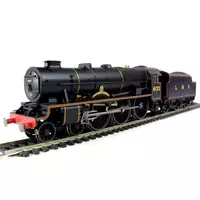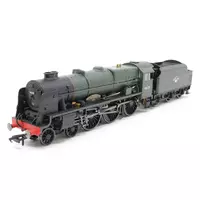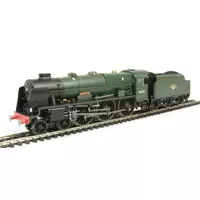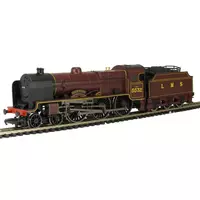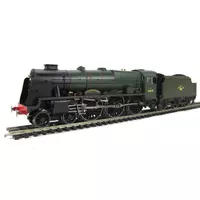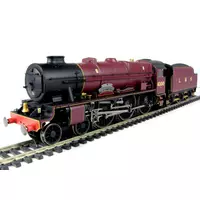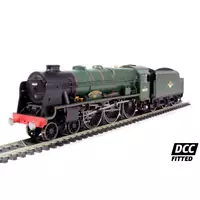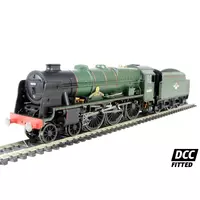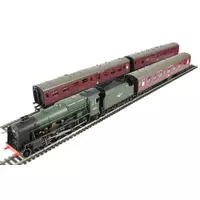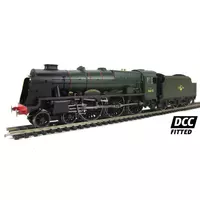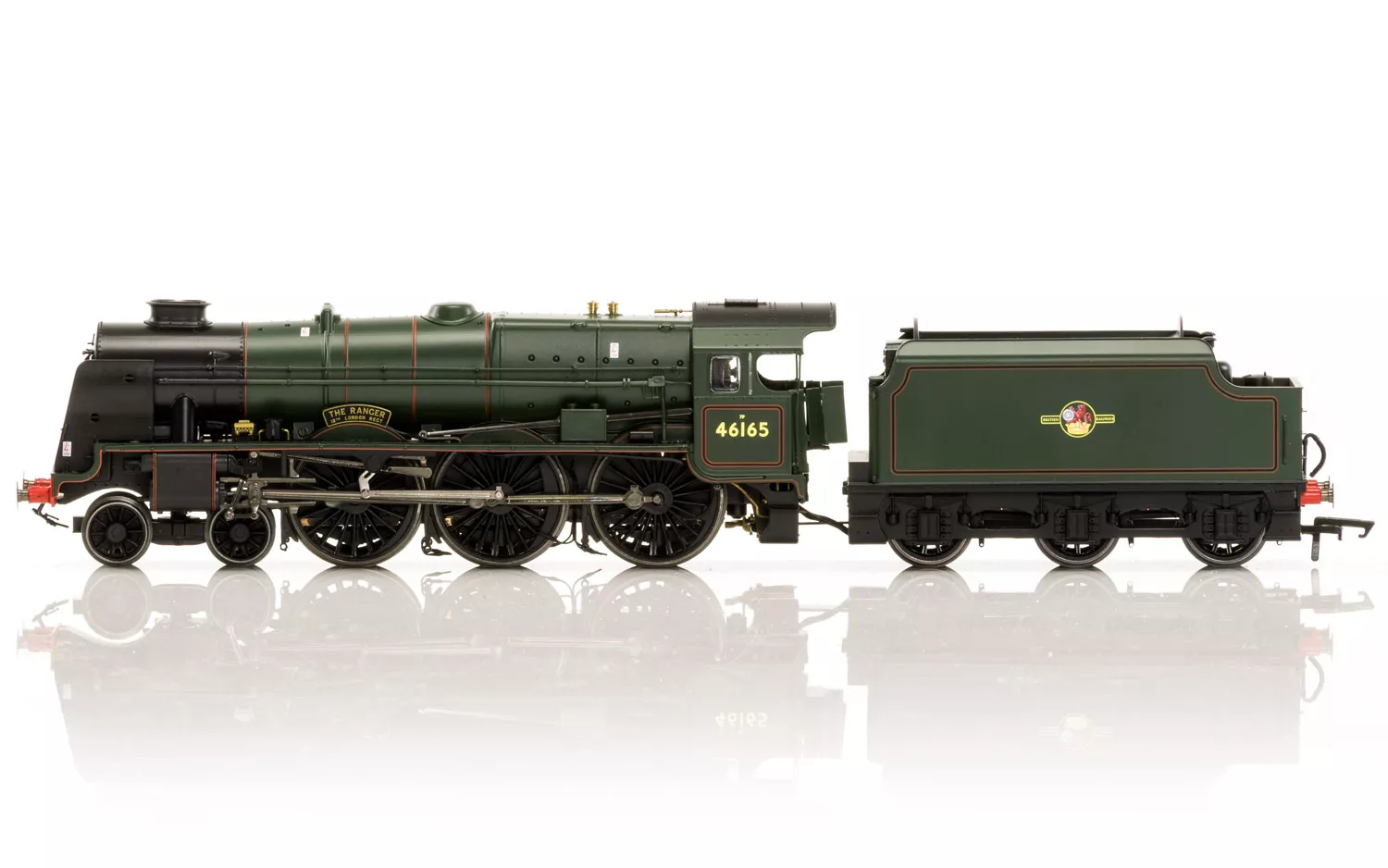
Manufacturer catalogue image - please note that pre-release images may be CAD renders or CGI/AI images rather than photographs
Prototype Eras
Era 4 (1948 to 1956) British Railways Early Crest
Era 5 (1956 to 1966) British Railways Late Crest
Manufacturer description
By 1926, faced with a stock book of outdated and unsuitable mainline locomotive traction, the London Midland Scottish Railway had an urgent need for provision of an improved and more powerful type of passenger engine for the purpose of avoiding double heading and duplication of certain heavy express passenger main line services.
In October 1926, following a degree of procrastination by the management of the LMS, the loan of Great Western Castle class No.5000 Launceston Castle spurred the LMS into action and in December, an order for fifty improved 4-6-0 tender engines from North British was placed; the result being the iconic 'Royal Scot' class of locomotive. Entry into service was expected by summer 1927, but with the GWR unwilling to lend drawings for the Castle class, Lord Nelson drawings were obtained from the Southern Railway and North British based their design around these, building them at both its Queens Park and Hyde Park works.
Sir Henry Fowler informed the LMS Board on July 27, 1927 that No.6100 was ready for inspection, suggesting that as the locomotive would be working the Royal Scot train, it would be appropriate that No.6100 should bear the same name. Trials between Euston, Carlisle, Crewe and Glasgow commenced and by late November 1927, Fowler was moved to comment that he was thoroughly satisfied with the results obtained. The public were also impressed, with over 172,000 visiting the various demonstrations of the new locomotives during 1927 and 1928, as well as being visited by both Royalty and celebrities of the time. Entry into traffic for the class increased from August 1927 and on September 26th, No.6100 Royal Scot embarked on the longest non-stop trip in the world, taking fifteen coaches the 299 miles from Euston to Carlisle. In 1930, twenty more locomotives were ordered, this time from the LMS Works at Derby and by 1932 the class was operating improved West Coast services at a greater speed, against heavier loading.
In 1932, William Stanier took over from Fowler as the LMS Chief Mechanical Officer and soon set about modifying the Royal Scot class, as they were experiencing a number of running problems that included axle box failures and bogie riding problems. Subsequently, other problems with the boilers, frames and cylinders were experienced and Stanier's answer was to rebuild the locomotives with a new, tapered 2A boiler, new frames and cylinders, from 1943.A result of this was that in 1948, two examples were chosen to take part in the locomotive exchanges, where they excelled and eventually, by 1955, the rest of the class were also modified.
Withdrawal of the class commenced in 1962, with 6100 Royal Scot and accelerated rapidly, being completed by the turn of 19660 with 6115 Scots Guardsman, these also being the sole preserved examples.46165 The Ranger (12th London Regiment) was built at LMS Derby and entered traffic at Longsight on October 22, 1930. On June 24, 1952, Ranger (12th London Regiment) received Stanier's tapered boiler, continuing in service until being withdrawn from Crewe North in November 1964.
Maximum curve Hornby 2nd radius + / 438mm+.
Catalogue listing
Model details
Prototype information
LMS, Derby Works
* Class names often change over the lifespan of a locomotive, so this is not necessarily the class name used by the operator in the period modelled.
Supplier Links



Supplier links are provided for your convenience and do not guarantee that the product is currently available. RailwayModels.uk is not a representative of these suppliers, but may receive a commission when purchases are made through links on this page.