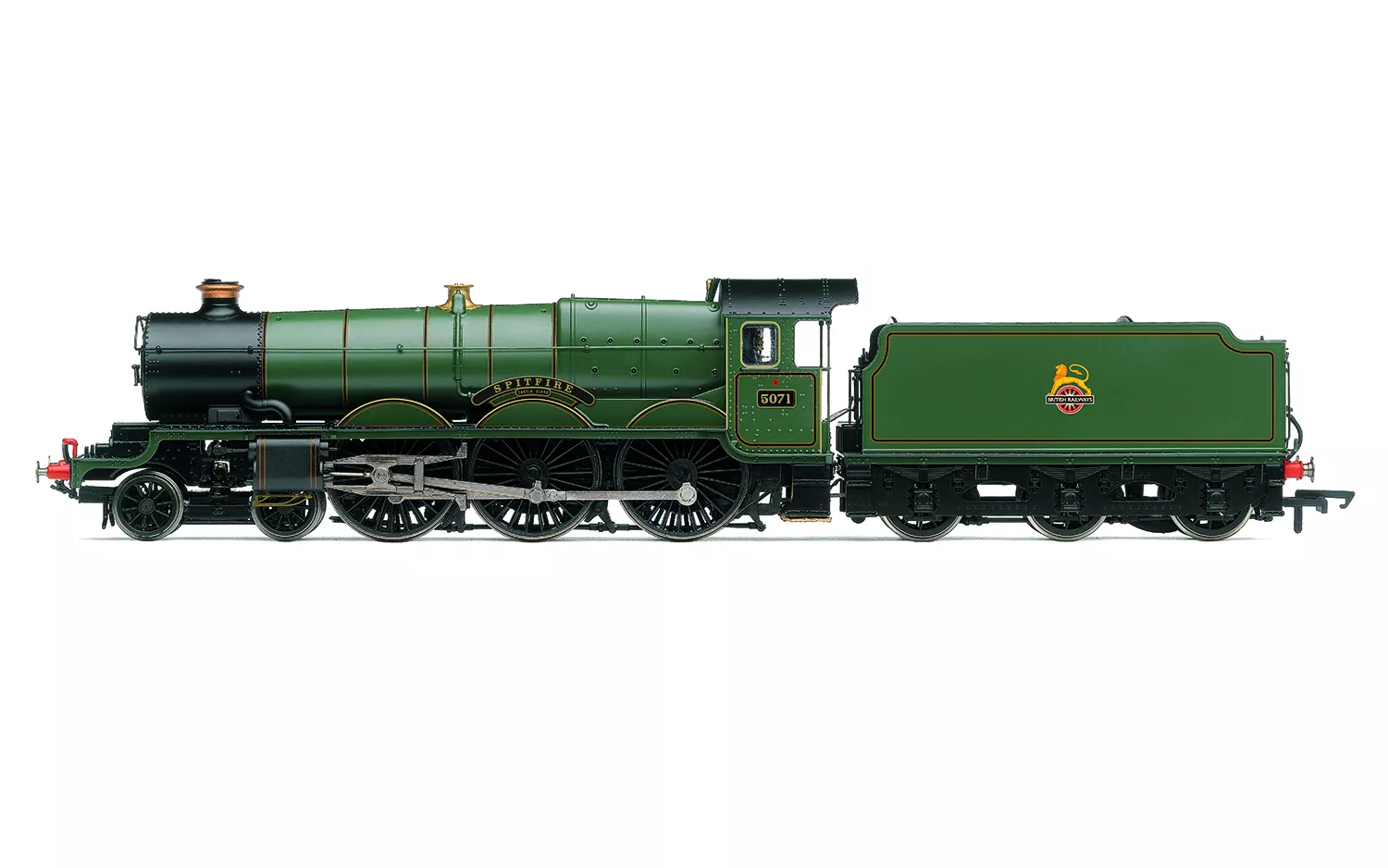
Manufacturer catalogue image - please note that pre-release images may be CAD renders or CGI images rather than photographs
Prototype Era
Era 4 (1948 to 1956) British Railways Early Crest
Manufacturer description
This locomotive entered service with the GWR at Newton Abbot in June 1938, initially named ‘Clifford Castle’, but this was changed to 'Spitfire' during the Second World War following the aeroplane’s pivotal role in the Battle of Britain during 1940.
It then spent most of its career shedded in the West Country, though after nationalisation, it had spells in the late 1950s at Gloucester and Worcester. The locomotive was fitted with a double chimney and four-row superheater in June 1959, before moving to St. Philip’s Marsh, Plymouth in February 1962, from where it was withdrawn in October 1963.
This detailed OO gauge model depicts 5071 in its original form, with a smart green livery. It also features sprung metal buffers, NEM tension lock couplings and a 21-pin socket, ready for upgrade to HM7000.
Product videos

Video links are generated algorithmically and may not necessarily be this precise product.
Catalogue listing
Model details
Prototype information
* Class names often change over the lifespan of a locomotive, so this is not necessarily the class name used by the operator in the period modelled.
Supplier Links



Supplier links are provided for your convenience and do not guarantee that the product is currently available. RailwayModels.uk is not a representative of these suppliers, but may receive a commission when purchases are made through links on this page.