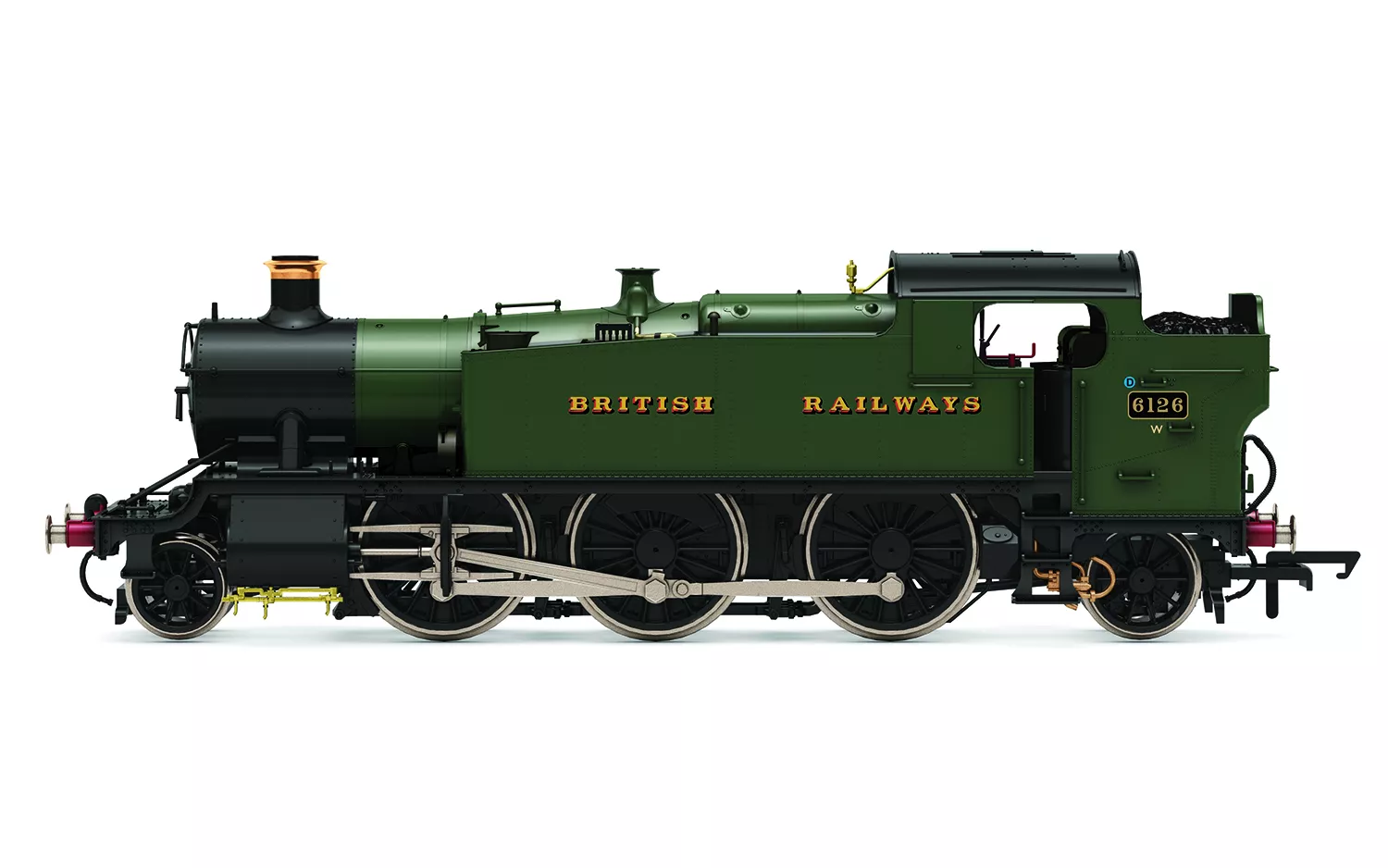
Manufacturer catalogue image - please note that pre-release images may be CAD renders or CGI/AI images rather than photographs
Prototype Era
Era 4 (1948 to 1956) British Railways Early Crest
Manufacturer description
A lovely addition to any OO gauge layout, this BR Class 61XX Large Prairie Locomotive is gorgeous in green. With sprung metal buffers and NEM tension lock couplings, this is a deligtful, highly detailed steam locomotive.
The ‘61XX’ Class was a direct development of the earlier ‘5101’ Class by Charles Collett, with a total of 70 locomotives turned out at Swindon Works between 1931 and 1935. The main difference was an increase in boiler pressure, which was raised to 225psi and gave a consequent increase in tractive effort.
No. 6126 entered service in October 1931 and spent much of its career based along the main Paddington to Bristol line, with postings at Slough, Southall, Reading, and Didcot. Its last shed was Oxford from May 1964, where it was withdrawn in December 1965 and sent for scrapping at Cashmore’s in Newport.
Product videos

Video links are generated algorithmically and may not necessarily be this precise product.
Catalogue listing
Model details
Prototype information
* Class names often change over the lifespan of a locomotive, so this is not necessarily the class name used by the operator in the period modelled.
Supplier Links


Supplier links are provided for your convenience and do not guarantee that the product is currently available. RailwayModels.uk is not a representative of these suppliers, but may receive a commission when purchases are made through links on this page.
