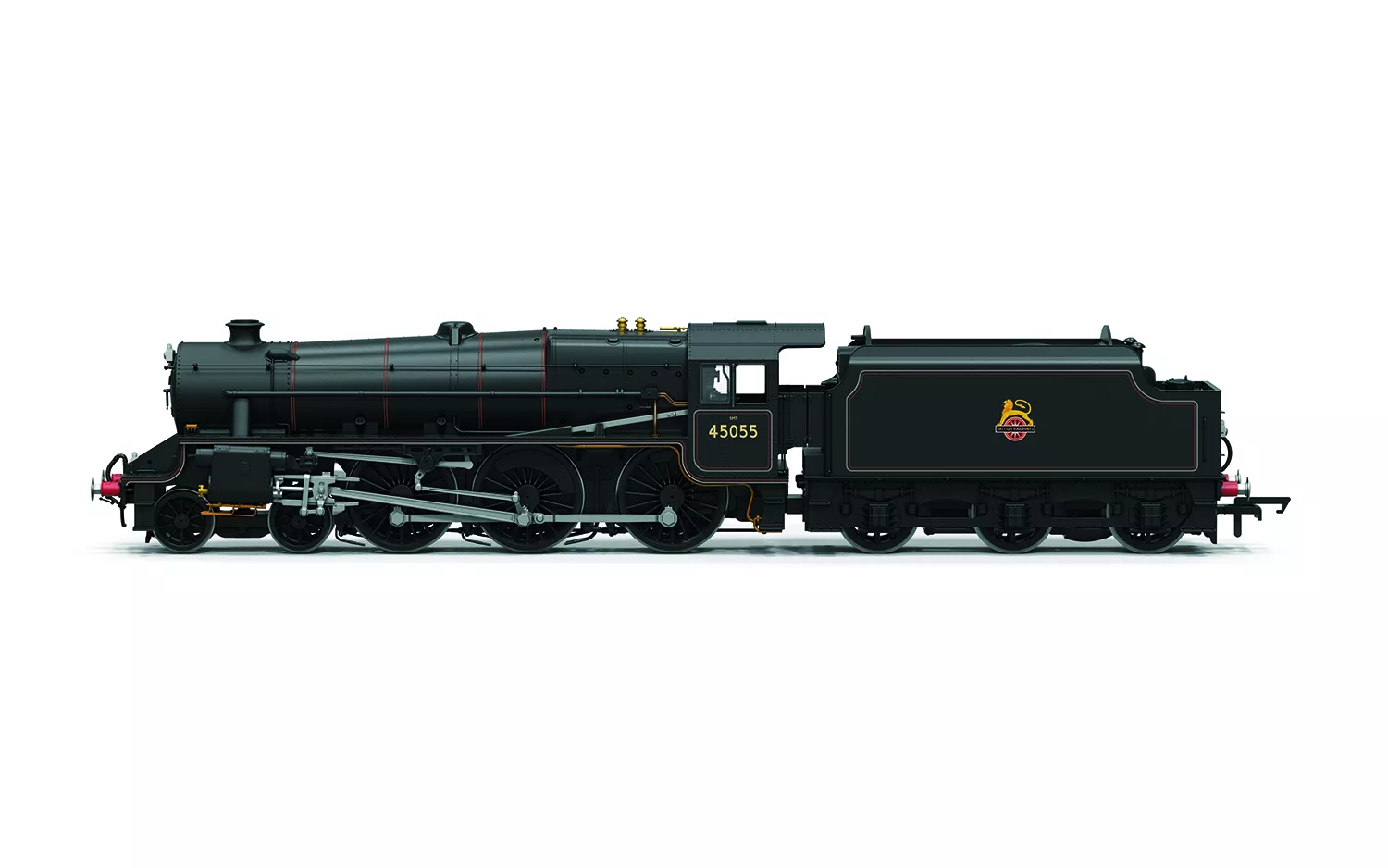
Manufacturer catalogue image - please note that pre-release images may be CAD renders or CGI/AI images rather than photographs
Prototype Era
Era 4 (1948 to 1956) British Railways Early Crest
Manufacturer description
Completed in November 1935, this ‘Black Five’ was built at Vulcan Foundry, near Newton-le-Willows in Lancashire.
It spent most of its working career in north-west England and North Wales, though in 1966 it had brief allocations at West Hartlepool and York, before moving back to the Liverpool area and serving at Bank Hall and then Aintree. It almost lasted to the end of steam, withdrawal coming a month shy on 6th July 1968 from Lostock Hall, Preston, with scrapping the following February.
This OO gauge locomotive model features sprung metal buffers and NEM tension lock couplings, and can be upgraded to HM7000 control with a 21-pin decoder (sold separately).
Specific to R30484
- Running number 45055
- BR Mixed Traffic livery
- Matt smokebox and cab roof finish
- 5MT long wheelbase configuration
- Flickering firebox
- Fluted die-cast connecting rods
- Walschaerts valve gear
- Parallel buffer stocks
Common Class 5MT features
- High detail OO gauge model based on extensive research and original works drawings
- Die-cast chassis and running plate. Model weight is 360 grams
- High detail cab and fully decorated backhead with decorated instrument dials
- HM7000 21-Pin Decoder socket
- HM7000 Power Bank compatible
- Powerful 5 pole skew wound motor
- Illuminated flickering firebox
- Illuminated head lamps and tail lamps (can be controlled using a DCC Decoder)
- Quick release locomotive to tender connector
- Pogo pin wheel pickup arrangement for easy pickup servicing
- Electrical pickups on main drive wheels and tender wheels
- Die-cast connecting rods and valve gear
- Prototypical size metal handrails with brass stanchions
- Brass main drive bearings
- Opening cab roof vent
- Adjustable cab doors
- Sprung metal buffers
- Front and Rear NEM coupling pocket
- Accessory bag contains tablet catcher, vacuum pipes, lamps and couplings
- Separately fitted lamps. Lamp code can be changed.
- Separately fitted simulated coal load.
Product videos

Video links are generated algorithmically and may not necessarily be this precise product.
Catalogue listing
Model details
Prototype information
* Class names often change over the lifespan of a locomotive, so this is not necessarily the class name used by the operator in the period modelled.
Supplier Links



Supplier links are provided for your convenience and do not guarantee that the product is currently available. RailwayModels.uk is not a representative of these suppliers, but may receive a commission when purchases are made through links on this page.