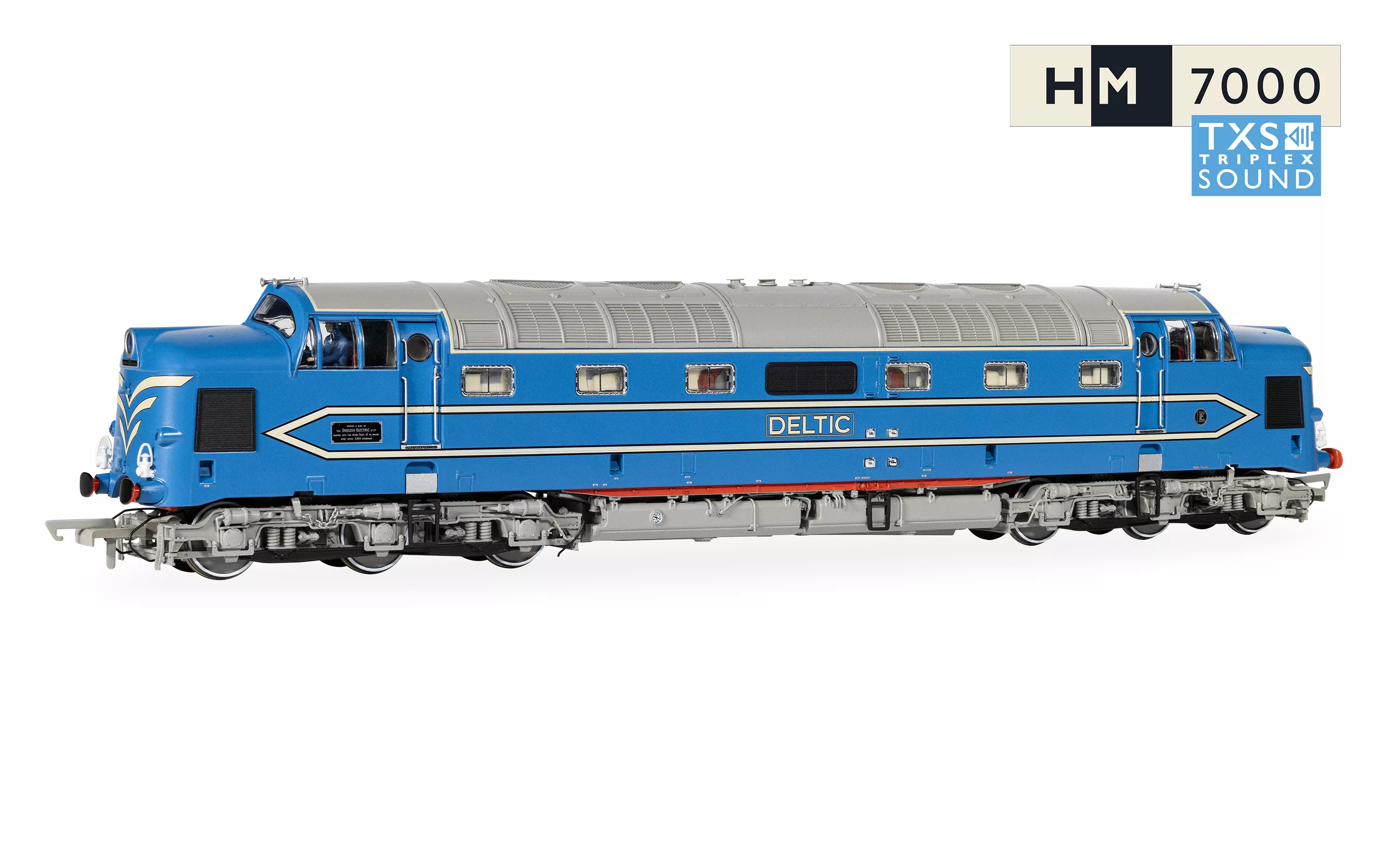
Manufacturer catalogue image - please note that pre-release images may be CAD renders or CGI/AI images rather than photographs
Prototype Era
Era 4 (1948 to 1956) British Railways Early Crest
Manufacturer description
The word 'Deltic' will likely mean different things to different people, as the word does mean a great many things. The Deltic was initially a valveless diesel engine designed to be fitted into some of the Royal Navy's smaller ships, such as the 'Dark' class of 1954.
These engines, or a version of them, were fitted to a test bed for a new class of British diesel engine in 1955, christened as DP1 but nicknamed 'DELTIC' after the engine. This nickname may have been enforced on the public by the designers of the locomotive, who had 'DELTIC' painted on the side of the model in the same cream as the lining nameplate style.
DP1 was in service with BR in its original colour scheme and condition until November 1960, when an enormous oil leak was discovered on one of the engines, something that could lead to terminal engine failure if not addressed. The locomotive was sent back to English Electrics works, however work on the locomotive was not given the go ahead, with the DP1 being officially withdrawn from BR's locomotive roster in 1961.
The locomotive was stored for a few years before being donated to the science museum in 1963. It has never run in preservation, largely because it has been inside on static display in various museums. And also because engine components were removed after the failure, with the engines fitted to the resulting Class 55 'Deltics' being sufficiently different enough to prevent the pool of BR spares being used.
In 2023, the Hornby Dublo Deltic model fills a hole in Hornby history, with the DP1 Deltic featuring on the cover of the 2nd edition catalogue in 1960, but never actually being made in physical form, unlike the Class 55 Deltic, which did receive a Hornby Dublo incarnation. This model is fitted with a die-cast body, 21 pin DCC decoder powering onboard sound, a 5 pole motor with dual flywheels and dual bogie drive. This is a Hornby Dublo model not to be missed.
DCC Fitted Deltic Features
- High detail OO gauge model based on extensive research and original works drawings
- Pre-installed with a 21-pin HM7000 decoder, with meticulously crafted Deltic sound profile
- As-built livery c.1955 with cream lining around roof, red chassis and buffer accents with black steps
- Heavy, fully die-cast chassis and body
- Highly detailed cab interior
- Decorated driver controls with illuminated instrument dials
- Directional head and tail lighting
- Working Mars lights
- Working cab lights
- Engine bay lighting
- Magnetic roof cover to access 21-pin DCC socket
- Dual working roof fans, with manually adjustable speed controls
- Separately fitted etched window frames
- Large, powerful coreless motor with two flywheels for smooth running
- Dual bogie drive
- Sprung metal buffers
- Front and rear NEM coupling pocket
- Additional lamps supplied in the accessory bag
- Hand-painted driver figures
- Supplied with six finely decorated etchings
- Decorated engine bay featuring printed ‘Napier Deltic’ plates
- Pre-fitted with sugar cube and EM1-type bass speakers
- Space inside fuel tank for a stay-alive
- Flange squeal sensor mounted in the bogies automatically detects when it is going round a curve to play flange squeal sounds dependant on speed.
Catalogue listing
Model details
Prototype information
* Class names often change over the lifespan of a locomotive, so this is not necessarily the class name used by the operator in the period modelled.
Supplier Links



Supplier links are provided for your convenience and do not guarantee that the product is currently available. RailwayModels.uk is not a representative of these suppliers, but may receive a commission when purchases are made through links on this page.