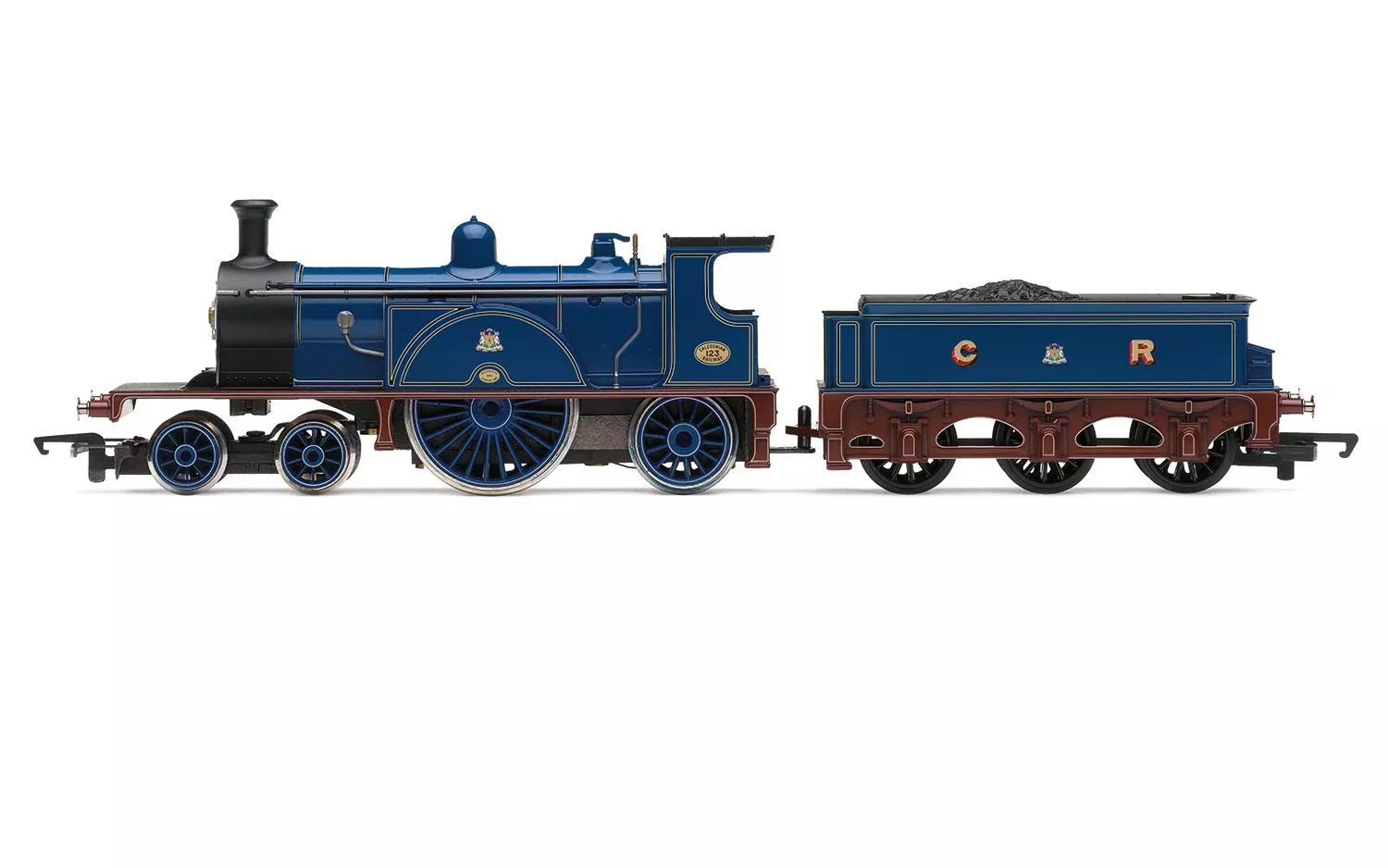
Manufacturer catalogue image - please note that pre-release images may be CAD renders or CGI/AI images rather than photographs
Prototype Era
Era 2 (1875 to 1923) Pre-grouping
Manufacturer description
The Caledonian Railway was the largest operator of steam locomotives in Scotland before the grouping act would see it be absorbed as part of the LMS in 1923. Prior to this it had its own identity and locomotive works with some of the worlds most notable 'single wheel' locomotives emerging from north of the Pennines. One such locomotive was No. 123, referred to as the Caledonian Single.
The Caledonian Single was an oddity, it was a locomotive built because it could be, not because it needed to be. While in effect it was a prototype, it was not a prototype in the sense it was a testbed for a further run of locomotives, but one built as a testament to what could be done. Built in 1886 as an exhibit for the International Exhibition of Industry, Science and Art, the locomotive was designed to represent the Caledonian Railway and the builder, Neilson and Company, with the locomotive receiving a gold medal at the exhibition.
Built as a 'Single' the locomotive had one set of driving wheels with a diameter of 7 foot, so successful was the design that it led to a brief resurgence in interest for the wheel configuration, which had been seen as being on the way out at the time that 123 was built. No.123 performed admirably during 'The Race to the North' a covert set of timed trials conducted by various railway companies utilising both the East and West Coast Main Lines, in order to determine who could traverse the route fastest.
It was a surprise that the Caledonian Railway offered this then new locomotive up to the challenge, but the locomotive was used, and performed honestly averaging a speed of between 50-59mph every day the locomotive would be used. This performance led to the development of the Great Western Railway's Achilles Class, before subsequent developments would lead to the supremacy of the Atlantic locomotives, and then the Pacifics.
Following the locomotives performance during the Race to the North, the locomotive would serve as the locomotive for the Caledonian Railway inspection saloon and managers train as well as assisting express trains over the fearsome Beattock Summit. The locomotive entered the service of the LMS as the grouping act came into effect, being renumbered 14010 and gaining the 1P power classification.
The locomotive would be withdrawn in 1935, wearing the LMS black livery, as the last single wheel locomotive in service in Britain. The locomotive is preserved, currently at the Riverside Museum in Glasgow.
In this pack, No.123 is paired with two Caledonian Style coaches. A pack of this specification has been seen multiple times throughout Hornby history, with the original one dating back to the Tri-ang era.
Catalogue listing
Model details
Prototype information
* Class names often change over the lifespan of a locomotive, so this is not necessarily the class name used by the operator in the period modelled.
Supplier Links


Supplier links are provided for your convenience and do not guarantee that the product is currently available. RailwayModels.uk is not a representative of these suppliers, but may receive a commission when purchases are made through links on this page.