Heljan RL3173
LNER Brown Electric Autocar No.3170 (1923-31)
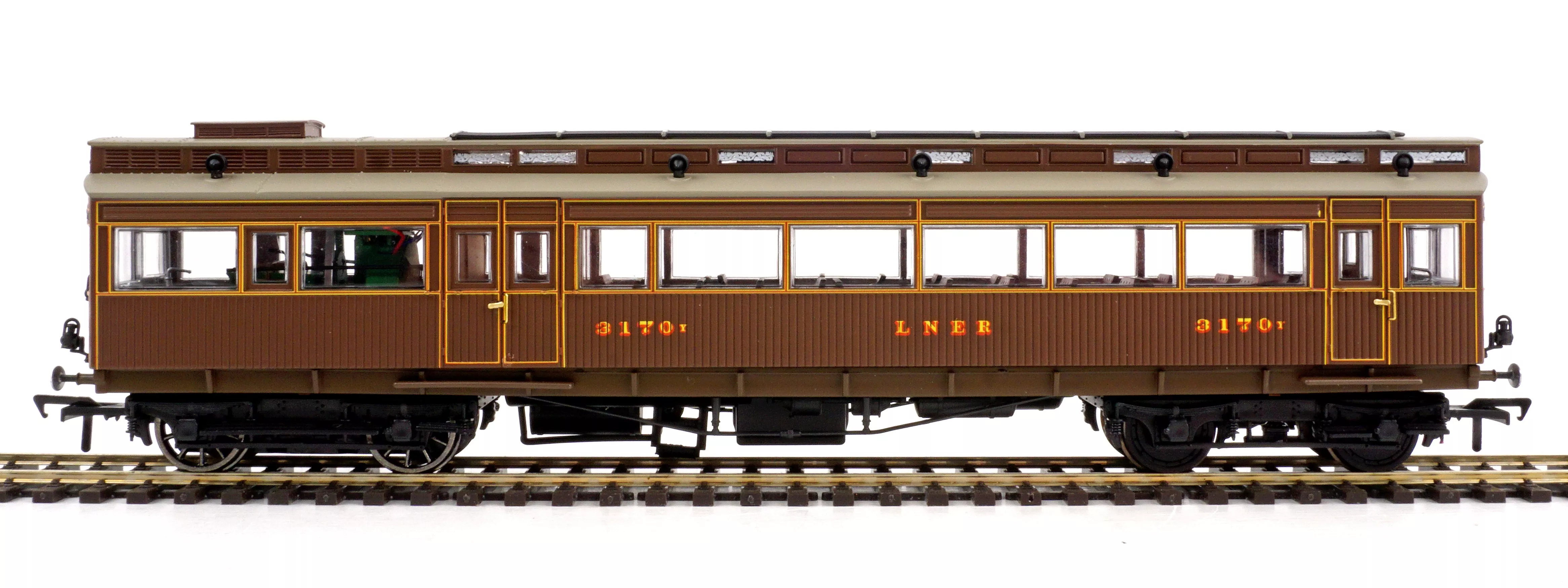
Manufacturer catalogue image - please note that pre-release images may be CAD renders or CGI/AI images rather than photographs
Prototype Era
Era 3 (1923 to 1947) The Big Four (LNER, LMS, GWR and SR)
Manufacturer description
NER ELECTRIC AUTOCAR – A WORLD FIRST AROUND the turn of the 19th and 20th century, many railway engineers were increasingly interested in the potential of electric traction. The initial focus was on urban transport, using trams and multiple units, but Wilson Worsdell and Vincent Raven of the North Eastern Railway saw even greater potential for electrically-powered rail vehicles.
In 1903, a pair of unusual railcars was unveiled by the NER, pioneers that would pave the way for future generations of self-powered passenger trains both in the UK and around the world.
Vincent Raven, the Assistant Chief Mechanical Engineer of the NER, was a forward-thinking designer who recognised the advantages of electric traction. The modern electric tramcars taking over the streets of Britain at this time showed that electric power provided superior acceleration and hill climbing ability over steam. Raven used this technology in his autocars but went a stage further. Instead of drawing electricity from overhead lines, as trams did, with all the expense and inconvenience that installing these involved, the autocars carried their own power plant – a petrol engine driving a dynamo which supplied power to the electric motors. It was the world’s first use of an internal combustion engine in a passenger carrying rail vehicle, but at the time the petrol engine was in its infancy and reliable diesel engines would not emerge until the mid-1930s. The two autocars, Nos. 3170 and 3171, were also fitted with electric track brakes, another first for the railways.
Although they are largely forgotten, it is hard to overstate the importance of these pioneering trains – they were 50 years ahead of their time. Initially the two autocars saw service between West Hartlepool and Hartlepool, in direct competition with electric tramcars. They later worked between Scarborough to Filey and proved extremely popular with passengers. Later, the autocars were transferred to the Selby-Cawood branch line in Yorkshire.
In 1923, No.3170 was fitted with a more powerful engine and new generator giving it sufficient power to pull a driving trailer carriage, thus increasing its passenger capacity. It worked in the Harrogate area for a while before rejoining its twin on the Cawood branch. No.3171 was withdrawn in 1930 and No.3170 in 1931.
That could have been the end of the story, but fortunately the body of No. 3170 was sold to a North Yorkshire landowner and converted into a holiday home. Fitted with a tin roof and veranda it was well protected from the weather and survived there until September 2003 when it was sold to carriage restoration specialist Stephen Middleton.
Over the last 15 years it has gradually been restored, reunited with appropriate running gear and returned to full working order. In October 2018, the world’s first combustion engined passenger vehicle made a triumphant return to action, albeit with a modern diesel power unit, closing a missing link in the history of British rail development. Our OO gauge models celebrate these historic vehicles, and the return of No. 3170 to working order in 2018. Models will feature fine detail and a host of features for the collector and operator to enjoy. They are being designed and manufactured by Heljan with the full co-operation of Stephen Middleton and The 1903 Electric Autocar Trust. Sales of the product will lead to a charitable donation to the Autocar Trust. – see www.electricautocar.co.uk for more information.
Catalogue listing
Model details
Prototype information
LNER
* Class names often change over the lifespan of a locomotive, so this is not necessarily the class name used by the operator in the period modelled.
Supplier Links
Special commissions are usually only available new from the commissioning organisation, and may well have sold out on pre-order before they even end up listed here! But you may be able to find used items on marketplace or auction websites.


Supplier links are provided for your convenience and do not guarantee that the product is currently available. RailwayModels.uk is not a representative of these suppliers, but may receive a commission when purchases are made through links on this page.
Heljan LNER Brown Electric Autocar No. 3170 (1923‑31) is a limited‑edition OO‑scale model released as part of the “Rails of Sheffield” range. It is finished in pristine condition, carries the manufacturer part number RL3173, and is ready to accept an 18‑pin DCC decoder. The model is built to 00 gauge, bears running number 3170, includes interior lighting and is powered by a petrol‑electric system. It represents the North Eastern Railway (later LNER) Petrol‑Electric Autocar class, one of only two such vehicles produced in 1903, and relates to the “Big Four” era of British railways.
The historic autocars were the world’s first passenger rail vehicles to use an internal combustion engine to drive a dynamo that powered electric traction motors. Introduced in 1903 by the North Eastern Railway, Nos 3170 and 3171 operated on routes such as West Hartlepool to Hartlepool, Scarborough to Filey and later the Selby‑Cawood branch. No 3170 received a more powerful engine in 1923, enabling it to haul a driving trailer, and remained in service until withdrawal on 31/12/1931. The original carriage body survived as a holiday cottage until it was purchased for restoration on 01/09/2003.
The Heljan model reproduces the vehicle with fine detail, including accurate livery, lighting and DCC‑ready wheelsets. It has been developed in collaboration with restoration expert Stephen Middleton and the 1903 Electric Autocar Trust, and incorporates modern running gear while retaining the original appearance of the 1903 design.
Proceeds from sales are pledged as a charitable donation to the Autocar Trust. Further information is available from the trust’s website at www.electricautocar.co.uk.