Heljan HJN1012
Sentinel Railcar - BR Crimson/Cream - 2267
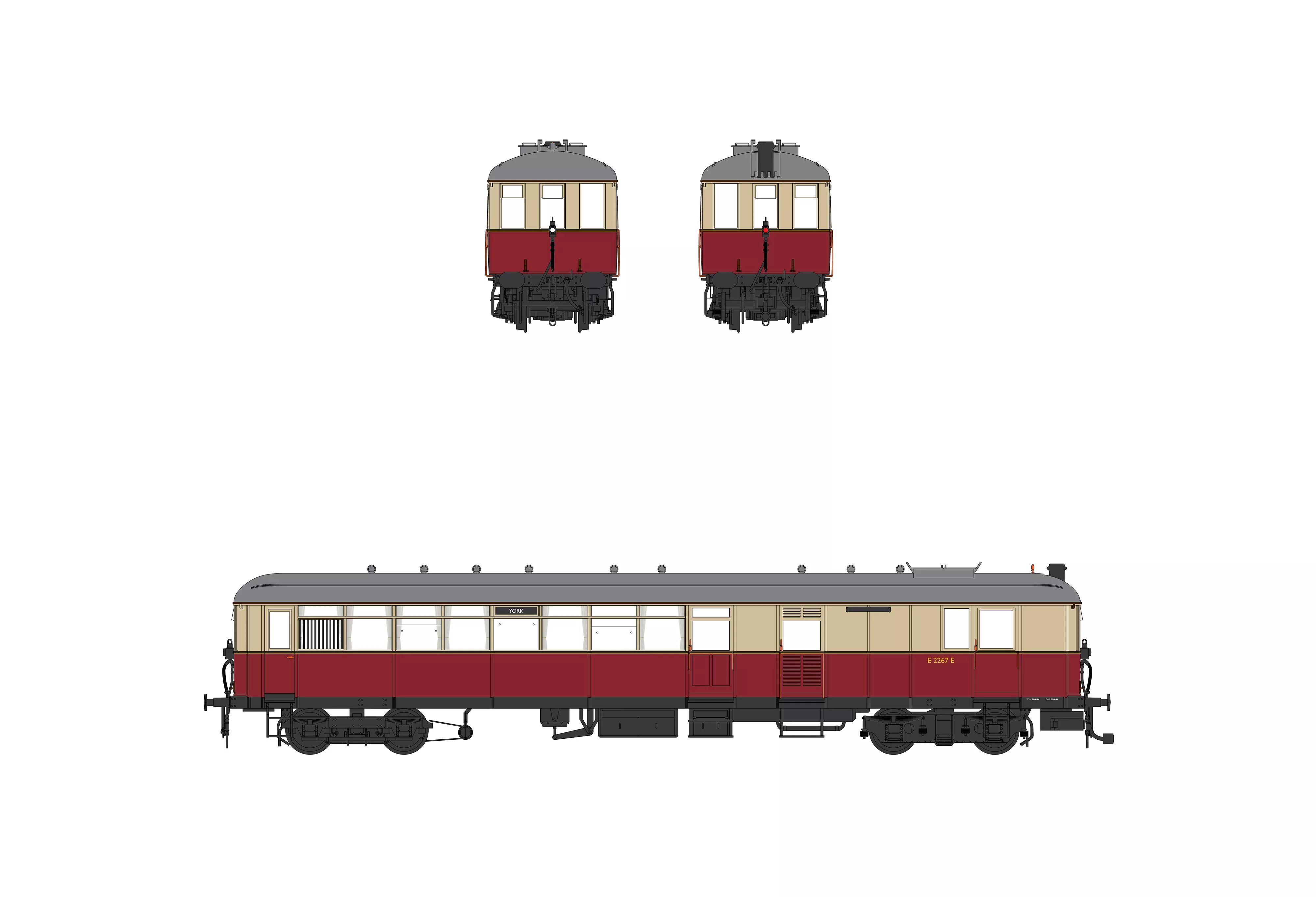
Manufacturer catalogue image - please note that pre-release images may be CAD renders or CGI/AI images rather than photographs
Prototype Era
Era 4 (1948 to 1956) British Railways Early Crest
Manufacturer description
These charismatic vehicles – nicknamed “Chip Vans” due to their bright livery and smoky chimneys – were introduced in 1925–1932 to reduce operating costs and attract passengers to local services. They were a precursor to modern diesel railcars.
In some ways, the LNER’s Sentinel railcars were victims of their own success, attracting so many passengers that they often couldn’t cope with demand.
At their peak, 80 vehicles across 13 diagrams were operated by the LNER, with Diagram 96 and 97 the most numerous. They worked across all LNER areas, from North London commuter lines to rural branch lines in East Anglia, the Midlands, Cheshire and Scotland. Yorkshire and the North East were key strongholds.
A 1934 LNER report showed they outperformed early diesel railcars, covering up to 2.25 million miles per year with some working 17 hours a day. However, lightweight construction and reliability issues led to withdrawal by 1948, with just No. 2136 HOPE briefly surviving into the BR era.
Our new model celebrates these important but often overlooked pioneers, offering Diagram 96 and 97 railcars in classic LNER liveries—perfect for both branch lines and main line layouts.
The Model
3187 BR Crimson/Cream No. 2267
Destinations: York/Goole/Hull/Whitby
Please note that item #3187 is a fictional ‘what if’ livery that could have been applied if the Sentinel steam railcars had survived long enough to gain BR livery.
Key Features
- Separately controlled LED lighting functions
- ESU electronics with “Stay Alive” capacitors
- Factory-fitted speaker
- Next18 DCC decoder interface
- Optional factory-fitted ESU sound project
- Low-profile motor hidden beneath the saloon
Detail Variations
- Diagram 96 – toplight vents
- Diagram 97 – droplight windows
- CLC variant (Diagram 97 style)
- Multiple LNER regional versions
- Destination boards included for each model
Standard Features
- Five switchable lighting functions (DCC)
- Interior and cab lighting
- Bi-colour LED head/tail lamps
- “Stay Alive” capacitors for smooth running
- Detailed interior with partitions and reversible seating
- Detailed engine room and cab
- NEM couplers and magnetic coupler bars
- Smooth, reliable motor performance
Catalogue listing
Supplier Links


Supplier links are provided for your convenience and do not guarantee that the product is currently available. RailwayModels.uk is not a representative of these suppliers, but may receive a commission when purchases are made through links on this page.
Heljan Sentinel Railcar (model HJN1012) represents the British Railways Early Crest period. The vehicles, nicknamed “Chip Vans” because of their bright livery and smoky chimneys, were introduced between 1925 and 1932 to reduce operating costs and to attract passengers on local services. They were an early form of diesel railcar and at their peak the LNER operated 80 of them across 13 diagrams, with Diagrams 96 and 97 being the most numerous. The railcars ran on a wide range of routes, from North London commuter lines to rural branch lines in East Anglia, the Midlands, Cheshire, Scotland, Yorkshire and the North East. A 1934 LNER report recorded mileage of up to 2.25 million miles per year and some units worked 17 hours a day, but lightweight construction and reliability problems led to withdrawal by 1948, with only No 2136 surviving briefly into the British Rail era.
The model is presented as a fictional “what if” BR Crimson/Cream livery that could have been applied to a Sentinel railcar had the class survived into the British Rail period. It is numbered 2267 and carries destination boards for York, Goole, Hull and Whitby. The model is intended for use on both branch‑line and main‑line layouts.
Key features include separately controlled LED lighting functions, ESU electronics with “Stay Alive” capacitors, a factory‑fitted speaker and a Next18 DCC decoder interface, with an optional factory‑fitted ESU sound project. A low‑profile motor is hidden beneath the saloon. Variations cover Diagram 96 with toplight vents, Diagram 97 with droplight windows, a CLC variant of Diagram 97, and multiple regional LNER versions. Standard equipment comprises five switchable lighting functions, interior and cab lighting, bi‑colour LED head and tail lamps, detailed interior partitions with reversible seating, a detailed engine‑room and cab, NEM couplers with magnetic coupler bars and smooth, reliable motor performance.