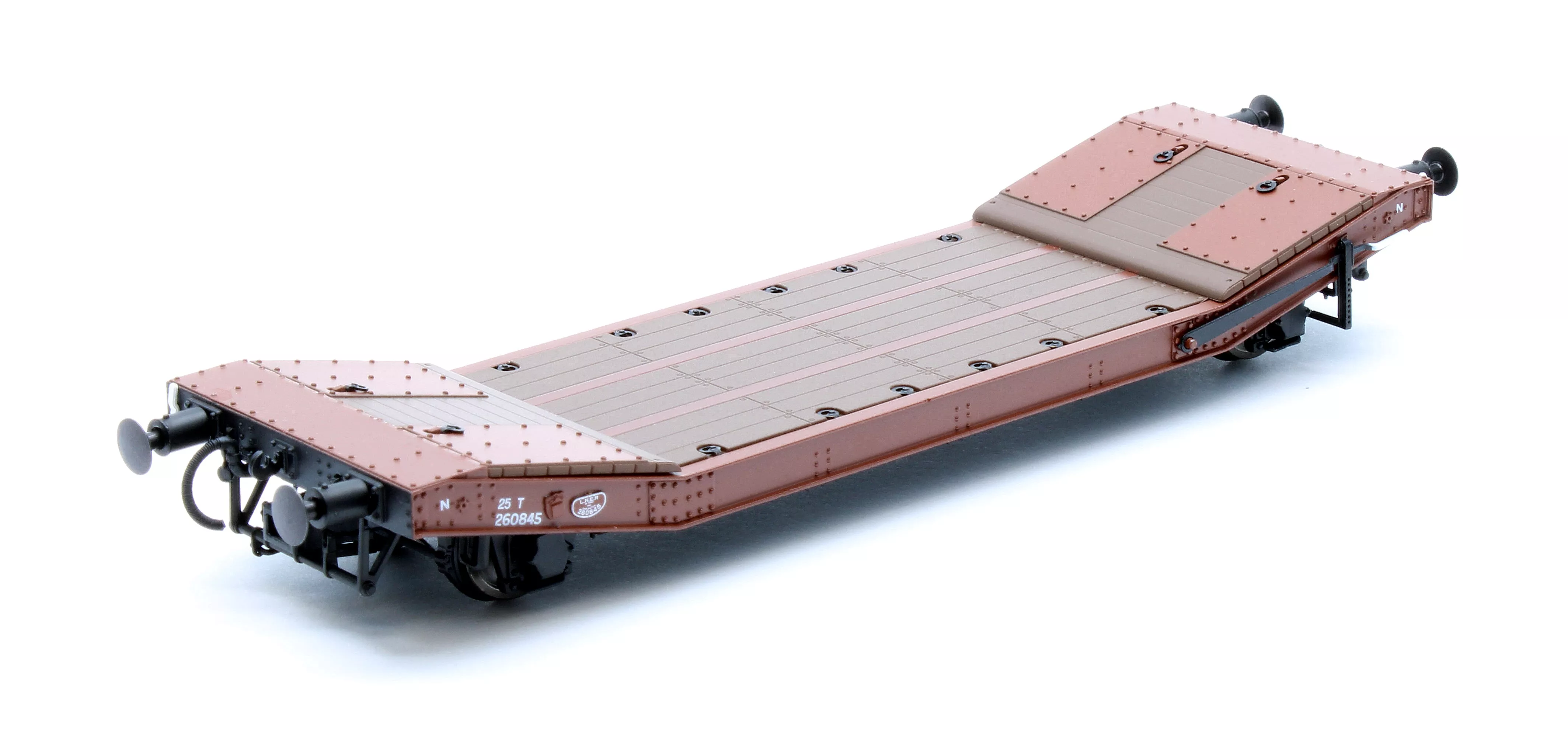
Manufacturer catalogue image - please note that pre-release images may be CAD renders or CGI/AI images rather than photographs
Prototype Era
Era 3 (1923 to 1947) The Big Four (LNER, LMS, GWR and SR)
Clark Railworks OO Gauge C3001B Lowmac '260845', LNER Red Oxide
Era 3
INTRODUCTION
Clark Railworks is proud to announce its first 4mm scale/OO gauge wagon: the LNER/BR Lowmac. Available now, our Lowmacs build on the success of our award-winning O gauge Presflos, with the sophisticated design and superb specification you’ve come to expect from our products. With an RRP of £40 each and a range of liveries, the Lowmacs are a perfect addition to any 4mm layout portraying the mid-1940s onwards.
RRP - £40.00
SPECIFICATIONS
Fully detailed diecast frame
Detailed end fittings and pipework
NEM pocket combined with vacuum cylinder, replaceable with a fully detailed cylinder
Sprung metal buffers
Optional EM brake shoes - supplied in detail pack
Finely detailed etched brass detail parts
Separately fitted etched brass tie down rings
Brass bearings with pin point axles
Fully detailed chassis
Supplier links are provided for your convenience and do not guarantee that the product is currently available. RailwayModels.uk is not a representative of these suppliers, but may receive a commission when purchases are made through links on this page.
The Ellis Clark Trains 25T Lowmac LNER Red Oxide Wagon 260845 is a model of a historic railway wagon. The model is in OO gauge and represents a wagon from the Big Four era, which includes the London, Midland and Scottish Railway, the Great Western Railway, the London and North Eastern Railway, and the Southern Railway.
The model features a fully detailed diecast frame, along with detailed end fittings and pipework. It also includes a NEM pocket combined with a vacuum cylinder, which can be replaced with a fully detailed cylinder. The model has sprung metal buffers and comes with optional EM brake shoes, which are supplied in a detail pack.
The model also features finely detailed etched brass detail parts, separately fitted etched brass tie down rings, and brass bearings with pin point axles. The chassis is fully detailed and provides a realistic representation of the real-life wagon.
The Lowmac wagon has a long history, dating back to the mid-19th century when the need to transport larger machinery on Britain's railways presented a challenge due to the restricted loading gauge. The design of the wagon was refined over the years to accommodate heavier loads, and it was during World War II that the Diagram 173 variant was developed.
The Diagram 173 Lowmac was constructed in 1944 and had a 25-ton capacity, making it suitable for transporting large military vehicles. After the war, the Lowmacs continued to be used for transporting awkward loads, including construction and agricultural equipment, and many soldiered on into the 1990s.
The Lowmac wagon was a versatile vehicle that could be used in a variety of scenarios, including as a companion to 'Austerity' engines on wartime traffic, or as part of mixed freight trains. The wagon was often overlooked by photographers, which makes it an interesting subject for model makers to use their imagination when loading it up. The wagon was used to transport a wide range of goods, from machinery and vehicles to oil tanks and even injured wagons.