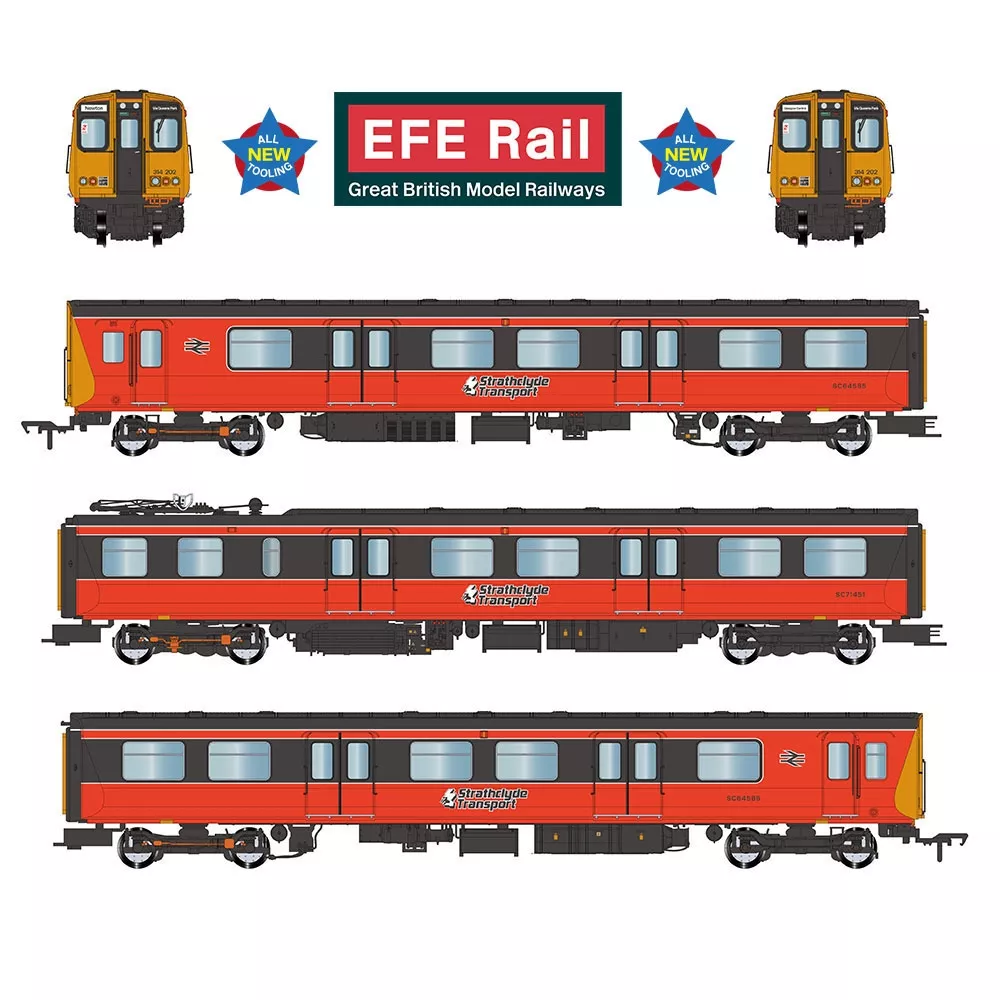
Manufacturer catalogue image - please note that pre-release images may be CAD renders or CGI/AI images rather than photographs
Prototype Era
Era 8 (1983 to 1994) British Rail Sectorisation
Manufacturer description
Bachmann Europe is delighted to unveil a range of all-new tooling Class 313 and Class 314 Electric Multiple Units from its EFE Rail brand; the first time that any such ‘PEP’ family EMUs have been produced ready-to-run in OO Scale. This model is painted in the Strathclyde PTE Orange & Black scheme.
The EFE Rail Class 313/314 is comprised of three highly detailed vehicles featuring precision moulded bodyshells adorned with separate detailing parts and an extensive collection of underfloor equipment and separately fitted pipework.
Drive is provided through the centre car, with a coreless motor powering each bogie and mounted within a diecast metal chassis to give a strong drive mechanism and low centre of gravity. This vehicle also houses a Plux22 DCC decoder socket and the close fitting electrically conductive couplings mean that just one decoder controls both motors and the lighting in all three vehicles.
MODEL FEATURES:
- EFE Rail OO Scale
- Era 8
- Pristine BR Strathclyde PTE Orange & Black livery
- Running No. 314202
- Three-car unit comprising car Nos. SC64585, SC71451 & SC64586
- Destination boards displaying ‘Newton via Queens Park’ & ‘Glasgow Central via Queens Park’
- Equipped with a PLUX 22 DCC Decoder Socket – recommended Decoder item No. 36-570A
- Length 799mm
MECHANISM:
- Coreless motor powering both bogies in centre car
- Diecast metal chassis provides strong driving mechanism and low centre of gravity
- 16.5mm (OO gauge) wheels to NEM310 & NEM311 standards with authentic profile and detailing
- NEM coupling fitted at driving cab ends
- Conductive couplings with integral close coupling mechanism at the inner end of driving vehicles and both ends of pantograph vehicle
- Designed to operate on curves of second radius (438mm) or greater
DETAILING:
- Separately applied metal detail parts
- Bogies constructed from multiple components featuring third rail shoe gear where applicable
- Separately fitted underframe components
- Intricately detailed pantograph which can be manually raised up and down
- Detailed interior, with specific variations dependant on class type
- Each model is supplied with an accessory pack
LIGHTING:
- Directional lighting, including illuminated headcode and destination panels
- Cab lighting
- High-intensity headlights where applicable
- Passenger saloon lighting
- Door interlock lights (controllable via DCC)
DCC:
- Plux22 DCC decoder interface – one decoder required per unit
- Pre-fitted with speaker to allow users to fit their own sound decoder
LIVERY APPLICATION:
- Authentic liveries applied to vehicles including interior decoration
- Multiple paint applications employed using BR and corporate specification colours
- Logos, numerals and text added as appropriate using authentic typefaces, logos and colours
CLASS 313/314 HISTORY
Both the Class 313s and 314s were developments of British Rail’s prototype ‘Standard Suburban Train’, for which three prototype units were built at the start of the 1970s. Designated 2-PEP and 4-PEP, which stood for Prototype Electro Pneumatic, these prototypes spawned a family of units known as the ‘PEP family’. The Class 313 were the very first production units to appear from this family, which eventually spanned five classes and encompassed some 755 individual vehicles.
The three-car Class 313s were not only the first production ‘PEP’ units to be built, but were also the first ‘dual-mode’ EMUs, having the ability to collect power from 25kV AC overhead power lines via a pantograph on the centre car, or from third rail shoe gear for 750V DC pick-up. A total of 64 Class 313s were built by British Rail Engineering Limited (BREL) at York Works in 1976-1977. The units were put to work on the Great Northern Inner Suburban lines operating from London Moorgate, and for 10 years they served their intended route before operations spread further afield.
The Class 314s comprised a smaller fleet of just 16 three-car units and these were constructed two years after the Class 313 build programme had been completed, once again at BREL York. Unlike their earlier counterparts, the Class 314s went north of the border to work on the then-newly opened Argyle Line. The units collected power from 25kV AC overhead lines only, for which they are equipped with a pantograph on the central PTSO (Pantograph Tourist Second Open) vehicle, and did not have the third rail pick-up of their Class 313 siblings.
Catalogue listing
Model details
Directional lighting
Prototype information
* Class names often change over the lifespan of a locomotive, so this is not necessarily the class name used by the operator in the period modelled.
Supplier Links


Supplier links are provided for your convenience and do not guarantee that the product is currently available. RailwayModels.uk is not a representative of these suppliers, but may receive a commission when purchases are made through links on this page.