Manufacturer catalogue image - please note that pre-release images may be CAD renders or CGI/AI images rather than photographs
Prototype Era
Era 8 (1983 to 1994) British Rail Sectorisation
Manufacturer description
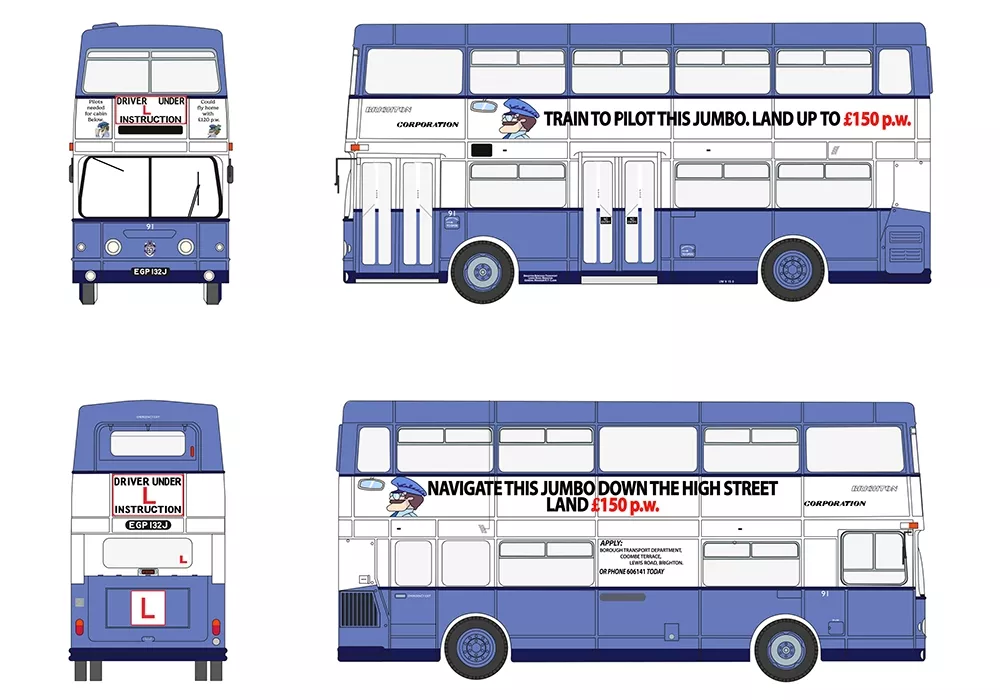
Daimler Fleetline DMS Brighton Corporation 91 Driver Trainer
The Daimler Fleetline DMS had its origins in a nationwide move towards One-Man Operation (OMO) buses in the late 1960s and early 1970s, replacing the tried-and-tested ‘driver and conductor’ crews that had been the staple for many years. London Transport (LT) was no exception, and as such began to explore the benefits that OMO might bring by trialling Leyland Atlanteans and Daimler Fleetlines. It was the latter that would go on to form the basis of an all-new London bus – the DMS.
The first of the new DMSs entered service in January 1971 working on Routes 95 and 220. They were powered by Gardner 6LXB engines and bodied by Park Royal Vehicles, with full OMO considerations included. Passengers would enter through a set of double folding doors at the front, opposite the driver, and immediately pass through an Automatic Fare-Collection (AFC) turnstile (located over the nearside front wheel arch) to gain access to the seating. Exit was via a second set of doors located centrally on the nearside of the body.
Building on the popularity of the ‘Routemaster’ tag, London Transport named the new type the ‘Londoner’, but it never caught on, and they were simply referred to as Fleetlines or DMSs. A total of 2,646 would be built between 1970 and 1978; the design evolving during that time, culminating in the B20 type. However, the DMS was never popular with passengers owing to the slower boarding times caused by the AFC equipment, and they proved equally unpopular with garage staff, so much so that the first started to be withdrawn the year after the last was delivered.
Our new models represent those built in the first batch, identified by the narrower position of the headlights. This example represents the former DMS132 in its post-London guise as Brighton Corporation No. 91. This vehicle was acquired to serve as a driver trainer, and for many years could be seen around the south coast resort as a mobile recruitment advert. It survives today with the Bromley Bus Preservation Group.
The new models are based on EFE Road’s updated Daimler Fleetline DMS tooling and feature the early style front end for the first time on an EFE DMS model.
• Colours/details of final model may vary from illustration
• Authentically detailed die-cast model from EFE Road
• Complementary to OO scale model railways (1:76 scale)
Catalogue listing
Supplier Links


Supplier links are provided for your convenience and do not guarantee that the product is currently available. RailwayModels.uk is not a representative of these suppliers, but may receive a commission when purchases are made through links on this page.