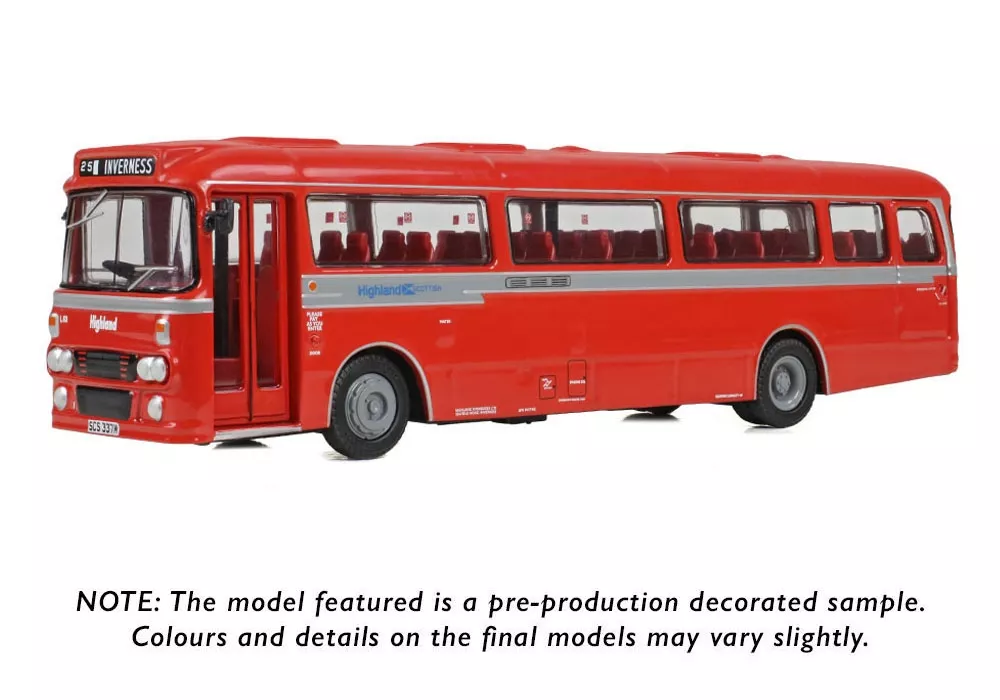
Manufacturer catalogue image - please note that pre-release images may be CAD renders or CGI/AI images rather than photographs
Prototype Era
Era 7 (1972 to 1982) British Rail Blue (TOPS)
Manufacturer description
.ALEXANDER Y-TYPE HIGHLAND SCOTTISH SCS337M, SERVICE 25 INVERNESS
The Alexander Y-Type buses and coaches were manufactured by Walter Alexander & Co (Coachbuilders) Ltd at its works in Falkirk, Scotland. The prototypes first appeared in 1961, with the first production versions entering service two years later. Some 3,266 production examples were constructed over the next 20 years, including small window buses and large window coaches in both long and short bodied variants. Over 2,800 of those constructed were delivered to the Scottish Bus Group and its predecessors.
It was a very versatile body design, capable of being built on a wide range of chassis types. The most notable of these was the Leyland Leopard, but the bodies were also carried on the AEC Reliance, the Seddon Pennine 7, and the Ford R series amongst others. It was also very adaptable thanks to its modular construction, and Alexander could offer various options according to the customer’s requirements. These included single piece, 2-leaf or 4-leaf entrance doors, as well as the various seating configurations depending on its purpose.
The front face of the Y-Type changed a few times during its 20-year construction, with different grille and headlight arrangements appearing as the design evolved. This saw it become the AY or AYS Type in 1971- the ‘A’ denoting its new alloy construction, and the ‘S’ signifying the bus specification. This change included the introduction of a new front end design, typically with twin grilles in an elongated moulding. In 1983, the Y-Type made way for Alexander’s P Type, a lighter and more modern successor, but continued to give good service well into the 2000s.
Our model represents registration SCS337M, an AY-Type bodied Leyland Leopard built in 1974 as part of a batch of 43 dual purpose 49-seaters for Western SMT. This example later became part of the Highland Scottish fleet, operating as number L53. The model depicts it in its circa 1984 condition, again with 2-leaf doors, as working Service 25 to Inverness.
The new models are based on EFE Road’s updated AY-Type coach tooling, and now feature such enhancements as mirrors, opaque glazed roof vents, and separate 2-leaf doors.
• Colours/details of final model may vary from illustration
• Authentically detailed die-cast model from EFE Road
• Complementary to OO scale model railways (1:76 scale)
Catalogue listing
Supplier Links


Supplier links are provided for your convenience and do not guarantee that the product is currently available. RailwayModels.uk is not a representative of these suppliers, but may receive a commission when purchases are made through links on this page.