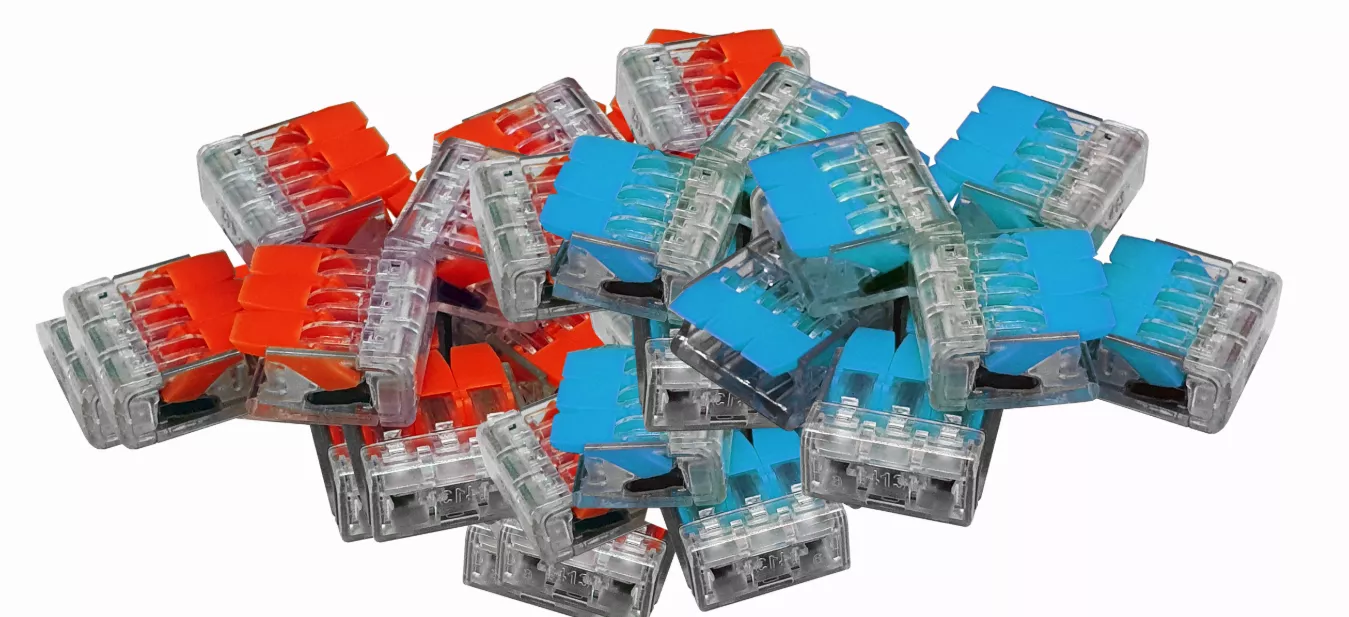
Manufacturer catalogue image - please note that pre-release images may be CAD renders or CGI/AI images rather than photographs
Manufacturer description
The DCW-iL3.24 pack contains 24, 3-terminal soldering-free connectors, 12 each Orange and Blue. The DCCconcepts i-Link Story: While we really do prefer soldered connections, there are modellers who are unable or do not want to work under the layout with a soldering iron and of course there are times and places where it's simply not convenient to solder! We therefore looked long and hard at what is available to find the ideal connectors to make it easy, while also maintaining versatility and the best possible quality of connection. DCCconcepts i-Link connectors are the result: DCCconcepts i-Link connectors are the simplest way to join several wires without soldering.
This is the original i-Link... a 3-way connector which lets you do the basics - All wires that are inserted into this type of i-Link connector will be joined electrically. You can insert several different size wires into one terminal if required.power bus in one, droppers in the others or perhaps, just for distributing accessory wiring for lights, or easily connecting several droppers for convenient distribution.
i-Link connectors work with EVERY commonly used wire size in model railway layout construction. We chose the terminal size so it will not only work reliably with both smaller and larger wires, it also perfectly manages a combination of different wires twisted tightly together... such as bus wire and droppers. General instructions: Instructions for i-Link connection: * Measure wire length carefully, then Strip the wires by approximately 12mm (1/2”). * Now twist the bare wire strands tightly making sure there are no stray strands. (If using the same entry port for two wires, then twist the two wires together as tightly as possible). * Cut off any excess or any “ragged ends”. Re-tighten the twist if needed with a pair of pliers. * Raise the coloured tab on the i-Link connector. * Insert the wire as far as you can into the connector. If there is any bare wire still visible please remove the wire and cut a little off the stripped end so that NO bare wire is exposed at the connector socket when you re-insert it. * Now SNAP the i-Link connector tab closed to grip the wire... As you will see, it will grip really well! Your wiring is now reliably connected. Wire capacity is 0.25mm2 to 3.5mm2 (23AWG~12AWG). i-Link connectors can be re-used as often as you wish. Enjoy your new, easier-than-ever wiring project!
Catalogue listing
Supplier Links


Supplier links are provided for your convenience and do not guarantee that the product is currently available. RailwayModels.uk is not a representative of these suppliers, but may receive a commission when purchases are made through links on this page.