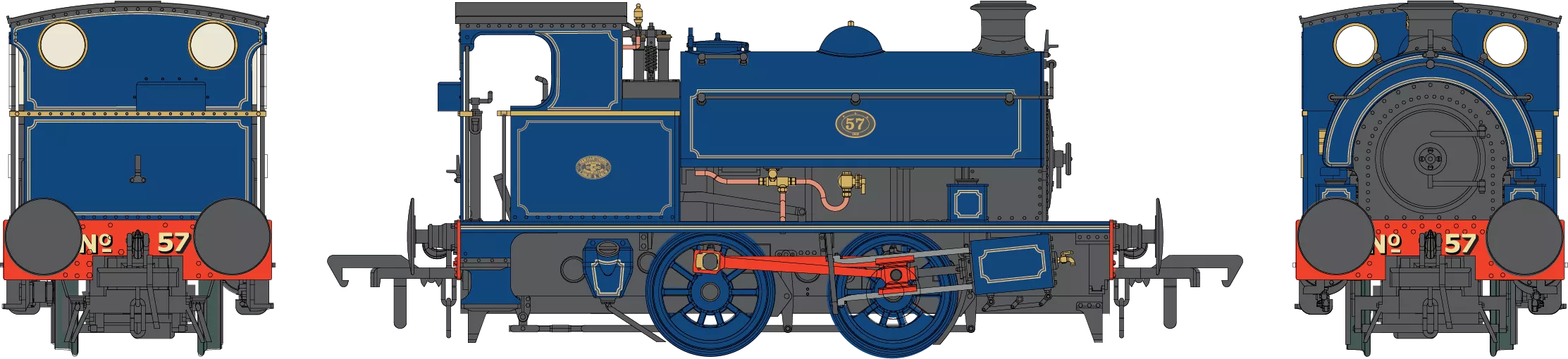
Manufacturer catalogue image - please note that pre-release images may be CAD renders or CGI images rather than photographs
Prototype Eras
Era 2 (1875 to 1923) Pre-grouping
Era 3 (1923 to 1947) The Big Four (LNER, LMS, GWR and SR)
Era 4 (1948 to 1956) British Railways Early Crest
Manufacturer description
Prototype
Hawthorn Leslie and Company was formed by the merger of the shipbuilder A. Leslie and Company in Hebburn with the locomotive works of R. and W. Hawthorn at St.Peter’s in Newcastle upon Tyne in 1886. The company manufactured locomotives to order for main line companies and later had a number of standard designs including 0-4-0 saddle tanks and fireless locomotives.
In 1937 Robert Stephenson of Darlington amalgamated with the locomotive works at Forth Banks to form Robert Stephenson and Hawthorns Ltd. By this time Hawthorn Leslie had built 2,783 locomotives.
The newly formed Robert Stephenson and Hawthorns became a subsidiary of the Vulcan Foundry in 1943 and Hawthorn’s 137-year connection with Forth Banks ended.
The Dapol model is based on the 0-4-0 saddle tanks built between 1899 and 1924. They were produced in large numbers and continued in a variety of industrial uses (included Iron works, collieries and power stations) until the early to mid 1970’s. Over 10 locomotives have made it into various states of preservation.
Specification
- Finely moulded body with many separately added fine details
- DCC ready with NEXT-18 socket included—accessed via the lift off dicast saddle tanks
- DCC fitted models available
- Cast wheels with fine relief and appropriate colouring
- Die-cast compensated chassis and all wheel pick up
- NEM pockets as standard
- Powerful 5 pole skew wound motor
- Accessory bag with spares and other optional detail
Catalogue listing
Model details
Supplier Links


Supplier links are provided for your convenience and do not guarantee that the product is currently available. RailwayModels.uk is not a representative of these suppliers, but may receive a commission when purchases are made through links on this page.