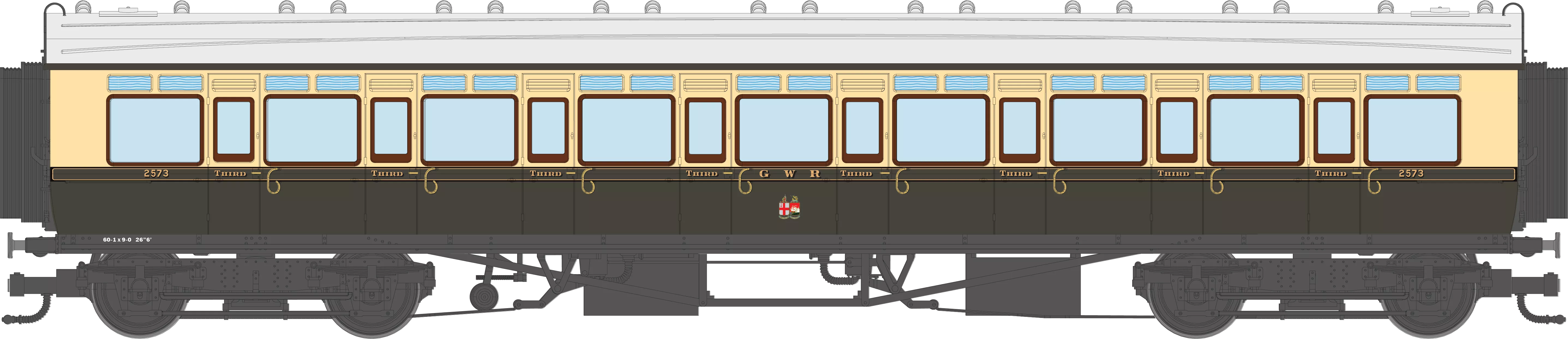
Manufacturer catalogue image - please note that pre-release images may be CAD renders or CGI/AI images rather than photographs
Prototype Era
Era 3 (1923 to 1947) The Big Four (LNER, LMS, GWR and SR)
Manufacturer description
The prototype coaches were constructed between 1914 and 1920 made of steel body sides with an absence of panelling but with bolection mouldings around the windows and frosted glass top light windows, sitting on Churchward 9’-0” bogies. They were designed to operate as a set comprising Left hand and right-hand Brake Thirds, 1 or 2-Thirds and left hand and right-hand Composites enabling all corridor windows to be displayed on the same side, commonly used for cross country and main line working between cities.
Chassis
- Bogie to have diecast frames with two stamped metal compensation beams enabling wheel bearing electrical pick-up using stub axles.
- Two styles of underframe truss rods.
- Diecast chassis framing.
- Couplings between coaches to be close coupled on a cam to negotiate R2 (438mm) curve trackwork with NEM pockets for magnetic couplings. Alternatively, the coaches can be used with NEM compatible customer supplied traditional couplings.
- Wheels designed for 00 gauge (16.5mm), but clearance for 18.2mm gauge wheels required, axles to be 26mm over end points.
- Sprung metal buffers.
Body
- Coach sides are separate parts in ABS plastic.
- Gap free corridor connections to operate on R2 (438mm) curves decorated interior with separately fitted luggage rack in each passenger compartment
- Separate shell ventilators fitted to roof, depending on period.
- Separate door and commode handles in metal.
- Destination boards provided separately for the modeller to adorn and fit.
- All coaches supplied with interior lighting.
- DCC Decoder plug and blanking plug.
Catalogue listing
Model details
Prototype information
Supplier Links


Supplier links are provided for your convenience and do not guarantee that the product is currently available. RailwayModels.uk is not a representative of these suppliers, but may receive a commission when purchases are made through links on this page.